

Key Takeaways :
- The January 2026 markup of the CLARITY Act marks the start, not the conclusion, of U.S. crypto legislation.
- Core definitions—especially around securities and DeFi decentralization—remain unresolved.
- The bill proposes a three-category framework: digital commodities, investment contract assets, and payment stablecoins.
- Even if passed, regulatory rulemaking may take up to 18 months, creating a prolonged hybrid regulatory environment.
- For builders and investors, regulatory uncertainty is shifting opportunity toward infrastructure, compliance-ready DeFi, and globally portable protocols.
1. January 2026: A Milestone That Is Often Misunderstood
In December 2025, David Sacks, the U.S. government’s AI and crypto policy lead, revealed that the Senate Banking Committee—under Chairman Tim Scott—plans to begin markup revisions of the CLARITY Act in January 2026. This announcement was widely interpreted as signaling that U.S. crypto regulation is finally nearing completion.
In reality, this interpretation is dangerously optimistic.
While the CLARITY Act passed the House of Representatives in July, the Senate phase represents the most complex and politically sensitive stage of U.S. lawmaking. Far from being a technical cleanup, the January markup opens what many policy insiders describe as a multi-year negotiation over the very definition of digital assets and decentralized finance.
The most striking detail is that several of the most important provisions in the Senate draft remain in brackets—explicit placeholders signaling that no agreement has yet been reached.
2. The Three-Tier Asset Classification at the Heart of CLARITY
At its core, the CLARITY Act proposes a new taxonomy for crypto assets, dividing them into three categories:
- Digital Commodities
- Investment Contract Assets
- Payment Stablecoins
Under this framework, the spot market for digital commodities would fall under the oversight of the Commodity Futures Trading Commission (CFTC), while the Securities and Exchange Commission (SEC) would retain authority over issuance and initial distribution.
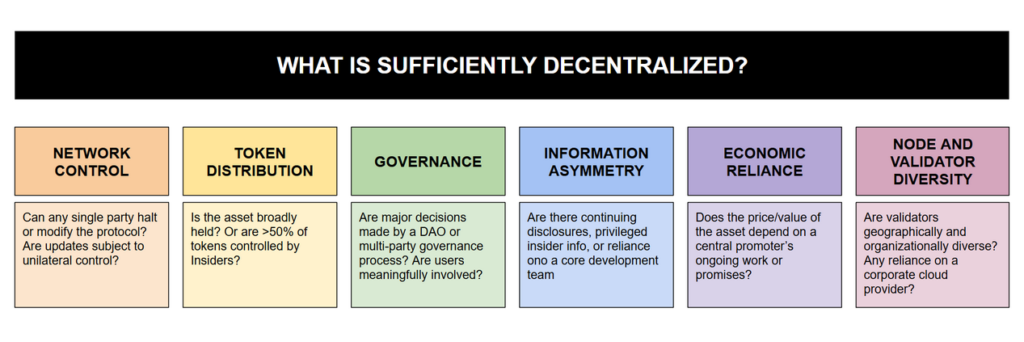
This division aims to resolve the long-standing turf war between regulators. However, classification depends on definitions that remain unsettled—particularly what constitutes “sufficient decentralization” to escape securities treatment.
3. DeFi: The Section That Is Still Completely Blank
The most telling aspect of the current Senate draft is that the DeFi section is effectively empty.
The reason is simple but profound: lawmakers cannot agree on what “decentralized” actually means in legal terms.
- Is a protocol decentralized if governance tokens are widely distributed?
- Does the existence of a development foundation imply control?
- Should front-end operators be treated as financial intermediaries?
If the definition is too broad, consumer protection collapses. If it is too narrow, innovation migrates offshore.
As a result, the Senate Agriculture Committee draft leaves the DeFi infrastructure provisions blank, signaling that negotiations have not even reached the compromise stage.
Expected timeline from CLARITY Act passage to full regulatory enforcement
4. A Long Hybrid Era: Old Market Structures, New Laws
Even if the CLARITY Act were to pass in 2026, implementation would be far from immediate.
Regulatory agencies are expected to require up to 18 months to draft and finalize rules. During this time, the crypto market would operate in a hybrid environment where:
- Legacy enforcement actions continue
- New statutory frameworks exist but are not yet operational
- Market participants face overlapping and sometimes contradictory guidance
Historically, such hybrid phases tend to favor well-capitalized incumbents while creating barriers for smaller startups—unless those startups are structurally global and protocol-based.
5. Political and Institutional Constraints
Beyond legal ambiguity, institutional constraints loom large.
The CFTC, designated as the primary overseer of digital commodity spot markets, remains underfunded. Without congressional appropriations, its ability to monitor markets comparable in scale to equities or FX remains questionable.
At the same time, partisan divisions over financial oversight, consumer protection, and innovation policy ensure that crypto regulation will remain a political bargaining chip well into the next election cycle.
January 2026, therefore, represents not resolution—but escalation.
6. Strategic Implications for Investors and Builders
For readers seeking new crypto assets, revenue opportunities, or practical blockchain applications, the implications are clear:
- Infrastructure over speculation: Compliance-ready middleware, custody, analytics, and settlement layers gain strategic value.
- DeFi with optionality: Protocols designed to operate with or without U.S. touchpoints are structurally advantaged.
- Stablecoin rails: Payment-focused stablecoins, explicitly recognized in CLARITY, may become the fastest path to regulated adoption.
Rather than waiting for regulatory clarity, market leaders are designing for regulatory resilience.
7. Conclusion: Clarity Will Come—But Not Soon
The CLARITY Act is often framed as the end of regulatory uncertainty in U.S. crypto markets. In truth, it marks the beginning of a slower, more nuanced phase.
With DeFi definitions unresolved, agency rulemaking years away, and political constraints intact, the industry is entering a prolonged period of selective clarity rather than universal certainty.
For those prepared to navigate ambiguity, this period may offer the greatest opportunities of all.
