
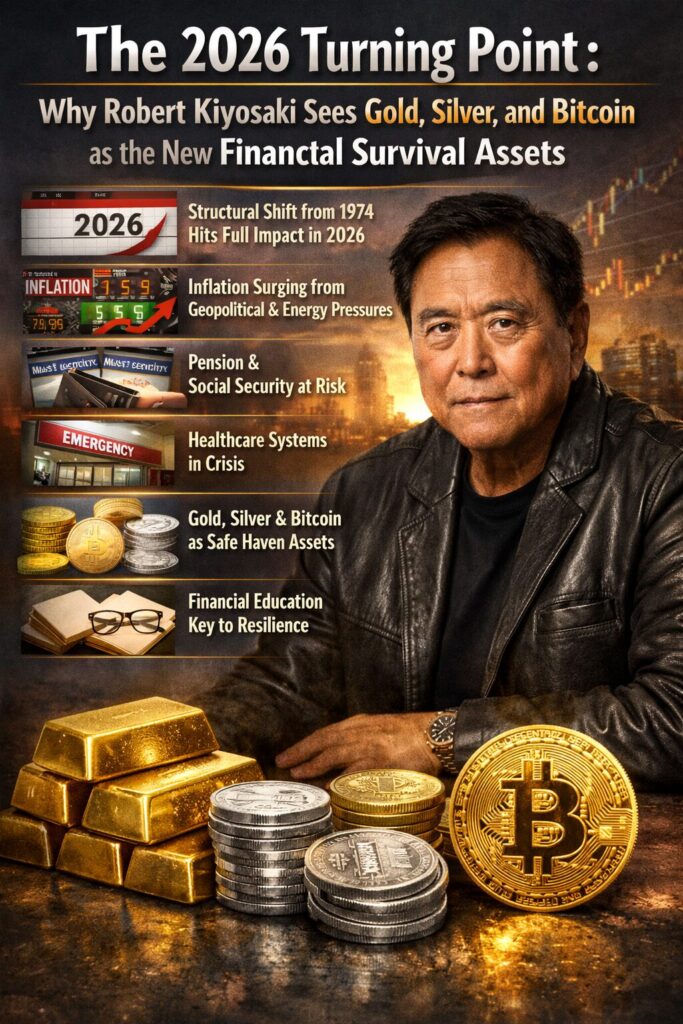
Key Points :
- The structural shift that began in 1974 is reaching its full impact in 2026
- Inflation is accelerating due to geopolitical and energy-related pressures
- Pension systems (401k/IRA model) are exposing individuals to systemic risk
- Social security and healthcare systems face sustainability challenges
- Hard assets—gold, silver, and Bitcoin—are increasingly positioned as wealth protection tools
- Financial education, not income alone, determines long-term resilience
Introduction: A Warning from History Repeating Itself
Robert Kiyosaki, globally recognized for Rich Dad Poor Dad, has once again issued a stark warning: the global financial system is approaching a breaking point similar to a structural shift that began in 1974. According to Kiyosaki, 2026 may mark the moment when the consequences of decades-old policy decisions fully materialize.
His argument is not based on short-term market volatility but on long-term systemic changes—particularly the transition from the gold-backed U.S. dollar to the petro-dollar system and the shift from defined-benefit pensions to individual retirement responsibility.
This article expands on his claims, integrates recent macroeconomic trends, and evaluates what this means for investors seeking new crypto opportunities, alternative assets, and practical blockchain applications.
1. The 1974 Turning Point: From Gold to Oil and Individual Risk
In 1974, two major shifts reshaped the global financial architecture.
First, the U.S. dollar transitioned from being backed by gold to being indirectly backed by oil through the petro-dollar system. This fundamentally changed the nature of money—from a scarce, asset-backed system to one dependent on geopolitical power and energy markets.
Second, the introduction of ERISA (Employee Retirement Income Security Act) accelerated the shift from defined-benefit pensions (guaranteed payouts) to defined-contribution plans like 401(k)s and IRAs. This transferred investment risk from institutions to individuals.
Kiyosaki argues that these two changes created a system where:
- Money can be printed without hard constraints
- Individuals bear the full burden of investment risk
- Financial literacy becomes essential for survival
Now, in 2026, these structural vulnerabilities are becoming visible.
2. Inflation Is Not Temporary—It Is Structural
Recent global developments support Kiyosaki’s concerns. Inflation is no longer seen as purely cyclical; it is increasingly structural.
Key drivers include:
- Energy supply disruptions and geopolitical tensions
- Persistent fiscal deficits and monetary expansion
- Supply chain fragmentation and deglobalization
Unlike previous inflation cycles, current conditions combine monetary expansion with real-world resource constraints, making inflation more difficult to control.
For individuals, this means that cash savings and traditional fixed-income instruments are losing purchasing power over time.
3. The Pension Crisis: A Silent Systemic Risk
The shift to 401(k) and IRA systems assumed that individuals could effectively manage their own investments. However, this assumption is increasingly being challenged.
Many retirees face:
- Insufficient savings due to market volatility
- Overexposure to equities during downturns
- Lack of financial education
At the same time, public systems such as Social Security and Medicare face funding gaps due to aging populations and declining worker-to-retiree ratios.
Kiyosaki warns that a growing number of retirees may struggle to maintain basic living standards, especially as inflation erodes purchasing power.
4. Hard Assets as a Hedge: Gold, Silver, and Bitcoin
Kiyosaki’s solution is straightforward: accumulate hard assets.
Gold and Silver
Gold and silver have historically served as stores of value during periods of monetary instability. Their characteristics include:
- Limited supply
- Global recognition
- Resistance to currency devaluation
Silver, in particular, also benefits from industrial demand, making it both a monetary and industrial asset.
Bitcoin (BTC)
Bitcoin introduces a modern alternative. Its properties align with many of the characteristics of hard money:
- Fixed supply (21 million coins)
- Decentralization
- Resistance to censorship
Unlike gold, Bitcoin is digitally native and easily transferable, making it suitable for a global, internet-based economy.
Kiyosaki views Bitcoin not as a speculative asset but as “digital gold”—a hedge against systemic monetary failure.
5. Insert Figure 1 Here
Bitcoin vs Gold vs Silver (USD)
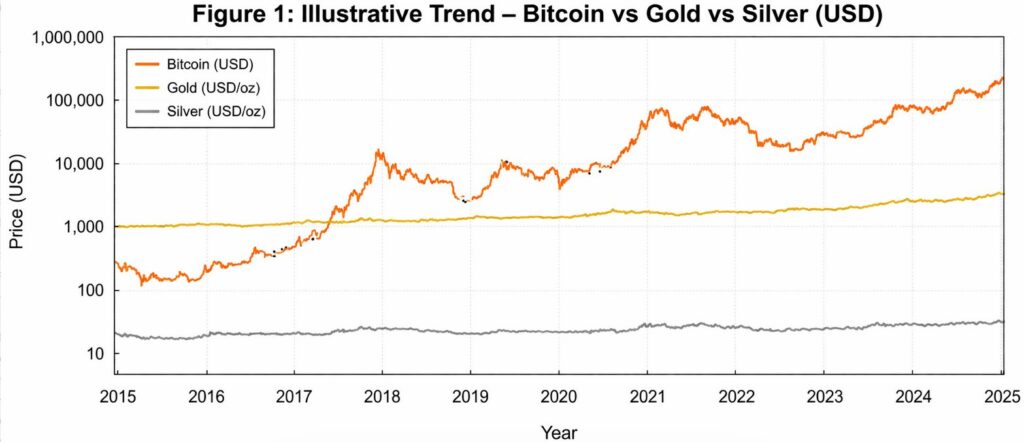
This chart illustrates the long-term upward trend of Bitcoin alongside relatively stable growth in gold and silver. While Bitcoin shows higher volatility, it also demonstrates significantly higher upside potential, reflecting its emerging role as a high-risk, high-reward store of value.
6. The Convergence of Macro Trends and Crypto Adoption
Beyond Kiyosaki’s thesis, broader market trends reinforce the growing relevance of Bitcoin and digital assets.
Institutional Involvement
Large financial institutions are increasingly entering the crypto space through ETFs, custody services, and tokenization initiatives.
Stablecoins and Payments
Stablecoins are becoming critical infrastructure for cross-border payments, offering faster and cheaper alternatives to traditional banking systems.
Tokenization of Assets
Real-world assets (RWAs) such as real estate and bonds are being tokenized, bridging traditional finance and blockchain ecosystems.
These developments suggest that Bitcoin and blockchain are not isolated phenomena but integral components of the future financial system.
7. Financial Education: The Missing Piece
One of Kiyosaki’s most consistent messages is the failure of traditional education systems to teach financial literacy.
Without understanding:
- Inflation dynamics
- Asset allocation
- Risk management
individuals are ill-equipped to navigate the modern financial landscape.
Investing in financial education is therefore as critical as investing in assets themselves.
8. Strategic Implications for Investors
For readers interested in crypto and new income opportunities, several strategic insights emerge:
Diversification Across Asset Classes
Holding a mix of gold, silver, and Bitcoin can provide exposure to both traditional and digital stores of value.
Long-Term Perspective
Short-term volatility should not overshadow long-term structural trends.
Integration with Blockchain Applications
Beyond holding assets, investors should explore:
- DeFi yield opportunities
- Tokenized asset platforms
- Blockchain-based payment systems
These represent practical applications of the evolving financial system.
Conclusion: 2026 as a Defining Moment
Kiyosaki’s warning is not merely a prediction—it is a call to action.
The structural changes initiated in 1974 have created a financial system that is increasingly fragile under the pressures of inflation, demographic shifts, and geopolitical instability.
In this environment:
- Traditional savings are insufficient
- Institutional guarantees are weakening
- Financial self-reliance is becoming essential
Gold, silver, and Bitcoin represent not just investment choices but strategic defenses against systemic risk.
For those willing to adapt, 2026 may not be a crisis—but an opportunity to reposition for the next era of finance.
