
Main Points :
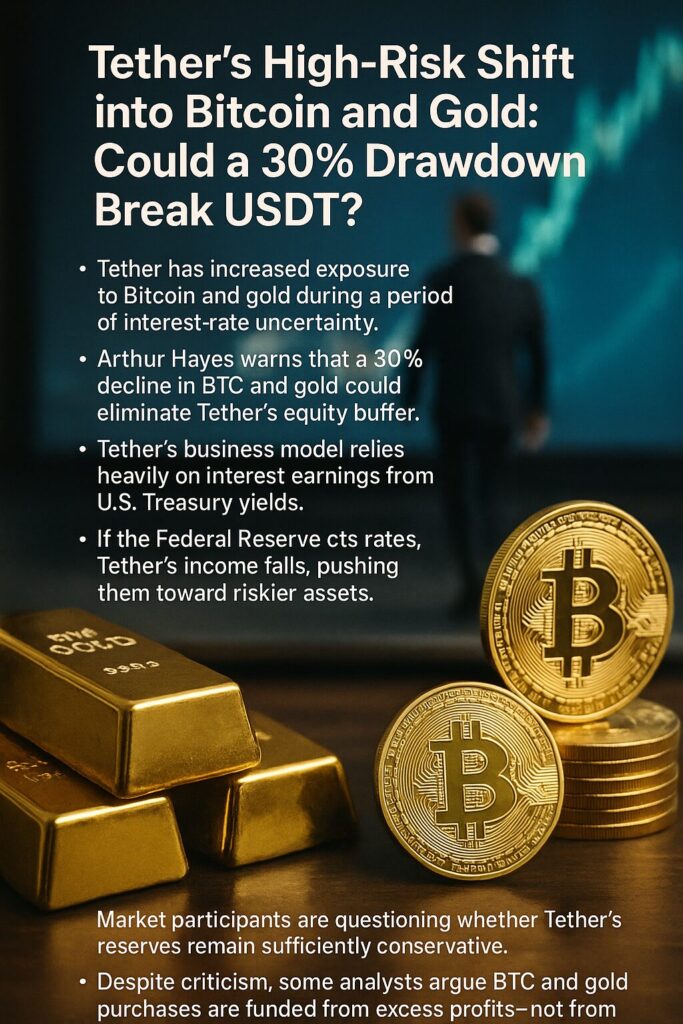
- Tether has increased exposure to Bitcoin and gold during a period of interest-rate uncertainty.
- Arthur Hayes warns that a 30% decline in BTC and gold could eliminate Tether’s equity buffer.
- Tether’s business model relies heavily on interest earnings from U.S. Treasury yields.
- If the Federal Reserve cuts rates, Tether’s income falls, pushing them toward riskier assets.
- Market participants are questioning whether Tether’s reserves remain sufficiently conservative.
- Despite criticism, some analysts argue BTC and gold purchases are funded from excess profits—not from user backing.
Introduction: Tether’s Strategic Pivot and the Rising Debate
Tether, the issuer of the world’s largest stablecoin USDT, has entered a new strategic phase—one that involves significant exposure to Bitcoin and gold at a time when global monetary conditions remain unpredictable. A recent comment by BitMEX founder Arthur Hayes has amplified concerns within the crypto community, raising a fundamental question: Could a downturn in these volatile assets compromise Tether’s stability and trigger a systemic shock across digital markets?
The discussion is not theoretical. According to Tether’s latest attestation report, the company now holds approximately $9.86 billion in Bitcoin and $13 billion in gold, forming a sizable portion of its risk-bearing reserves. Hayes warns that a 30% decline in this combined position could erase Tether’s equity cushion—leaving USDT theoretically insolvent.
This article examines Hayes’s analysis, recent market data, macroeconomic dynamics, and broader implications for crypto investors who seek new assets, profit opportunities, and practical blockchain insights.
Section 1: Hayes’s Warning—Is Tether Running a Massive Interest-Rate Trade?
Arthur Hayes argues that Tether is essentially executing a large leveraged macro trade. His reasoning is based on a simple observation:
Tether earns billions annually from its holdings of U.S. Treasury bills—but only as long as interest rates remain high.
Hayes interprets Tether’s latest attestation as a sign that:
“The Tether folks think the Federal Reserve will cut rates, which will crush their interest income. So they are buying gold and Bitcoin, which theoretically ‘moon’ when the price of money falls.”
If the Federal Reserve reduces interest rates in 2026 or beyond, USDT’s primary revenue engine—the yield from T-bills—will slow dramatically. To compensate, Tether is accumulating hard assets that generally outperform during monetary easing cycles.
However, Bitcoin and gold also carry the risk of rapid drawdowns. Hayes’s central claim is that this risk could hit Tether where it hurts the most: its capital buffer.
Section 2: Understanding Tether’s Balance Sheet—A Breakdown of $181 Billion in Assets
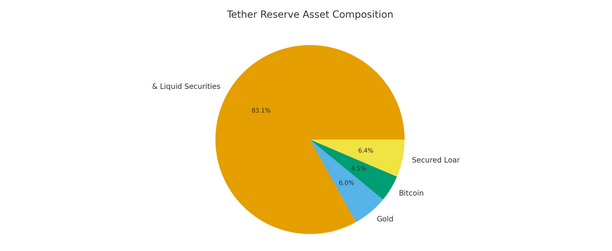
Tether reports approximately $181 billion in total assets backing USDT. Its composition can be summarized as follows:
| Asset Category | Estimated Value (USD) |
|---|---|
| Cash & Liquid Securities (Treasuries, Repo, MMFs) | ~$181B (majority) |
| Gold | ~$13B |
| Bitcoin | ~$9.86B |
| Secured Loans | ~$14B |
| Other Investments | Minor |
Section 3: The Core Risk—A 30% Drawdown in BTC and Gold
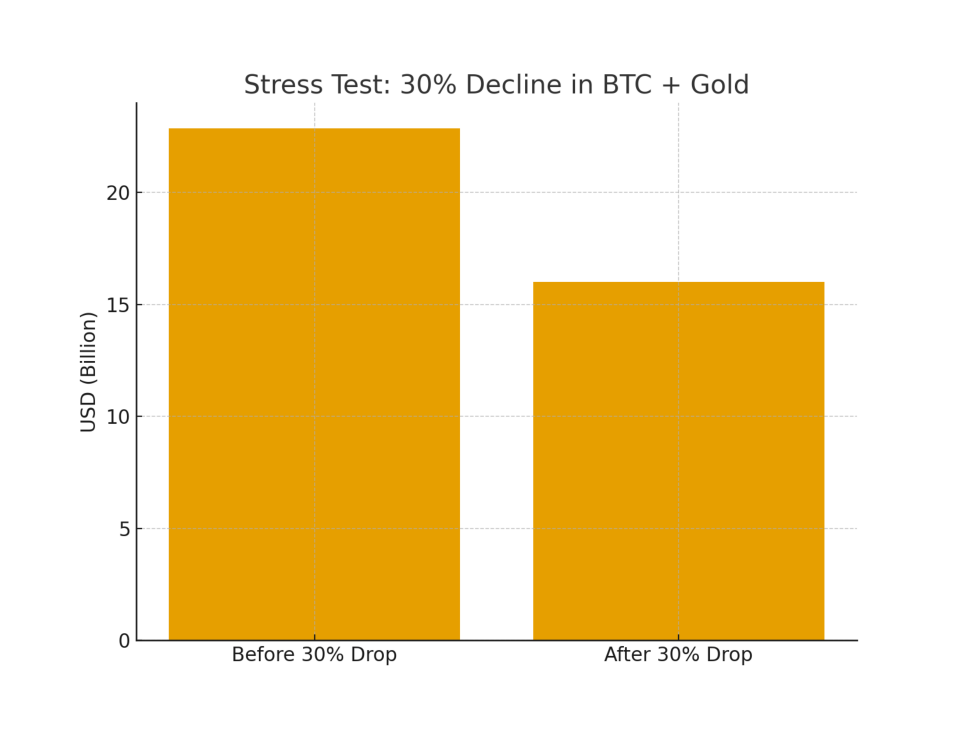
Hayes estimates that Tether’s capital buffer would be wiped out if its gold and Bitcoin portfolio dropped by 30%.
This does not necessarily mean USDT would instantly collapse, but it raises questions about solvency transparency and market confidence.
Calculation Example:
- Total BTC + Gold = ~$22.86B
- 30% decline = ~$6.86B loss
- Tether’s reported excess reserves ≈ similar magnitude
Thus, a sharp market downturn could, in theory, eliminate Tether’s cushion.
Section 4: Why Is Tether Taking This Risk? The Interest-Rate Puzzle
To understand Tether’s behavior, one must examine its incentive structure.
High Interest Rates = Huge Profits
With U.S. T-bill yields above 5%, Tether earns billions simply by holding user deposits in short-term government debt.
But Rate Cuts Are Coming
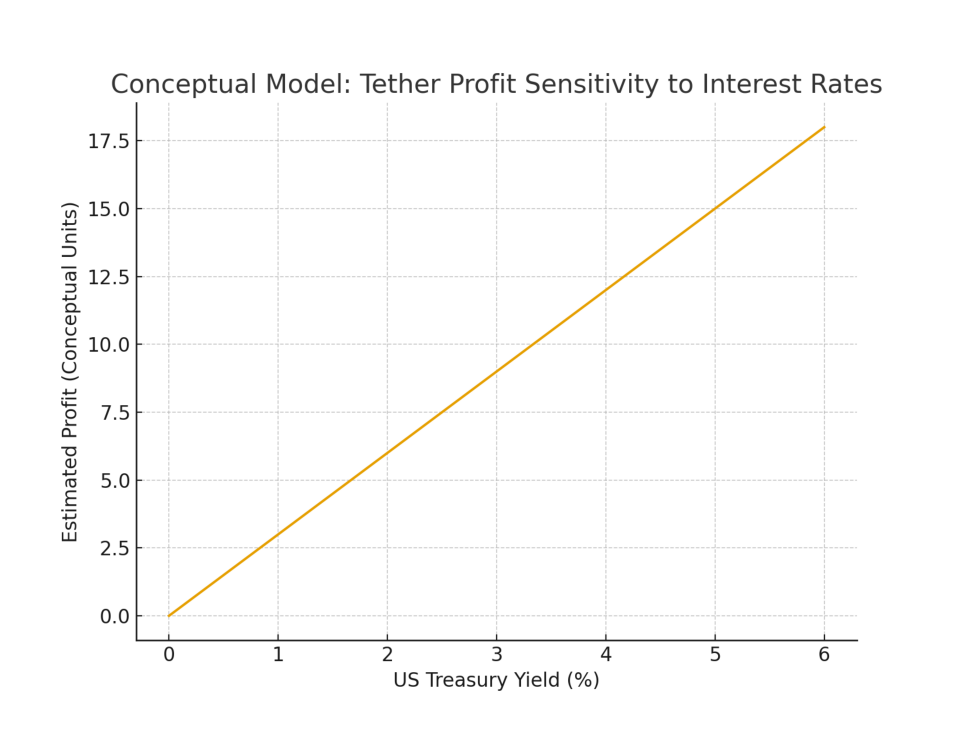
Most global macro analysts expect rate cuts in late 2025–2026.
When rates fall:
- Treasury yields drop
- Tether’s cash flow shrinks
- Gold and Bitcoin typically increase in price
From this perspective, Tether’s strategy appears logical—if they correctly predict macro conditions.
However, Hayes warns that the strategy introduces asymmetric risk:
“Tether is in the early innings of running a massive rate trade. If the market moves against them, their buffer disappears.”
Section 5: Critics, Supporters, and Transparency Issues
Critics argue:
- Gold and BTC are too volatile for stablecoin reserves.
- Tether relies heavily on attestation, not full audits.
- The reserve definition of “cash assets” appears smaller than short-term liabilities.
Supporters counter:
- Bitcoin and gold purchases come from profits, not user backing.
- Reserves remain fully backed even without these investments.
- Tether’s profitability allows reinvestment into non-core assets.
A user on X explained:
“They mint USDT only when there is demand, and use excess profits—not customer funds—to buy BTC and gold.”
Hayes responded by questioning discrepancies in cash reporting, which suggests potential gaps in data interpretation.
Section 6: Market Context—Recent Trends in BTC, Gold, and Stablecoins
To understand Tether’s risk, investors must consider broader market trends.
Bitcoin Trends (2024–2025)
- BTC gained institutional support following multiple ETF approvals.
- Several countries expanded Bitcoin reserves.
- Volatility remains high, with 20–40% corrections still common.
Gold Trends (2024–2025)
- Gold surpassed $2,500+ as central banks increased purchases.
- Seen as a hedge against geopolitical instability.
- Correlation with Bitcoin has risen during liquidity cycles.
Stablecoin Ecosystem Trends
- Tether remains dominant (>70% market share).
- Circle (USDC) is expanding globally with stronger regulatory frameworks.
- Governments are introducing CBDCs, increasing scrutiny on private stablecoins.
Tether’s shift toward volatile assets must be viewed against this competitive and regulatory backdrop.
Section 7: Implications for Crypto Investors Seeking New Opportunities
Readers of this publication typically seek:
- promising digital assets
- new sources of revenue
- practical blockchain applications
Here is what Tether’s situation means for them.
1. BTC and Gold May Increase in Strategic Importance
Tether’s asset allocation reflects macroeconomic expectations shared by many major investors.
2. Stablecoin Risk Assessment Becomes More Important
Traders relying heavily on USDT liquidity must monitor reserve transparency.
3. Market Volatility Could Create Profit Opportunities
A negative shock to USDT would:
- push capital into BTC, ETH, USDC
- create extreme volatility in altcoins
- open arbitrage and hedging strategies
4. Risk-Managed Stablecoins Will Gain Momentum
Projects offering algorithmic transparency or fully audited reserves may attract new capital.
Conclusion: A Strategic Bet or a Systemic Risk?
Tether’s increasing exposure to Bitcoin and gold signals a major shift in how stablecoin issuers approach reserve management. Hayes’s analysis highlights legitimate risks: a significant downturn in these assets could jeopardize Tether’s equity buffer.
However, supporters argue the opposite—that Tether is simply reinvesting profits, not undermining its core reserves.
For crypto investors, the key takeaway is not panic but awareness.
Tether’s strategy reflects a broader macro trend: the transition from high interest rates to an era where hard assets regain prominence. This shift will influence everything from stablecoin liquidity to Bitcoin price dynamics, offering both risks and opportunities for those positioned to act.
