
Main Points :
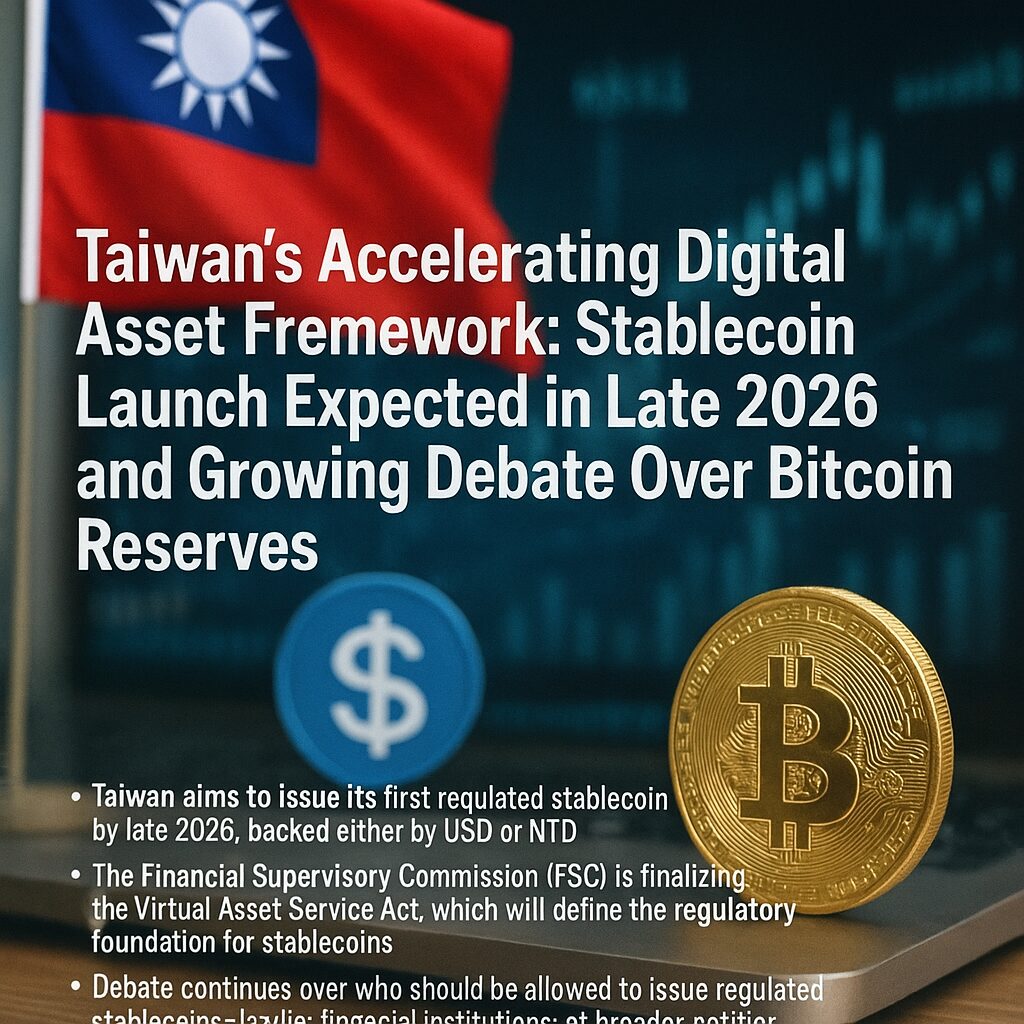
- Taiwan aims to issue its first regulated stablecoin by late 2026, backed either by USD or NTD.
- The Financial Supervisory Commission (FSC) is finalizing the Virtual Asset Service Act, which will define the regulatory foundation for stablecoins.
- Debate continues over who should be allowed to issue regulated stablecoins—banks, financial institutions, or broader entities.
- A political movement is pushing for Bitcoin to be included in Taiwan’s national reserves, citing global economic uncertainty.
- Taiwan’s digital asset strategy shows a balancing act between innovation, national currency protection, and financial stability.
- Global context: Several countries (EU, Japan, Hong Kong, Singapore) have moved ahead with stablecoin regulation, influencing Taiwan’s timeline and policy stance.
- For crypto investors, Taiwan’s new framework may create opportunities for stablecoin-related businesses, cross-border payments, and institutional Bitcoin adoption.
(Taiwan Stablecoin Timeline)
(Taiwan Reserve Asset Composition)
Introduction: Taiwan’s Digital Asset Turning Point
Taiwan is entering a critical phase in its digital asset strategy. After years of limited regulatory clarity, the government is moving quickly toward establishing a comprehensive legal framework for virtual asset service providers (VASPs), stablecoin issuers, and digital currency infrastructure. The most significant development is the Financial Supervisory Commission’s (FSC) projection that Taiwan’s first regulated stablecoin could be launched in late 2026, ushering in a new era of compliant digital finance for the island.
This comes at a time when global financial conditions are shifting, blockchain adoption is accelerating, and institutional interest in digital assets is broadening—especially around stablecoins and Bitcoin as macro-hedging instruments. Taiwan’s evolving regulatory environment is therefore not simply a domestic policy discussion; it represents a strategic response to global monetary transformation.
In this article, we will examine the upcoming regulatory structure, the political debate over Bitcoin in national reserves, the implications for Taiwan’s financial ecosystem, and the broader global context driving these changes. We will also look at opportunities being created for investors and businesses seeking new revenue sources within the digital asset space.
1. Taiwan’s Stablecoin Initiative: A New Regulatory Milestone
Taiwan’s FSC chairman Peng Jin-long recently acknowledged that if legislative processes progress smoothly, the country’s first regulated stablecoin could enter the market in the second half of 2026. This would represent a major leap forward for Taiwan, which historically has taken a conservative stance on digital asset oversight.
1.1 Legal Foundation: The Virtual Asset Service Act
The proposed Virtual Asset Service Act (VASA) has already passed initial executive-level review and is expected to be submitted to the Legislative Yuan during the current session. The act will define:
- Registration and licensing requirements for VASPs
- Consumer protection and operational risk frameworks
- Rules for asset safeguarding, custody, and cybersecurity
- Anti-money laundering (AML) requirements
- The definition and treatment of stablecoins
If passed, the FSC will publish detailed implementation rules. A six-month transition period is expected before the law becomes fully effective, placing the earliest stablecoin launch timeline at late 2026.
1.2 What Will the Stablecoin Be Pegged To? USD or NTD?
A major unresolved issue concerns the peg mechanism. Taiwan must choose between:
| Option | Advantages | Risks |
|---|---|---|
| USD-pegged stablecoin | Avoids complications related to NTD capital controls; easier global interoperability | Reduces monetary sovereignty; may limit domestic monetary policy influence |
| NTD-pegged stablecoin | Strengthens national currency digitization; aligns with domestic financial strategy | Taiwan has strict NTD outflow controls; digital NTD could create offshore price distortions |
Taiwan has long restricted NTD circulation outside the country to avoid unofficial offshore markets. An NTD stablecoin may risk undermining those efforts unless designed with strict controls.
1.3 Who Will Issue the Stablecoin?
While the draft legislation does not explicitly restrict stablecoin issuance to banks, both the FSC and the Taiwan central bank have expressed a preference that only regulated financial institutions—particularly banks—take on this role.
This mirrors international models such as Japan’s 2023 Stablecoin Law, which similarly restricts issuance to licensed banks and trust companies.
For Taiwan’s crypto sector, this means collaborations between fintech firms and banks may become the preferred model, rather than fully independent crypto-native stablecoin issuers.
2. Political Debate: Should Taiwan Hold Bitcoin as a National Reserve Asset?
As Taiwan moves toward a digital regulatory framework, a parallel political conversation has emerged: Should Taiwan include Bitcoin in its national reserves?
2.1 Arguments For Bitcoin Reserves
The most vocal advocate is legislator Ko Ju-chun, who in a November hearing urged the government to diversify its reserves in anticipation of growing geopolitical and macroeconomic uncertainty.
His key arguments include:
- Taiwan’s reserves are heavily dependent on U.S. Treasuries (≈80%) and influenced by China’s economic cycle.
- Bitcoin is increasingly recognized globally as a hedge against inflation, geopolitical instability, and systemic risk.
- Several countries—including El Salvador, Bhutan, and some Middle Eastern sovereign wealth funds—have begun accumulating Bitcoin.
- Major institutions expect central banks worldwide to hold digital assets by 2030.
Ko questioned whether Taiwan can afford to wait until 2030 to begin diversification, suggesting that early entry would reduce risk and increase strategic flexibility.
2.2 Taiwan’s Current Reserve Composition
As shown in the pie chart above:
- ~80% of reserves are U.S. Treasuries
- ~15% is gold
- ~5% is classified as other forms of financial assets
- 0% is cryptocurrency
This heavy concentration exposes Taiwan to inflation, interest rate fluctuations, and geopolitical dependency.
2.3 Counterarguments: Stability and Currency Protection
Opponents argue:
- Bitcoin’s volatility makes it unsuitable as a reserve asset
- Taiwan must maintain confidence in the NTD
- The central bank’s primary mandate is stability, not investment performance
- National reserves should avoid speculative assets
The debate reflects broader global tension between financial orthodoxy and the rising relevance of digital assets.
3. Global Drivers Shaping Taiwan’s Decisions
Taiwan’s move is influenced not only by domestic politics but by international trends:
3.1 EU MiCA (Markets in Crypto-Assets, 2024)
Europe now has the world’s most comprehensive digital asset law, requiring full transparency, reserve backing, and strict licensing for stablecoin issuers.
3.2 Hong Kong (2023–2024)
Hong Kong has implemented a licensing regime and plans regulated stablecoin frameworks, aiming to attract crypto firms.
3.3 Singapore’s MAS Framework
Singapore restricts stablecoin issuance to entities meeting strict reserve and disclosure requirements — a likely model for Taiwan.
3.4 Japan’s Stablecoin Act
Japan legalized stablecoins in 2023 but requires issuers to be banks or trust institutions, influencing Taiwan’s preference for bank-issued stablecoins.
3.5 U.S. Regulatory Pressures
Despite regulatory fragmentation, U.S. markets remain a major force in stablecoin liquidity, especially for USD-pegged assets.
Across these jurisdictions, three common themes shape Taiwan’s strategy:
- Strong consumer and reserve protection
- Institutional-grade backing for stablecoins
- Integration with traditional financial infrastructure
This suggests Taiwan is aiming to position itself as a compliant digital-asset hub similar to Japan or Singapore.
4. Opportunities for Investors and Blockchain Innovators
4.1 Stablecoin Infrastructure and Payments
A regulated Taiwanese stablecoin could open new opportunities for:
- Cross-border remittances
- Merchant payments
- FX conversion services
- Treasury management tools
- DeFi gateways for institutional users
Regions with strict FX controls typically present strong demand for digital-asset payment rails that are both compliant and efficient.
4.2 Banking Partnerships and Tokenization
Taiwanese banks have begun exploring tokenization of:
- Bonds
- Funds
- Real estate
- Commercial paper
A government-recognized stablecoin will accelerate such tokenization initiatives.
4.3 Bitcoin Reserve Debate Boosts Institutional Interest
Regardless of the outcome, the mere discussion of state-level Bitcoin acquisitions:
- Increases legitimacy
- Signals future institutional demand
- Encourages new ETFs, custody solutions, and derivatives markets
- May catalyze Taiwanese fintech firms to build regulated digital asset products
4.4 Strategic Advantage for International Crypto Firms
Firms targeting Asia may find Taiwan appealing for:
- High fintech adoption
- Strong rule of law
- Proximity to East Asian capital flows
- A developing but stable regulatory environment
5. Taiwan’s Digital Asset Future: Balancing Innovation and Stability
The dual push for a regulated stablecoin and a national conversation on Bitcoin reserves shows Taiwan’s commitment to shaping a modern financial system. Yet this must be balanced against:
- Capital control concerns
- Currency protection
- Financial stability
- Political sensitivities
As Taiwan positions itself within the global digital economy, its emerging framework blends innovation with caution, aiming to modernize without destabilizing.
Conclusion: A Strategic Moment for Taiwan—and Investors
Taiwan’s plan to introduce a regulated stablecoin by late 2026 and its ongoing debate over Bitcoin reserves signal a pivotal shift in the nation’s financial future. These developments reflect broader global momentum toward digital currency integration, stablecoin standardization, and Bitcoin’s role as a macro-level asset.
For investors and blockchain builders, Taiwan’s evolving landscape offers new opportunities in:
- Stablecoin issuance
- Payment and remittance solutions
- Institutional custody
- Tokenization platforms
- Regulatory-compliant crypto services
As Taiwan finalizes its Virtual Asset Service Act, the island may emerge as one of Asia’s most strategically positioned digital-asset hubs, bridging innovation, regulation, and financial security.
