
Main Points :
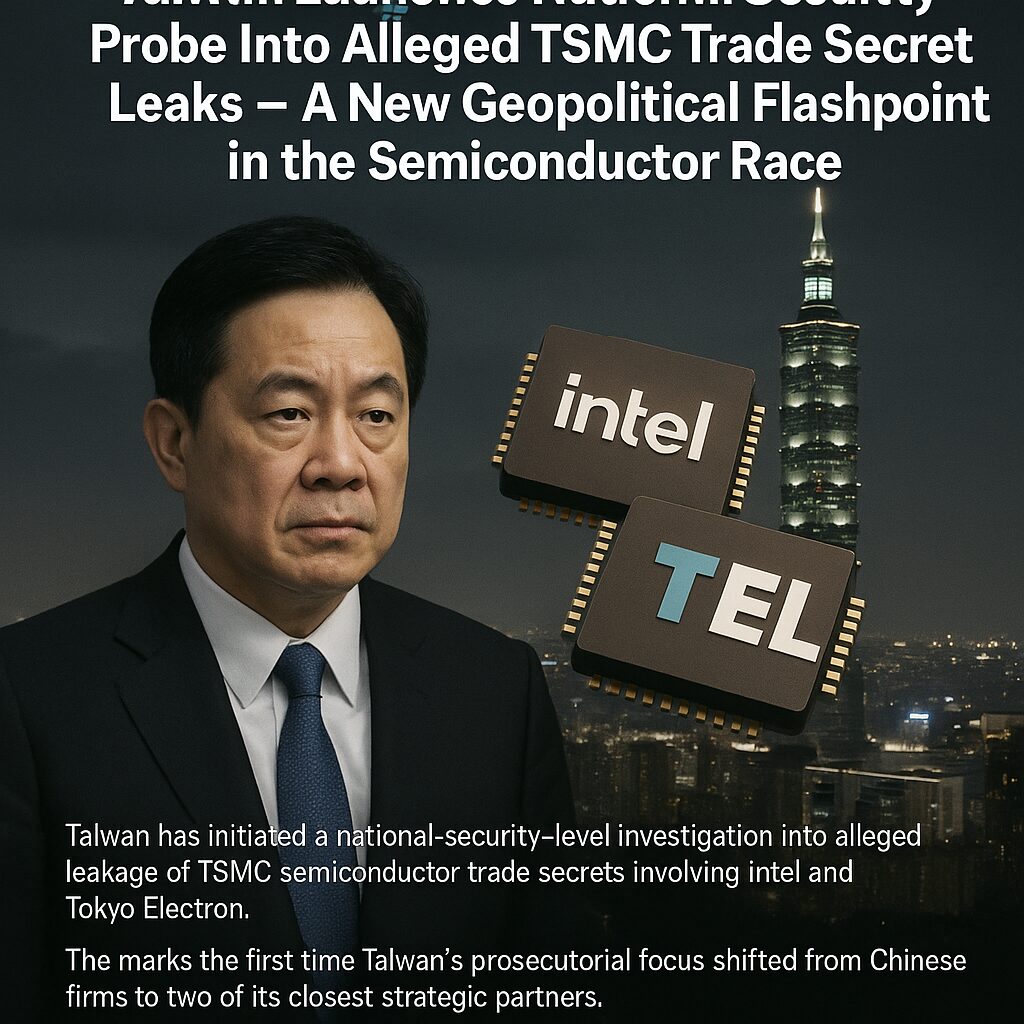
- Taiwan has initiated a national-security–level investigation into alleged leakage of TSMC semiconductor trade secrets involving Intel and Tokyo Electron.
- This marks the first time Taiwan’s prosecutorial focus shifted from Chinese firms to two of its closest strategic partners.
- The probe comes as global competition for semiconductor supremacy intensifies and the U.S.–China rivalry pushes Taiwan into a tighter geopolitical corner.
- The incident raises concerns about intellectual-property protection, supply-chain resilience, and the future of cross-border semiconductor collaboration.
- For crypto and blockchain investors, the semiconductor narrative matters because AI chips, GPU shortages, and geopolitics directly affect mining economics, hardware pricing, and the feasibility of decentralized compute solutions.
Introduction: Semiconductor Security Becomes a Global Economic Issue
Taiwan has long been the epicenter of global semiconductor production, and Taiwan Semiconductor Manufacturing Company (TSMC) remains the most strategically important chipmaker in the world. Although Taiwan has conducted intellectual-property (IP) investigations before, a newly launched high-level national security probe has shocked the region: Taiwanese prosecutors are scrutinizing allegations of TSMC trade-secret leakage involving two companies typically regarded as allies—Intel (U.S.) and Tokyo Electron (Japan).
The gravity of this probe lies not only in the alleged leaks themselves but in what this signals: the geopolitical environment surrounding chips has become so sensitive that even friendly nations are no longer exempt from national security scrutiny.
The following sections detail the incident, explain its strategic importance, and expand on related global developments—including how these trends may influence crypto markets, blockchain infrastructure, and the economics of digital-asset ecosystems.
Section 1 — Background of the Investigation
Taiwanese media outlets reported that prosecutors executed a search on the residence of former TSMC executive Luo Wei-Jen, while also formally indicting the Taiwan branch of Tokyo Electron. At the heart of the probe is whether confidential semiconductor manufacturing knowledge—potentially related to advanced process nodes—was improperly accessed or transferred.
Taiwan’s New Security Law as Legal Foundation
This investigation is conducted under Taiwan’s updated national security framework, which strengthens protections around strategically sensitive technologies.
Key aspects include:
- expanded definition of “national core technologies,”
- tougher criminal penalties for trade-secret violations,
- stronger surveillance powers for prosecutors,
- applicability even when suspected actors come from friendly nations.
The probe’s legal basis shows that Taiwan now treats semiconductor IP not merely as corporate property but as a matter of national continuity and geopolitical leverage.
Section 2 — Why the Investigation Shocked Taiwan
Traditionally, Taiwan’s IP enforcement efforts focused on preventing leakage to China, given Beijing’s explicit ambition to achieve semiconductor self-sufficiency.
However, the current probe targets Intel and Tokyo Electron, both essential partners in Taiwan’s semiconductor supply chain. This shift has startled Taiwanese public opinion for several reasons:
1. Strategic Partners Becoming Subjects of Investigation
Intel is a major customer and occasional competitor, while Tokyo Electron is one of the world’s most important semiconductor equipment manufacturers. Taiwan relies heavily on both for global competitiveness.
Investigating them suggests Taiwan will protect its semiconductor secrets regardless of diplomatic alignment.
2. Broader Security Context Under the U.S.–China Rivalry
Sources in Taipei indicate rising concern about U.S. political volatility.
Former U.S. President Donald Trump publicly complained that Taiwan was “stealing the U.S. semiconductor business” while still depending on American military protection.
The remark ignited debate in Taiwan:
If geopolitical winds shift, even the U.S. may pressure Taiwan economically, making stringent IP safeguards indispensable.
3. Fear of Losing Technological Advantages
Semiconductors underpin everything from AI servers to global data-centers, defense systems, and financial infrastructure. Any erosion of TSMC’s technological lead—currently around 2–3 years ahead of competitors—could weaken Taiwan’s geopolitical bargaining position.
<<< Timeline of Security Investigation >>>

This investigation does not exist in isolation. Several global shifts increase the sensitivity of semiconductor IP:(A) The AI Boom Has Made Advanced Chips the New “Oil”
The global race for AI-focused chips—especially GPUs and custom accelerators—has exploded since 2023. NVIDIA’s data-center GPU revenue now exceeds $47 billion annually, and demand still outstrips supply.
TSMC manufactures nearly all of NVIDIA’s most advanced chips (H100, H200, Blackwell B100), meaning:
- any leakage of advanced node technology
- any disruption of TSMC production
- any weakening of supply-chain security
…would hit AI, cloud computing, and crypto-related GPU markets simultaneously.
For crypto miners and decentralized compute networks, advanced chips are a core economic driver. Even slight supply-chain disruptions can push GPU prices up by hundreds of dollars.(B) U.S. Export Controls Have Increased the Stakes
The U.S. has imposed strict chip-export restrictions targeting China, limiting access to 7nm and below. This has created:
- a “chip blockade” environment,
- rising incentives for industrial espionage,
- intense geopolitical competition for manufacturing capacity.
Taiwan, being the world’s bottleneck for advanced production, sits directly at the friction point of U.S.–China tensions.(C) Japan Is Rapidly Rebuilding Its Semiconductor Industry
Tokyo Electron and Rapidus (Japan’s new advanced semiconductor venture) have become strategically important for Japan’s chip revival.
Japan sees chip tech as vital for:
- economic security,
- energy infrastructure,
- defense modernization.
This increases pressure on Taiwan to protect shared technological ecosystems.
Section 4 — Why Crypto & Blockchain Investors Should Care
At first glance, a TSMC secrecy probe seems unrelated to digital assets.
But in reality, semiconductors and blockchain economics are deeply connected.(1) AI Chips Drive the Future of Decentralized Compute
Projects promoting decentralized GPU networks—such as Render (RNDR), Akash (AKT), Bittensor (TAO), and various zk-proof accelerators—depend on global chip availability and cost.
If geopolitical pressure constrains chip production:
- GPU prices rise
- decentralized compute tokens often rally
- mining profitability changes
- cloud-compute arbitrage strategies shift
Thus, semiconductor instability directly influences crypto-asset valuations.(2) Tighter Security = Higher R&D Costs = Higher Hardware Prices
More security investigations typically lead to:
- stricter export controls
- compliance requirements
- increased operational costs for chip fabrication
Consumers—especially miners—experience:
- more expensive GPUs
- longer lead times
- reduced supply of high-end hardware
This influences the economics of Bitcoin mining, AI-assisted trading systems, and L2/ZK-based projects requiring heavy computation.(3) Capital Rotation Toward “Digital Hard Assets”
Whenever geopolitical risks rise, investors often shift into:
- Bitcoin
- stablecoins
- tokenized commodities
- alternative yield opportunities
Semiconductor tensions reinforce a global macro theme: physical supply chains are fragile, but digital assets can move freely.
Expect capital to flow into crypto whenever semiconductor bottlenecks appear in the news.
Section 5 — What Is Not Yet Known
Despite the public shock, several key details remain undisclosed:
- what specific TSMC technologies were allegedly leaked
- whether Intel or Tokyo Electron employees knowingly participated
- whether the leak affected 3nm or 2nm process nodes
- whether any confidential design files, EUV recipes, or production workflows were compromised
The investigation is still in its early stages, and prosecutors have released minimal information.
Given the strategic consequences, Taiwanese authorities are proceeding cautiously.
Conclusion — A New Era of Semiconductor Geopolitics
Taiwan’s national security investigation into alleged TSMC trade-secret leaks marks a major shift in global semiconductor policy. By scrutinizing two of its closest partners—Intel and Tokyo Electron—Taiwan has signaled that protecting semiconductor IP is now an existential priority rather than a commercial one.
This reflects a new geopolitical reality:
- AI is accelerating global competition
- chips have become tools of national strategies
- semiconductor supply chains are now matters of national survival
For investors in crypto, AI, and decentralized compute ecosystems, these developments should not be ignored. Chip security concerns translate directly into hardware costs, production timelines, and market volatility. The semiconductor story is no longer just “tech news”—it is an essential macroeconomic pillar that shapes the future of digital assets.
