

Main Points :
- Strategy (formerly MicroStrategy) purchased 17,994 BTC worth approximately $1.28 billion.
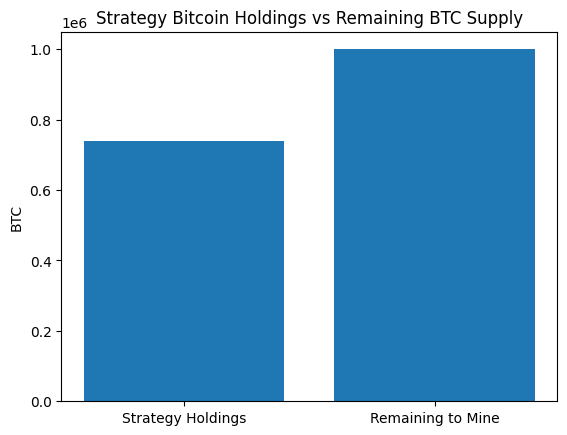
- The company’s total holdings reached 738,731 BTC, approaching 740,000 BTC.
- The new acquisition was made at an average price of $70,946 per BTC.
- Funds were raised through the sale of Class A common stock and preferred shares.
- Strategy’s total cumulative investment in Bitcoin is now around $56 billion.
- Institutional accumulation is intensifying as the remaining Bitcoin supply approaches the final 1 million BTC.
1. Strategy Adds Nearly 18,000 BTC in a $1.28 Billion Purchase
Michael Saylor’s company Strategy announced on March 9 that it had purchased 17,994 BTC, investing approximately $1.28 billion to expand its Bitcoin treasury. The acquisition took place between March 2 and March 8, with the company paying an average price of $70,946 per BTC.
This latest purchase continues Strategy’s long-standing corporate policy of converting capital into Bitcoin as a primary treasury reserve asset. According to the company’s disclosure, the funding for the purchase came from the sale of Class A common stock and variable-rate preferred shares, reinforcing Strategy’s capital markets strategy of issuing equity-like instruments to accumulate Bitcoin.
With this new acquisition, Strategy’s total holdings reached 738,731 BTC, bringing the company within striking distance of the symbolic milestone of 740,000 BTC. At current market prices near the purchase level, this reserve is valued at over $52 billion, making Strategy the largest corporate holder of Bitcoin by a wide margin.
The company’s total cumulative cost basis for its Bitcoin acquisitions is now estimated at approximately $56 billion, reflecting years of strategic accumulation across multiple market cycles.
This move once again demonstrates the unwavering conviction of Michael Saylor, who has repeatedly stated that Bitcoin is “the best long-term store of value in the digital age.”
2. The Corporate Bitcoin Treasury Strategy
Strategy’s approach represents one of the most radical corporate treasury transformations in modern financial history.
Traditionally, corporate treasuries hold a mix of cash, government bonds, and low-risk securities. Strategy, however, has aggressively shifted its reserves toward Bitcoin, viewing fiat currencies as structurally vulnerable to inflation and monetary expansion.
Michael Saylor first announced this pivot in 2020, describing Bitcoin as “digital gold engineered for the internet era.”

Since then, Strategy has repeatedly executed capital-raising operations to purchase more Bitcoin, including:
- Convertible bonds
- Equity offerings
- Preferred stock issuance
This strategy effectively turns Strategy into a Bitcoin accumulation vehicle, combining public market capital with long-term digital asset exposure.
Many investors now treat Strategy’s stock as a leveraged Bitcoin proxy, since the company’s balance sheet is heavily tied to Bitcoin price performance.
The strategy has influenced other institutions as well. Companies such as Tesla, Block, and several public mining firms have also adopted Bitcoin as part of their treasury reserves, though none at the scale of Strategy.
3. Institutional Accumulation and Market Psychology
Large-scale purchases like Strategy’s latest acquisition have a powerful impact on market psychology.
Institutional investors and hedge funds often interpret such purchases as a signal of strong long-term confidence in Bitcoin’s price trajectory.
When a major corporate entity consistently buys Bitcoin regardless of market fluctuations, it reinforces the narrative that Bitcoin is transitioning from a speculative asset into a global strategic reserve asset.
This psychological effect can trigger several market dynamics:
- Reduced circulating supply
- Increased institutional legitimacy
- Long-term holding behavior among investors
Strategy’s holdings alone represent over 3.5% of Bitcoin’s total supply, which is capped at 21 million BTC.
As a result, the company has effectively become one of the largest long-term custodians of Bitcoin in existence.
This concentration of holdings also fuels debates within the crypto community about corporate influence over decentralized assets, though most analysts view it primarily as a reflection of market conviction.
4. The Supply Shock: Only 1 Million BTC Left to Mine
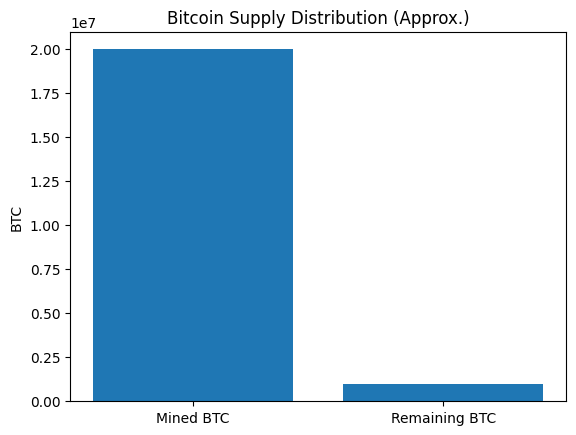
At the same time as Strategy’s latest purchase, another milestone was reported in the Bitcoin ecosystem: over 20 million BTC have now been mined.
Since Bitcoin’s maximum supply is fixed at 21 million coins, fewer than 1 million BTC remain to be issued.
This milestone has major implications for long-term price dynamics.
Bitcoin’s issuance schedule is governed by a process known as the halving cycle, which reduces the block reward approximately every four years. As the supply growth slows, new Bitcoin entering the market becomes increasingly scarce.
This creates the conditions for what many analysts call a “supply shock.”
When institutional demand increases while new supply decreases, prices can experience upward pressure.
Several analysts have suggested that the final stage of Bitcoin issuance could trigger a global competition among institutions, governments, and sovereign wealth funds seeking exposure to digital scarcity.
The concept of a “Bitcoin supply race” has already emerged among large investors.
5. The Institutional Bitcoin Era
The current market cycle is increasingly defined by institutional participation.
Several major developments have accelerated this trend:
- Approval of spot Bitcoin ETFs in the United States
- Institutional custody infrastructure expansion
- Integration of Bitcoin into traditional finance platforms
These developments have opened the door for pension funds, hedge funds, and asset managers to gain exposure to Bitcoin without directly holding the asset.
In addition, governments and regulators have gradually shifted from outright skepticism to cautious acceptance.
For example, several central banks are now studying Bitcoin as part of broader research into digital asset reserve diversification.
While no major nation currently holds Bitcoin as an official reserve asset, some countries—including El Salvador—have already adopted Bitcoin as legal tender.
These developments signal the early stages of a potential transformation in the global financial system.
6. What This Means for Investors Seeking New Crypto Opportunities
For investors searching for new crypto assets or revenue opportunities, Strategy’s continued accumulation provides several insights.
First, it reinforces Bitcoin’s position as the foundational asset of the digital economy. Many emerging crypto projects derive their legitimacy and liquidity from Bitcoin’s market dominance.
Second, institutional accumulation can create new opportunities in related sectors, including:
- Bitcoin infrastructure
- Layer-2 scaling networks
- institutional custody platforms
- tokenized financial products
For example, technologies such as the Lightning Network and emerging Bitcoin DeFi ecosystems are gaining attention as ways to build financial applications on top of Bitcoin.
Investors looking for early opportunities often monitor these adjacent ecosystems for the next wave of innovation.
7. Long-Term Implications for the Global Financial System
Strategy’s Bitcoin strategy also reflects a broader philosophical shift about the nature of money.
In traditional finance, value is anchored in government-issued currencies and central bank policies.
Bitcoin introduces a different paradigm: algorithmic monetary policy enforced by decentralized consensus.
This difference has profound implications.
If Bitcoin continues to gain institutional adoption, it could gradually evolve into a global neutral reserve asset, similar to gold but optimized for the digital age.
Such a shift would transform not only investment portfolios but also international monetary dynamics.
While the timeline for this transition remains uncertain, Strategy’s massive accumulation illustrates how some institutions are already positioning themselves for that future.
Conclusion
Strategy’s purchase of 17,994 BTC worth $1.28 billion marks another milestone in the company’s ambitious Bitcoin treasury strategy.
With total holdings approaching 740,000 BTC, Strategy has become one of the most influential participants in the Bitcoin ecosystem.
At the same time, the broader market is approaching a critical structural moment: more than 20 million BTC have already been mined, leaving fewer than 1 million coins remaining.
This convergence of institutional demand and diminishing supply could shape the next era of the cryptocurrency market.
For investors and entrepreneurs exploring the practical applications of blockchain technology, these developments highlight a powerful trend: Bitcoin is steadily transitioning from an experimental asset into a core component of the emerging digital financial infrastructure.
The race for the final Bitcoin supply may only just be beginning.
