

Main Points :
- Strategy, the world’s largest corporate holder of Bitcoin, has increased its U.S. dollar cash reserves to $2.19 billion, equivalent to over $22 billion at current exchange rates, by selling common stock.
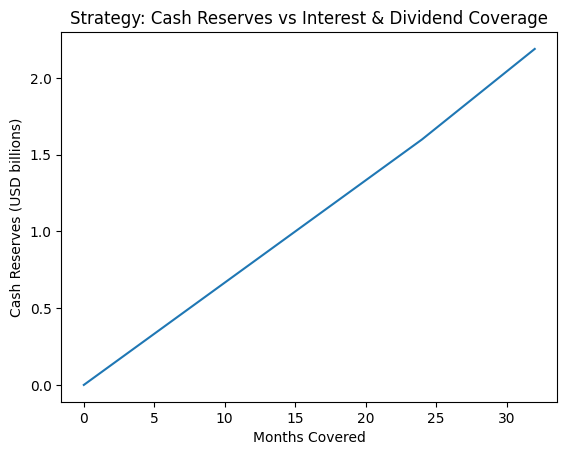
- The enlarged cash position is sufficient to cover approximately 32 months of dividend and interest payments, significantly reducing near-term liquidity risk.
- Analysts interpret this move as a deliberate preparation for a prolonged “crypto winter”, strengthening balance-sheet resilience without liquidating Bitcoin holdings.
- Strategy currently holds 671,268 BTC, and projections suggest holdings could reach approximately 835,000 BTC by fiscal year 2027.
- This approach reinforces Strategy’s role not only as a Bitcoin proxy investment but as a long-term experiment in Bitcoin-centric corporate treasury management.
1. Background: Why Cash Matters in a Bitcoin-Heavy Balance Sheet
The announcement that Strategy has boosted its U.S. dollar reserves to $2.19 billion marks a critical shift in how the market views corporate Bitcoin accumulation strategies. While Strategy is widely known for its aggressive Bitcoin purchases, this move highlights a more nuanced and disciplined financial strategy—one that balances conviction with survivability.
In previous crypto cycles, many firms over-leveraged themselves during bull markets, only to face forced liquidations when prices collapsed. Strategy’s decision to accumulate cash—rather than simply doubling down on Bitcoin purchases—signals an awareness that volatility is not a temporary anomaly but a structural feature of crypto markets.
This cash buffer, raised entirely through common stock issuance, provides insulation against macroeconomic shocks, regulatory uncertainty, and extended downturns in digital asset prices.
2. The Details of the Capital Raise
According to filings with the U.S. Securities and Exchange Commission, Strategy raised approximately $748 million through the sale of common shares. Combined with earlier financing activities, this brought total dollar reserves to $2.19 billion.
Importantly, the company disclosed earlier in December that it had already secured $1.44 billion specifically earmarked to support preferred stock dividends and debt interest payments. The latest raise builds upon that foundation, extending the company’s financial runway to nearly 32 months—a timeframe that comfortably spans most historical crypto bear markets.
From a corporate finance perspective, this move converts equity dilution into strategic optionality: the ability to hold Bitcoin through downturns without selling into weakness.
3. Analyst Interpretation: Preparing for a Long Crypto Winter
Investment bank TD Cowen, through its TD Securities division, framed this move as a decisive step toward balance-sheet fortification. Analysts emphasized that Strategy’s strengthened liquidity profile mitigates concerns about its ability to survive a prolonged downturn in Bitcoin prices.
Historically, the term “crypto winter” refers to extended periods—often lasting 18 to 36 months—of depressed prices, low trading volumes, and reduced investor enthusiasm. By securing nearly three years’ worth of interest and dividend coverage, Strategy positions itself to outlast such conditions without compromising its core Bitcoin thesis.
This is particularly relevant in an environment where interest rates remain structurally higher than in the previous decade, increasing the cost of debt servicing.
4. Market Impact: Why the Stock Sale Did Not Disrupt Liquidity
Over the past four weeks, Strategy sold more than 22 million shares, a figure roughly equivalent to its average daily trading volume. Analysts noted that this disciplined execution avoided undue pressure on market liquidity or excessive downward movement in the share price.
This point is crucial. In many cases, large equity issuances spook investors, signaling distress. In Strategy’s case, the orderly nature of the sale reinforced confidence that management retains ongoing access to capital markets.
By proactively strengthening the balance sheet, Strategy has reduced speculation about emergency fundraising or forced asset sales in the future.
5. Strategy as the World’s Largest Bitcoin Treasury Company
Strategy currently holds 671,268 BTC, making it the single largest corporate Bitcoin holder globally by a significant margin. This position effectively transforms the company into a publicly traded Bitcoin treasury vehicle, albeit one with operating software and analytics businesses still attached.
TD Cowen projects that Strategy’s Bitcoin holdings could reach approximately 835,000 BTC by the end of fiscal year 2027, assuming continued accumulation during favorable market conditions.

The firm also estimates Strategy’s intrinsic Bitcoin value per share at:
- $380 per share in one year
- $515 per share in two years
These estimates underline why many investors view Strategy less as a traditional equity and more as a leveraged, actively managed Bitcoin exposure.
6. No Bitcoin Purchases Last Week: A Strategic Pause
Notably, Strategy did not purchase additional Bitcoin in the previous week. While some market participants interpreted this as caution, others saw it as evidence of strategic discipline.
With Bitcoin prices fluctuating and macroeconomic signals mixed, holding cash provides flexibility. Strategy can choose to deploy capital aggressively during sharp drawdowns rather than chasing momentum during uncertain rallies.
This reinforces the idea that cash is not a contradiction to a Bitcoin-maximalist strategy, but rather its enabler.
7. Broader Context: Corporate Treasury Management in the Crypto Era

Strategy’s approach is increasingly influential. Other corporations exploring digital asset exposure are studying its model closely, particularly the balance between:
- Long-term asset conviction
- Short-term liquidity management
- Capital market access
For firms interested in blockchain-based treasury strategies, Strategy demonstrates that survivability is as important as belief. Without sufficient fiat liquidity, even the strongest thesis can fail under real-world constraints.
8. Implications for Investors and the Crypto Market
For investors seeking new crypto-related opportunities, Strategy offers a case study in institutional-grade risk management. Its actions suggest that the next phase of crypto adoption will favor entities that:
- Maintain transparent balance sheets
- Avoid forced selling
- Align capital structure with market volatility
This shift could gradually reduce systemic risk in the crypto ecosystem, as more participants adopt conservative liquidity practices alongside digital asset exposure.
9. Conclusion: A Blueprint for Enduring the Next Crypto Cycle
Strategy’s decision to raise cash rather than sell Bitcoin represents a maturation of crypto-centric corporate finance. By ensuring nearly three years of financial runway, the company has significantly reduced existential risk while preserving upside exposure to Bitcoin’s long-term appreciation.
For readers searching for new crypto assets, revenue models, or practical blockchain applications, Strategy’s case illustrates a crucial lesson: the future of crypto is not just about accumulation, but about endurance.
In an industry defined by cycles, those who survive the winter are best positioned to lead the next spring.
