

Main Points :
- South Korea is preparing new regulatory guidelines allowing listed companies and institutional entities to invest in cryptocurrencies.
- Stablecoins such as USDT and USDC will be excluded from the permitted investment assets.
- The main reason is a legal conflict with the country’s Foreign Exchange Transactions Act.
- Corporations can still trade stablecoins through overseas exchanges or OTC markets.
- The policy reflects broader global tensions around stablecoin regulation, cross-border payments, and digital asset compliance.
Introduction: A New Phase for Institutional Crypto in South Korea
South Korea is one of the most active cryptocurrency markets in the world. Retail participation is high, exchanges such as Upbit, Bithumb, Coinone, and Korbit handle billions of dollars in trading volume, and Korean investors have historically driven some of the most dramatic price premiums in global crypto markets.
However, institutional participation has been limited. Korean regulations historically focused on retail investor protection and anti-money-laundering (AML) compliance rather than corporate investment frameworks.
That may soon change.
According to recent reports from Korean media outlets, South Korea’s Financial Services Commission (FSC) is preparing new regulatory guidelines that will allow listed corporations and specialized investment entities to trade cryptocurrencies for investment and treasury purposes.
But there is a notable restriction.
Under the draft framework, stablecoins—particularly those denominated in U.S. dollars—will not be included in the list of permitted digital assets.
At first glance this may seem counterintuitive. Stablecoins have become a cornerstone of the global crypto economy, acting as liquidity bridges between fiat and blockchain markets.
Yet South Korea’s decision reflects a deeper legal and regulatory tension: the intersection between cryptocurrency markets and foreign exchange regulation.
Understanding this policy requires examining not only South Korea’s domestic legal structure but also the evolving global debate over stablecoins and digital payments.
Why Stablecoins Were Excluded
The primary reason stablecoins are excluded from the corporate investment guidelines lies in South Korea’s Foreign Exchange Transactions Act.
Under current law, cross-border payments must generally be conducted through authorized foreign exchange banks. This framework ensures regulatory oversight over international financial flows, helping authorities manage currency stability, taxation, and financial crime risks.
Stablecoins complicate that system.
Dollar-pegged tokens such as Tether (USDT) and USD Coin (USDC) function as digital equivalents of the U.S. dollar on blockchain networks. If corporations were allowed to hold or transact in these assets freely, they could potentially conduct cross-border transfers outside traditional banking channels.
From a regulatory standpoint, this could undermine the existing foreign exchange control framework.
Officials reportedly concluded that allowing stablecoins as corporate investment assets might create a legal contradiction. On one hand, the government would permit companies to acquire dollar-denominated digital assets. On the other hand, existing law would still prohibit using those assets as payment instruments for cross-border transactions.
Until the legal framework is updated, regulators prefer to avoid introducing such inconsistencies.
Legislative Debate Around Stablecoins
The issue is not entirely settled.
In October of last year, lawmakers in South Korea proposed amendments to the Foreign Exchange Transactions Act that would formally recognize stablecoins as a payment instrument.
If passed, the amendment could pave the way for companies to use stablecoins in international commerce.
That possibility has attracted significant interest from export-oriented Korean corporations.
Many Korean firms operate in industries such as electronics, semiconductors, automotive manufacturing, and global e-commerce. These companies regularly manage foreign currency exposure, particularly against the U.S. dollar.
Some executives had hoped that stablecoins could become a real-time foreign exchange hedging tool.
Because dollar-pegged tokens track the value of the U.S. currency on a near-instant basis, they could potentially allow firms to manage FX risk faster than traditional banking systems.
However, until legislation clarifies the legal status of stablecoins, regulators remain cautious.
What Corporations Will Be Allowed to Do
Despite excluding stablecoins, the new guidelines will still represent a major shift for South Korea’s crypto industry.
Under the proposed framework, listed companies and registered professional investment firms will be able to trade digital assets for:
- Investment purposes
- Treasury management
- Strategic portfolio diversification
This marks an important step toward institutional adoption.
Many global corporations have already incorporated digital assets into their treasury strategies. For example:
- MicroStrategy has accumulated billions of dollars worth of Bitcoin.
- Tesla previously held Bitcoin on its balance sheet.
- Several investment funds and asset managers now treat cryptocurrencies as an emerging asset class.
South Korea’s policy suggests the country intends to follow a similar trajectory—albeit with a more cautious regulatory approach.
Stablecoins Still Tradable Through Overseas Platforms
Although stablecoins are excluded from the official investment guidelines, the policy does not completely prohibit corporations from trading them.
Companies may still access stablecoins through:
- Overseas cryptocurrency exchanges
- Over-the-counter (OTC) trading platforms
- Private wallets such as MetaMask
For example, institutional OTC platforms operated by exchanges like Coinbase allow large entities to conduct bulk crypto transactions outside standard order books.
This means corporations that want exposure to stablecoins can still obtain them through international channels.
However, these transactions would fall outside the formal domestic regulatory framework.
From a compliance perspective, that distinction matters.
Global Context: Stablecoins at the Center of Regulatory Debate
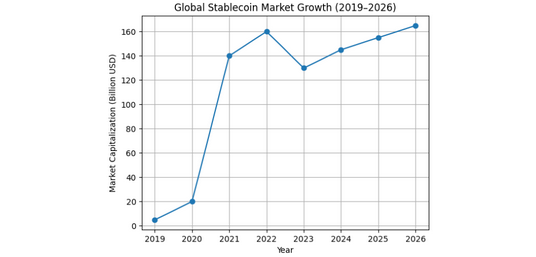
Description : Line chart showing the expansion of stablecoin market capitalization from under $10 billion in 2019 to over $150 billion in recent years.Suggested Diagram
South Korea’s cautious stance mirrors a broader global conversation about stablecoins.
Over the past five years, stablecoins have become one of the most important infrastructure layers in the cryptocurrency ecosystem.
Today the global stablecoin market exceeds $150 billion in circulation.
They serve several critical functions:
- Trading liquidity on crypto exchanges
- Settlement layers for decentralized finance (DeFi)
- Cross-border remittance tools
- Dollar access in emerging markets
However, regulators worldwide worry about their implications for monetary policy and financial stability.
United States
In the United States, lawmakers have debated multiple stablecoin regulatory frameworks. Proposed legislation typically requires issuers to hold fully backed reserves and banking-level oversight.
Major issuers such as Circle (USDC) and Tether (USDT) are closely monitored due to their systemic importance in crypto markets.
Europe
The European Union’s Markets in Crypto-Assets Regulation (MiCA) introduces strict licensing and reserve requirements for stablecoin issuers operating in the EU.
Asia
Asian governments have taken diverse approaches:
- Japan has introduced a legal framework recognizing certain fiat-backed stablecoins.
- Singapore has created licensing standards for stablecoin issuers under its payment services regime.
- South Korea, as this new policy shows, is taking a more cautious stance.
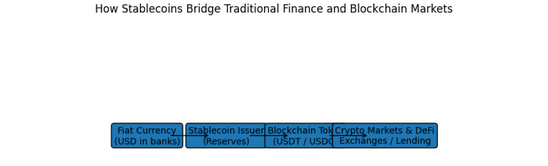
Diagram showing: Fiat Currency → Stablecoin Issuer → Blockchain Token → Crypto Exchanges / DeFi → Global Payments
Strategic Implications for Crypto Investors
For cryptocurrency investors and entrepreneurs, South Korea’s decision offers several strategic signals.
Institutional Crypto Adoption Is Expanding
Allowing corporations to invest in cryptocurrencies—even with restrictions—represents a major milestone.
Institutional participation typically brings:
- deeper liquidity
- more stable markets
- stronger infrastructure
Over time, this can accelerate mainstream adoption.
Stablecoins Remain Politically Sensitive
Even though stablecoins dominate crypto trading volumes, regulators remain wary of their monetary implications.
Investors should expect continued regulatory scrutiny in this sector.
Cross-Border Payments Are a Key Battlefield
Stablecoins have the potential to disrupt the $150 trillion global cross-border payments industry.
Governments are aware of this—and policies like South Korea’s reflect the desire to maintain oversight over international capital flows.
Conclusion: Regulation Catching Up With Crypto Innovation
South Korea’s decision to allow corporate cryptocurrency investment while excluding stablecoins illustrates the delicate balance regulators face.
On one hand, governments recognize that blockchain technology and digital assets are becoming a permanent part of global finance. Institutional participation is increasing, and companies are looking for new tools to manage capital, hedge risk, and participate in digital markets.
On the other hand, stablecoins raise fundamental questions about currency sovereignty, cross-border payments, and financial oversight.
For now, South Korea has chosen a cautious path—opening the door to corporate crypto investment while keeping stablecoins outside the official framework.
But the debate is far from over.
As legislation evolves and global financial infrastructure continues to digitize, stablecoins may eventually become a central component of international commerce.
For investors, developers, and blockchain entrepreneurs, that makes regulatory developments in countries like South Korea worth watching closely.
