
Main Points :
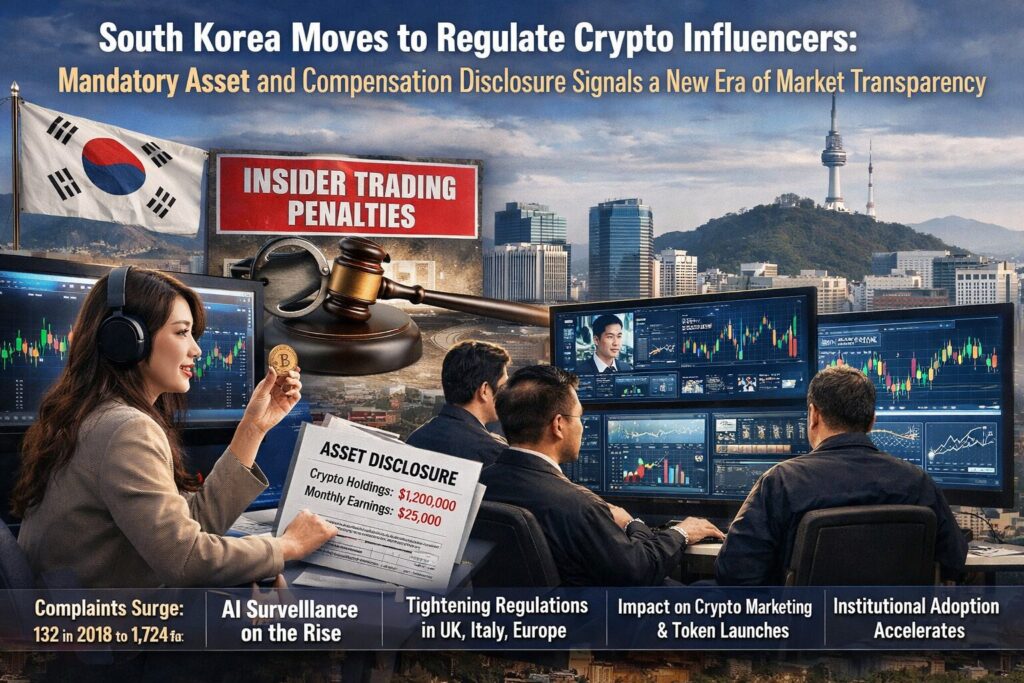
- South Korea is introducing legislation requiring crypto and financial influencers to disclose asset holdings and compensation.
- Violations may be treated similarly to market manipulation or insider trading.
- Complaints against quasi-investment advisors surged from 132 in 2018 to 1,724 in 2024.
- AI-based real-time surveillance tools are being implemented.
- The move aligns with regulatory tightening in the UK, Italy, and across Europe.
- The law could reshape crypto marketing, token launches, and influencer-based growth strategies.
- Transparency may accelerate institutional adoption and professionalize crypto advisory markets.
1. Bringing Influencer Investment Advice Under the Rule of Law
South Korea is preparing a major shift in how crypto and financial influencers operate. According to local media reports, a legislative amendment drafted by Democratic Party lawmaker Kim Seung-won would require influencers who promote cryptocurrencies or financial products to publicly disclose both their asset holdings and any compensation received for promotional activities.
The proposal amends two key statutes: the Capital Markets and Financial Investment Services Act and the Virtual Asset User Protection Act. The objective is straightforward yet transformative—investor protection and market transparency.
Under the proposed framework, individuals who repeatedly provide investment advice for the purpose of encouraging public buying or selling of financial products or crypto assets must disclose:
- The type and quantity of assets they hold.
- The compensation received for promotional activities.
- Whether the content constitutes paid promotion.
This obligation would apply across a wide range of media, including:
- Online posts
- Live streaming
- Broadcast appearances
- Publications
- Social media channels
Specific thresholds and definitions will be determined by Presidential Decree, ensuring flexibility in enforcement.
If passed, this law would create one of the most stringent influencer disclosure regimes in the crypto world.
2. Severe Penalties: Equal to Market Manipulation
Perhaps the most consequential aspect of the proposal is the penalty structure.
Violations may be treated similarly to:
- Market manipulation
- Insider trading
This means that failure to disclose holdings or compensation could lead to substantial fines and even criminal liability.
This is particularly relevant in crypto markets, where pump-and-dump schemes often rely on:
- Influencer promotion
- Retail buying pressure
- Silent liquidation by insiders
By mandating disclosure of asset positions and financial incentives, the law seeks to disrupt this cycle.
For token projects and crypto startups, this signals a new compliance burden. Paid influencer marketing campaigns would no longer be opaque growth strategies—they would be legally scrutinized financial promotions.
3. The Data Behind the Crackdown: Explosive Growth in Complaints
The legislative move is not occurring in isolation. It is a response to measurable escalation in consumer harm.
According to Korea’s Financial Supervisory Service, reports concerning quasi-investment advisors surged from 132 cases in 2018 to 1,724 in 2024.
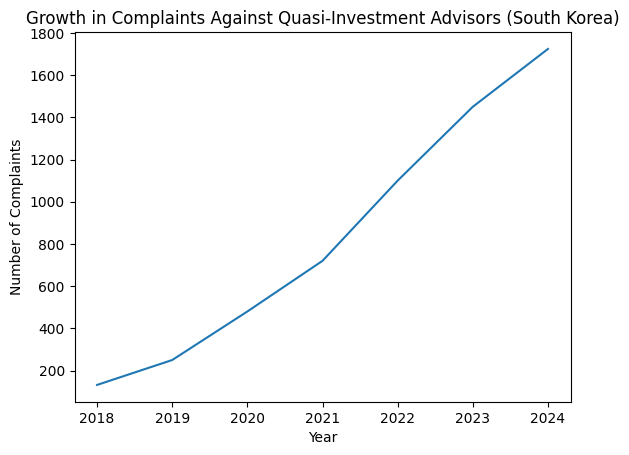
This exponential increase reflects:
- Rapid retail crypto participation
- Expansion of social media investment advice
- Limited regulatory oversight of online commentators
The numbers indicate a structural regulatory gap rather than isolated misconduct.
In response, South Korea introduced AI-based surveillance tools in 2026 capable of detecting abnormal trading patterns and market manipulation in real time. This reflects a broader digital supervision strategy combining legislative reform with algorithmic monitoring.
4. International Context: A Coordinated Global Shift
South Korea is not alone.
United Kingdom
The Financial Conduct Authority (FCA) requires prior approval for financial promotions. Influencers promoting high-risk assets must comply with strict advertising standards.
Italy
Italy’s securities regulator, guided by the European Securities and Markets Authority (ESMA), has applied advertising restrictions to influencers promoting high-risk financial instruments.
Across Europe, the Markets in Crypto-Assets (MiCA) framework has further tightened promotional transparency requirements.
South Korea’s proposed law aligns with this global trend: crypto promotion is being treated as financial activity, not entertainment.
5. Regulatory Escalation Model
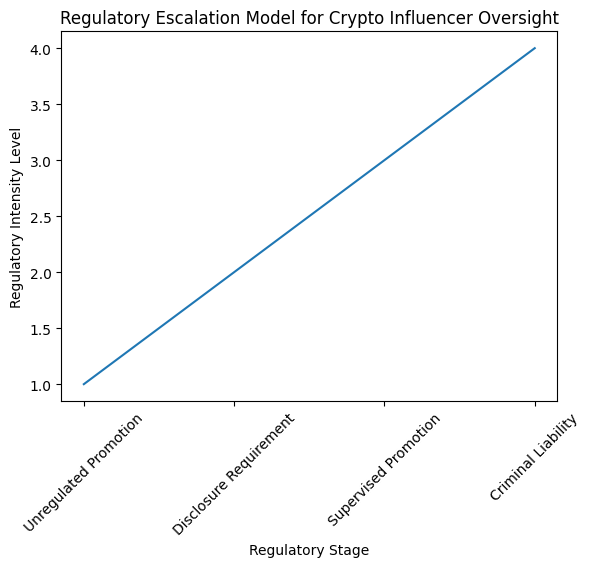
The regulatory trajectory can be understood as an escalation ladder:
- Unregulated Promotion
- Disclosure Requirement
- Supervised Promotion
- Criminal Liability
South Korea is moving from stage 1 toward stage 3–4 simultaneously.
This leapfrogging effect reflects lessons learned from earlier regulatory failures in other jurisdictions.
6. Implications for Crypto Projects and Token Launches
For readers seeking new crypto assets and revenue opportunities, the implications are profound.
A. Influencer Marketing Becomes Regulated Finance
Token projects relying on influencer-driven hype cycles must now:
- Structure contracts transparently
- Budget for compliance disclosure
- Consider cross-border regulatory exposure
B. Higher Barrier to Manipulation
While this increases compliance costs, it reduces asymmetric information risk.
Retail investors may gain confidence knowing that influencers must reveal:
- If they hold 100,000 tokens worth $500,000.
- If they received $50,000 in promotional fees.
This transparency could reduce volatility driven by undisclosed insider selling.
C. Institutional Capital Signal
Institutional investors often cite regulatory uncertainty as a barrier to crypto allocation. Stronger oversight may accelerate capital inflows by reducing reputational risk.
7. Economic Impact on the Influencer Ecosystem
The influencer economy may bifurcate into:
- Licensed, professional advisory operators.
- Informal commentators exiting the space.
Disclosure rules transform influencers into quasi-regulated actors. Over time, this could:
- Increase consolidation.
- Encourage formal licensing.
- Reduce speculative micro-cap token pumps.
8. Strategic Opportunities in a Transparent Environment
For sophisticated crypto entrepreneurs, stricter regulation is not purely restrictive—it can be strategically advantageous.
Projects that:
- Embed compliance from inception.
- Maintain transparent treasury reporting.
- Avoid opaque promotional tactics.
May gain long-term competitive advantage.
Transparency is becoming an asset class in itself.
9. AI Surveillance and the Future of Crypto Monitoring
South Korea’s AI-based monitoring tools represent a technological escalation. Real-time anomaly detection may identify:
- Wash trading.
- Coordinated price spikes.
- Cross-account manipulation.
Combined with influencer disclosure, this creates a dual defense:
- Information transparency.
- Behavioral surveillance.
This hybrid model could become a template for other Asian jurisdictions.
10. Broader Market Significance
The crypto industry has long operated in a gray zone between innovation and speculation.
South Korea’s initiative signals a maturation phase:
- Promotion becomes accountable.
- Advice becomes traceable.
- Compensation becomes transparent.
Markets may initially react with reduced hype-driven volatility. However, over time, the reduction of manipulative cycles could stabilize long-term asset growth.
Conclusion: From Speculative Hype to Structured Transparency
South Korea’s proposed crypto influencer regulation marks a pivotal transition.
By mandating disclosure of holdings and compensation—and attaching penalties equivalent to market manipulation—the country is redefining digital financial promotion as regulated conduct.
For investors, this increases clarity.
For projects, this increases compliance responsibility.
For the global crypto ecosystem, this reinforces a clear direction: transparency is no longer optional—it is foundational.
As regulatory intensity escalates globally, the next wave of successful crypto ventures may not be those that shout the loudest, but those that disclose the most.
