
Key Takeaways :
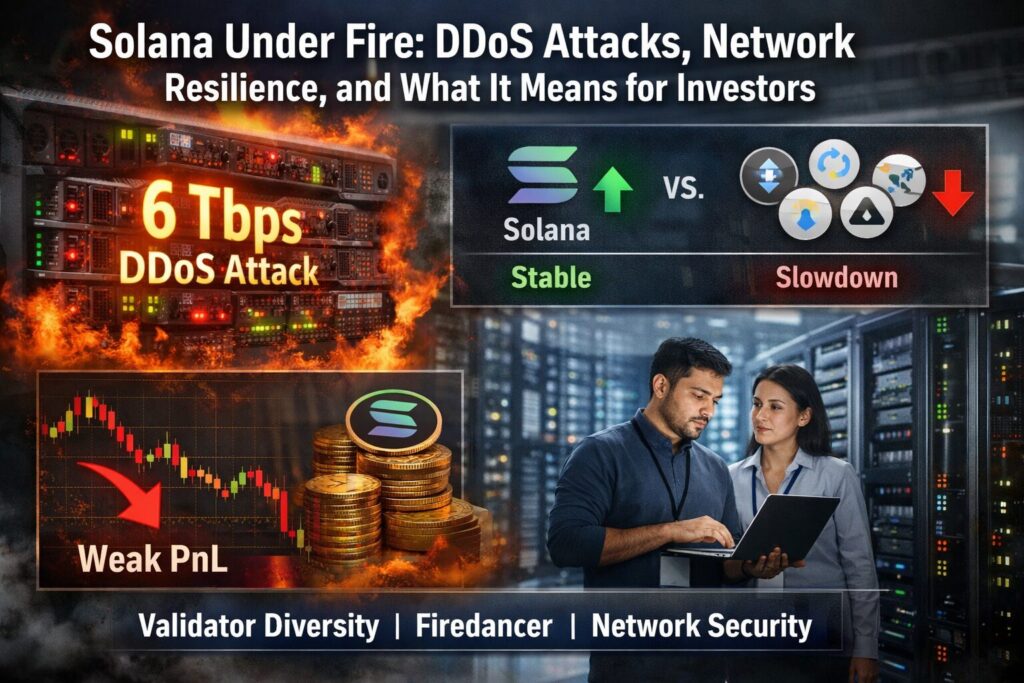
- Solana has reportedly endured sustained large-scale DDoS attacks peaking near 6 Tbps without observable disruption to block production or transaction finality.
- The incident highlights a growing divergence among high-performance blockchains in network-layer resilience, with Solana showing stability while other chains have experienced slowdowns.
- From a market perspective, SOL is currently in a weak realized PnL regime, historically associated with late-cycle drawdowns or early-stage liquidity resets.
- For builders and investors, the event reinforces the importance of validator diversity, client implementations (e.g., Firedancer), and network-level mitigation, rather than simple TPS metrics.
1. Overview: A Stress Test for High-Performance Blockchains
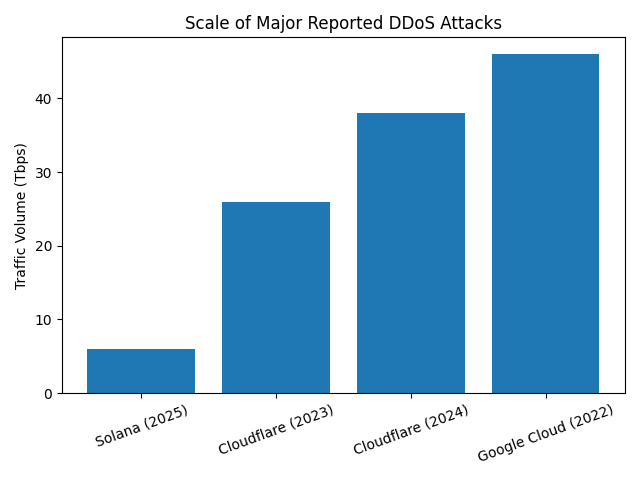
In mid-December 2025, Solana became the target of what appears to be one of the largest sustained Distributed Denial of Service (DDoS) attacks ever directed at a public blockchain network. According to reporting by SolanaFloor, the attack persisted for nearly a week, with traffic volumes peaking at close to 6 terabits per second (Tbps). To contextualize this magnitude, such throughput would be sufficient to stream roughly 240,000 concurrent 4K video feeds, an extraordinary volume by any networking standard.
Despite this, Solana’s core network metrics reportedly remained stable. Transaction confirmations continued to complete in under one second, block production showed no abnormal variance, and no chain halt or partial outage was observed. In an industry where network interruptions have historically undermined confidence, this episode has become an unplanned but highly visible stress test of Solana’s architectural choices.
[Comparative scale of major DDoS attacks (Tbps)]
2. Understanding DDoS Attacks in a Blockchain Context
A Distributed Denial of Service attack aims to overwhelm a target system by flooding it with excessive traffic from multiple sources. In traditional Web2 environments, such attacks typically incapacitate centralized servers or content delivery networks. In blockchain systems, however, the impact can manifest differently: transaction queues may grow uncontrollably, validators may fall out of consensus, block times may elongate, or in worst cases, the network may temporarily halt.
Historically, several blockchain networks have suffered from DDoS-related incidents. These have ranged from spam transaction floods designed to exploit fee models, to network-layer saturation targeting validator infrastructure. The Solana incident appears to fall into the latter category, suggesting that attackers were less focused on manipulating on-chain economics and more on testing or disrupting the network’s raw throughput capacity.
3. How Solana Withstood the Attack
Solana’s apparent resilience is not accidental. The network has spent the last two years aggressively reworking its validator client diversity, networking stack, and transaction processing pipeline. One of the most anticipated upgrades in this regard is Firedancer, a new validator client developed by Jump Crypto, designed to dramatically improve throughput and fault isolation.
While Firedancer’s full production rollout is still ongoing, its design philosophy has influenced broader improvements across the ecosystem. These include more efficient packet handling, improved QUIC-based networking, and better separation between transaction ingestion and execution layers. As a result, even when inbound traffic spikes dramatically, the core consensus process remains insulated from noise.
This contrasts with incidents on other networks. On December 15, 2025, the Sui network reportedly experienced DDoS-related block delays and performance degradation. While no permanent damage occurred, the comparison underscores how architectural differences can materially affect real-world reliability.
4. Historical Precedents: Lessons from Cardano and Others
DDoS attacks are not new to crypto. In 2024, Cardano faced a sophisticated attack that attempted to exploit transaction processing mechanics to suppress fees for large-value transfers. According to public commentary from Fluid Tokens’ CTO Raul Antonio, the attacker’s objective was not merely disruption but economic manipulation.
In that case, Cardano developers managed to identify the exploit vector, mitigate the attack, and even recover misappropriated ADA. The episode demonstrated that while DDoS attacks can be damaging, they also serve as catalysts for protocol hardening.
Solana’s recent experience fits into this broader pattern: attacks function as adversarial testing environments, revealing weaknesses and validating design assumptions under extreme conditions.
5. Market Impact: Solana’s On-Chain and Financial Signals
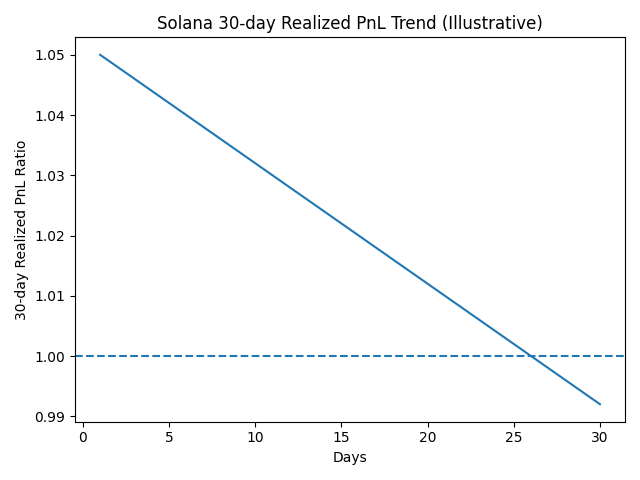
From a market standpoint, the timing of the attack is notable. Data from Glassnode indicates that Solana’s 30-day realized profit and loss ratio has remained below 1 since mid-November. This implies that, on average, market participants are realizing more losses than gains, a condition typically associated with bearish sentiment.
However, such phases have historically preceded either prolonged downturns or sharp liquidity-driven reversals. Analysts at Altcoin Vector have described the current environment as a “complete liquidity reset,” suggesting that speculative excess has been flushed out of the system.
[SOL 30-day realized PnL ratio trend]
Compounding this sentiment, Bitwise’s Solana staking ETF—launched in late October—recorded its first net outflow on December 15, with approximately $4.6 million withdrawn. While modest in absolute terms, the outflow is symbolically important, signaling caution among institutional or semi-institutional allocators.
6. Macro and Seasonal Factors
It would be misleading to attribute recent SOL price weakness solely to the DDoS incident. Broader crypto markets have softened amid declining pre-holiday trading volumes and heightened sensitivity to upcoming macroeconomic events, including central bank policy signals and geopolitical risk.
Seasonality also plays a role. Historically, liquidity tends to thin toward year-end, amplifying volatility and exaggerating price moves in both directions. In this context, Solana’s resilience at the network layer may matter more for long-term positioning than short-term price fluctuations.
7. Implications for Builders and Investors
For developers, the episode reinforces the necessity of designing applications that assume hostile network conditions. Rate limiting, transaction prioritization, and robust RPC infrastructure are no longer optional optimizations but baseline requirements.
For investors, the key takeaway is more nuanced. Network uptime during extreme stress strengthens the case for Solana as a settlement layer for high-frequency and consumer-facing applications. At the same time, weak on-chain profitability metrics and ETF outflows counsel patience rather than aggressive positioning.
In practical terms, this environment may favor strategies focused on infrastructure plays, staking yields, and application-level revenue, rather than purely directional bets on token price appreciation.
8. Conclusion: Stress Today, Signal Tomorrow
The reported 6 Tbps DDoS attack on Solana is best understood not as a crisis, but as an involuntary demonstration of network maturity. While market sentiment around SOL remains cautious, the technical performance under extreme conditions strengthens Solana’s long-term narrative as a high-throughput, resilient blockchain platform.
For those seeking new digital assets, revenue opportunities, or practical blockchain use cases, Solana’s recent experience offers a valuable reminder: resilience is often revealed not during bull markets, but under attack.
