
Main Points :
- The tokenization of real-world assets (RWA) is emerging as a foundational megatrend in global finance.
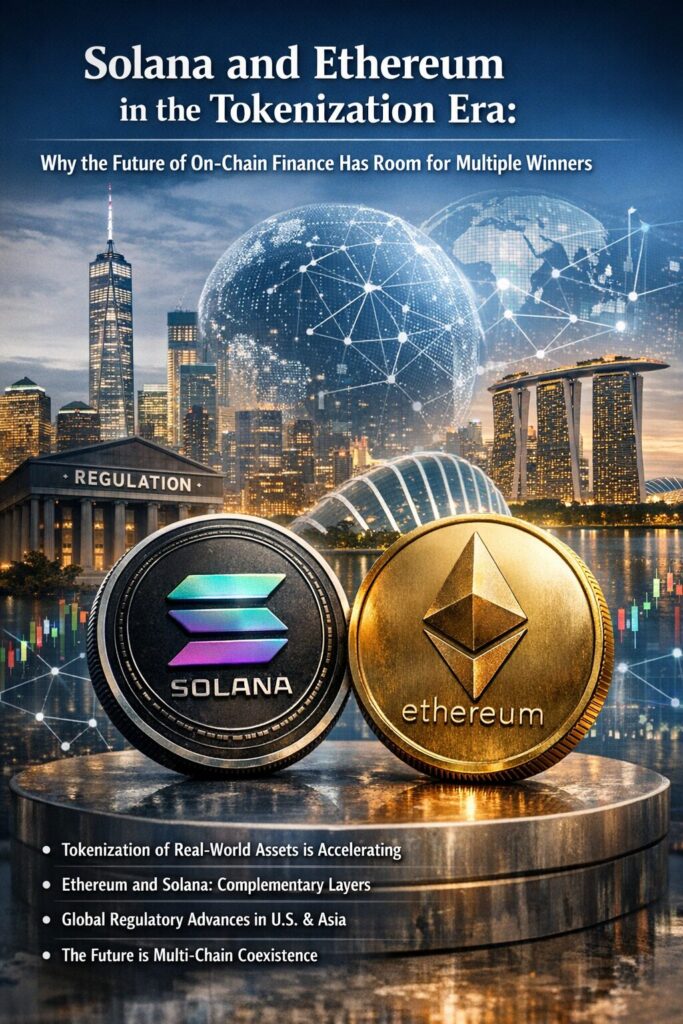
- According to leading venture capital perspectives, Solana and Ethereum are not mutually exclusive rivals but complementary infrastructure layers.
- Ethereum continues to dominate asset issuance, stablecoins, and institutional-grade settlement.
- Solana is increasingly positioned as a high-performance execution layer optimized for scale, UX, and consumer-facing applications.
- Regulatory progress in the U.S. and Asia is accelerating institutional adoption of tokenized assets.
- For investors and builders, the next growth phase will be driven by multi-chain coexistence, not single-chain dominance.
1. “SOL and ETH Will Coexist”: A VC Perspective on the Future of Tokenization
In December 2025, Dragonfly General Partner Rob Hadick articulated a view that challenges the persistent “winner-takes-all” narrative surrounding blockchain platforms. Speaking in a CNBC interview, Hadick argued that neither Ethereum nor Solana is destined to eliminate the other in the competition over asset tokenization.
Instead, he likened their relationship to early social media platforms, remarking that “both are Facebooks,” suggesting that large-scale digital economies can sustain multiple dominant platforms simultaneously. As on-chain economic activity expands and trillions of dollars’ worth of assets become tokenized, Hadick emphasized that no single blockchain can absorb all future demand.
This statement resonated strongly in an industry often defined by zero-sum debates. Rather than framing tokenization as a battle for supremacy, Hadick’s perspective positions it as an infrastructure problem—one that inherently requires parallel systems.
2. Tokenization as a Financial Megatrend
Tokenization refers to the representation of real-world assets—such as government bonds, commodities, equities, and funds—as blockchain-native tokens. This process enables near-instant settlement, fractional ownership, programmable compliance, and global accessibility.
In 2025, tokenization transitioned from a theoretical concept to an operational reality. Institutional pilots, regulatory sandboxes, and live products now demonstrate that blockchain is no longer peripheral to finance but increasingly embedded within it.
Hadick described tokenization as a structural megatrend rather than a short-term cycle. From this perspective, debates over which chain “wins” miss the more important question: how different blockchains specialize to serve different layers of the tokenized economy.
3. Functional Differentiation Between Ethereum and Solana
Ethereum: The Center of Gravity for On-Chain Assets
Ethereum remains the dominant settlement and issuance layer for tokenized assets. The majority of stablecoins, tokenized treasuries, and institutional-grade DeFi protocols continue to rely on Ethereum’s security model, tooling, and deep liquidity.
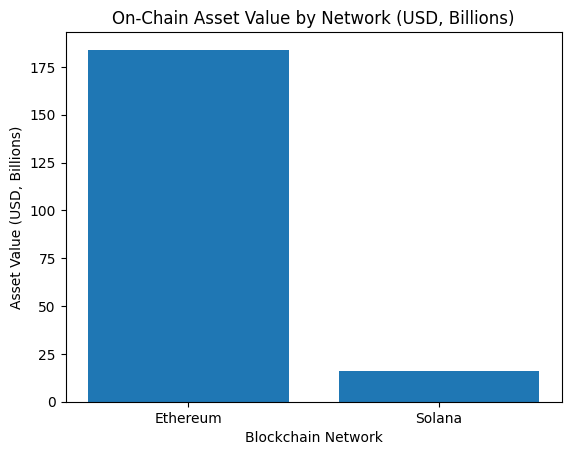
According to data from RWA-focused analytics platforms, Ethereum hosts approximately $184 billion in on-chain asset value, including stablecoins and tokenized securities. Its role increasingly resembles that of a global financial backbone—slowly evolving, conservative by design, but trusted at scale.
Solana: High-Performance Execution and UX Layer
Solana, by contrast, has carved out a reputation for high throughput, low fees, and fast finality. These attributes make it particularly suitable for applications requiring large volumes of transactions, such as payments, gaming, consumer DeFi, and real-time financial interactions.
Solana’s total network asset value stands at approximately $16 billion, significantly smaller than Ethereum’s, but its growth trajectory reflects expanding adoption in performance-sensitive use cases.📊 Insert Figure 1 here
“On-Chain Asset Value by Network (USD)”
(Bar chart comparing Ethereum ~$184B vs Solana ~$16B)
4. Why a Single-Chain Future Is Unrealistic
From a venture capital standpoint, Hadick stressed that expecting one blockchain to scale infinitely across all use cases is neither technically nor economically realistic. Different applications impose different constraints: security, latency, compliance, cost, and composability all trade off against each other.
As a result, multiple blockchains are likely to coexist, each optimized for specific roles. In this model:
- Ethereum anchors high-value, institutionally sensitive assets.
- Solana supports high-frequency, consumer-facing activity.
- Emerging chains may target niche or next-generation requirements.
Hadick also pointed to newer projects such as Monad as examples of how innovation continues beyond today’s incumbents.
5. Investment Strategy: Looking Beyond Price Cycles
Hadick revealed that Dragonfly’s investment strategy spans not only major tokens like Bitcoin, Ethereum, and Solana, but also DeFi infrastructure, stablecoin issuers, and ecosystem tooling companies.
While acknowledging that market conditions in 2025 remain challenging, he cautioned against overemphasizing single-year price performance. Instead, he suggested that structural adoption curves—particularly in tokenization—point toward improved conditions in 2026 and beyond.
For investors seeking new income sources or emerging digital assets, this implies that infrastructure positioning may matter more than short-term volatility.
6. UX-Driven Chain Migration: The Sorare Case
Industry behavior increasingly reflects this multi-chain logic. In October 2025, the NFT-based fantasy sports platform Sorare announced its decision to migrate from Ethereum to Solana after six years.
The rationale was not ideological but practical: improved scalability, lower transaction costs, and better user experience. Sorare’s CEO described the move as an “upgrade,” while explicitly reaffirming confidence in Ethereum.
This example illustrates a broader trend: applications choosing chains based on fitness for purpose, not tribal loyalty.
7. RWA Tokenization: A Market Reaching Critical Mass
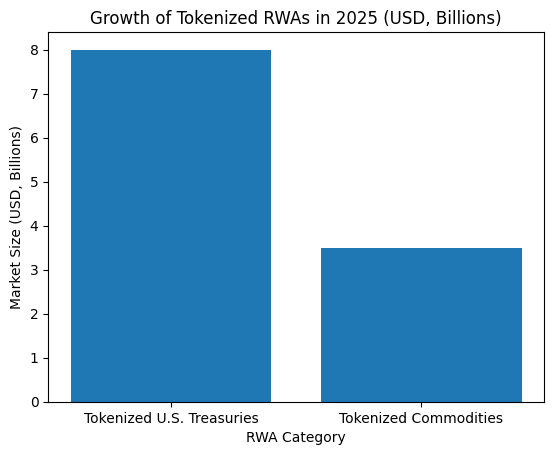
Real-world asset tokenization has gained significant momentum in 2025. According to Chainalysis, tokenized U.S. Treasury-backed money market funds surpassed $8 billion in assets under management by December.
Tokenized commodities, including gold, exceeded $3.5 billion. While still small compared to traditional markets, the growth rate signals accelerating institutional acceptance.📊 Insert Figure 2 here
“Growth of Tokenized RWAs in 2025 (USD)”
(Line graph showing expansion of tokenized treasuries and commodities)
8. Regulatory Tailwinds in the U.S. and Asia
Regulators are increasingly shaping the tokenization landscape. In December, the SEC issued a no-action letter permitting limited tokenization experiments involving the Depository Trust & Clearing Corporation (DTCC).
Meanwhile, the Monetary Authority of Singapore published an operational framework following its “Project Guardian” trials, providing clarity for financial institutions managing tokenized assets.
These developments suggest that tokenization will integrate with existing financial infrastructure rather than replace it—and that no single blockchain will monopolize regulated finance.
9. The Coexistence Thesis: Multiple Winners in a Tokenized World
As regulatory clarity improves and asset tokenization scales, the blockchain ecosystem is evolving toward functional specialization. Rather than competing head-on, Ethereum, Solana, and emerging networks are positioning themselves as complementary layers within a shared financial stack.
For builders, this means designing systems that are chain-aware and interoperable. For investors, it suggests diversification across ecosystems aligned with distinct economic roles.
The tokenization debate, therefore, is no longer about which chain survives, but about how value flows across multiple chains.
Conclusion: From Rivalry to Infrastructure Pluralism
The idea that Solana and Ethereum can both “win” is not a compromise—it is a recognition of economic reality. As the world’s assets migrate on-chain, demand will exceed the capacity of any single system.
In this environment, success will belong not to the loudest maximalist narrative, but to platforms that integrate seamlessly into a multi-chain, regulated, and user-centric financial future.
For those seeking the next generation of digital assets, revenue models, and blockchain applications, understanding this coexistence is no longer optional—it is essential.
