

Main Points :
- Bitcoin’s market structure is showing clear signs of stabilization following the deleveraging cycle triggered in late 2025.
- Cascading liquidation risks have declined significantly as excessive leverage has been flushed out of derivatives markets.
- Institutional investors are increasingly shaping price behavior through disciplined capital allocation and risk-managed strategies.
- Options markets are overtaking perpetual futures as the dominant derivatives instrument, signaling a defensive shift.
- On-chain data points to redistribution by long-term holders rather than panic-driven capitulation.
- Macro factors such as U.S. monetary policy, global liquidity, inflation trends, and geopolitical risks remain decisive.
- Bitcoin is increasingly perceived as a macro-responsive, portfolio-diversifying asset rather than a purely speculative instrument.
1. Deleveraging as the Foundation of a More Resilient Bitcoin Market
In late January 2026, institutional research teams from Coinbase and on-chain analytics firm Glassnode jointly released their report “Charting Crypto: 1Q 2026.” The report presents a notable shift in tone compared with prior cycles, emphasizing structural resilience rather than speculative momentum.
According to the report, Bitcoin’s market has undergone a substantial deleveraging process since the sharp correction in October 2025. Excessive leverage—long a defining feature of crypto bull markets—was systematically unwound across futures and perpetual swap markets. As a result, the probability of cascading liquidations, which previously amplified downside volatility, has materially declined.
This transition marks a departure from a leverage-dependent, reflexive market structure toward one that prioritizes sustainability. Bitcoin is increasingly behaving like a macro-sensitive asset whose valuation reflects broader economic forces rather than short-term speculative flows alone.
2. Post-2025 Crash: How Bitcoin Built Resistance to Cascading Liquidations
The October 2025 drawdown, which saw Bitcoin fall from its all-time high of approximately $126,000 to significantly lower levels, served as a stress test for the market. During the fourth quarter of 2025, leveraged positions were aggressively liquidated, particularly among retail-driven perpetual futures traders.
While painful in the short term, this reset strengthened the market’s structural integrity. With fewer overextended positions remaining, Bitcoin’s sensitivity to sudden price shocks has diminished. The Coinbase–Glassnode report highlights that the market now absorbs macro or idiosyncratic shocks with less forced selling than in previous cycles.
This development suggests that Bitcoin is evolving beyond a purely momentum-driven asset and beginning to function more like a long-duration macro hedge, evaluated on medium- to long-term fundamentals.
3. Institutional Investors and the Rise of Market Discipline
One of the most important shifts identified in the report is the growing dominance of institutional participants. Unlike retail traders, institutional investors typically prioritize risk-adjusted returns, capital preservation, and portfolio-level correlations.
This change has introduced a new form of discipline into Bitcoin price discovery. Rather than chasing rapid upside, institutional capital tends to enter the market incrementally, hedge downside risks, and rebalance exposure based on macro indicators such as interest rates, liquidity conditions, and currency debasement trends.
The report characterizes the current phase as one where “sustainability is valued over speed.” This stands in contrast to prior cycles, where speculative leverage often overwhelmed fundamentals and led to sharp boom-bust dynamics.
4. A Structural Shift in Derivatives: Options Over Perpetual Futures
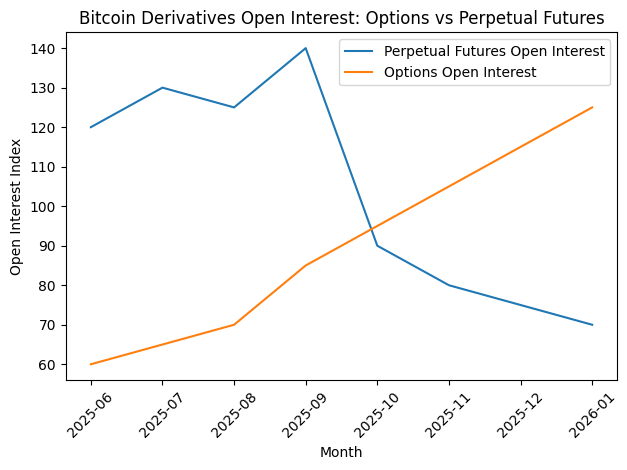
Another critical finding is the changing composition of Bitcoin derivatives markets. For the first time in this cycle, open interest in Bitcoin options has surpassed that of perpetual futures.
This shift reflects a growing preference for defined-risk strategies. Rather than using high-leverage perpetual contracts, market participants are increasingly employing options to hedge downside exposure, manage volatility, and express directional views with limited risk.
This transition has contributed directly to reduced market volatility. Options-based positioning dampens forced liquidations and smooths price movements, reinforcing the broader trend toward stability.
[“Bitcoin Derivatives Open Interest – Options vs Perpetual Futures”]
5. On-Chain Signals: Redistribution, Not Capitulation
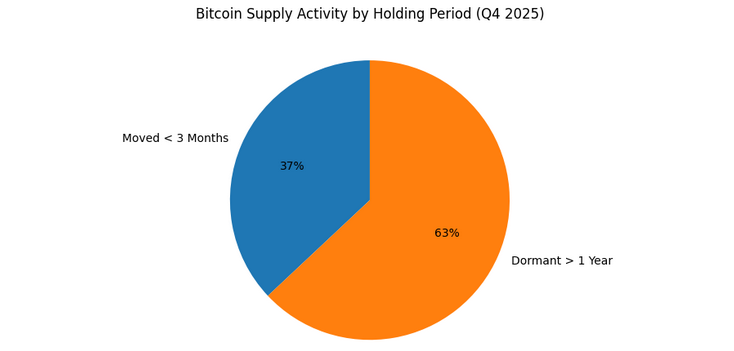
On-chain data further supports the thesis of structural stabilization. During Q4 2025, approximately 37% of Bitcoin’s circulating supply moved at least once within a three-month period. At the same time, the proportion of coins that had remained dormant for over one year declined.
Rather than indicating panic selling, this pattern suggests redistribution. Long-term holders appear to be rebalancing portfolios—taking partial profits, reallocating capital, or repositioning exposure—while remaining engaged with the market.
This behavior contrasts sharply with prior bear-market phases, where long-term holders tended to capitulate en masse. The current pattern implies a more mature investor base with strategic intent rather than emotional reaction.
[“Bitcoin Supply Activity by Holding Period”]
6. Investor Psychology: Caution Without Collapse
The Net Unrealized Profit/Loss (NUPL) metric shows that since October 2025, investor sentiment has shifted from optimism to anxiety. Importantly, however, this anxiety has not translated into widespread capitulation.
The report emphasizes that caution now dominates market psychology. Investors remain alert to downside risks but are not exiting positions en masse. This balance between caution and conviction is consistent with a market that has internalized risk rather than ignored it.
7. Macro Forces: Monetary Policy and Geopolitics Still Matter
Despite improvements in internal market structure, Bitcoin remains highly sensitive to external macro forces. Expectations of interest rate cuts by the Federal Reserve have supported risk assets, including Bitcoin, by easing financial conditions and weakening the U.S. dollar.
At the same time, risks persist. A resurgence of inflation, renewed monetary tightening, or escalating geopolitical tensions could undermine market stability. Bitcoin’s role as “digital gold” is being tested in parallel with traditional safe-haven assets such as gold and silver, which have also seen strong inflows.
At the time of writing, Bitcoin is trading around $89,000, down roughly 30% from its peak but firmly range-bound between $85,000 and $95,000. Institutional surveys cited by Coinbase indicate that many professional investors view current levels as undervalued and are prepared to accumulate further on weakness.
8. Implications for Investors Seeking New Assets and Practical Blockchain Use
For investors searching for new digital assets or sustainable revenue opportunities, these developments are significant. Bitcoin’s maturing market structure reduces tail risks and improves its suitability as a core portfolio component.
For builders and enterprises exploring practical blockchain applications, stability at the base layer is essential. A less volatile Bitcoin market supports the development of payment systems, treasury strategies, collateral frameworks, and cross-border settlement solutions built on or around BTC.
Conclusion: Bitcoin’s Transition Into a Mature Macro Asset
The Coinbase and Glassnode analysis suggests that Bitcoin is entering a new phase of its lifecycle. Deleveraging, institutional discipline, and evolving derivatives usage have collectively reduced systemic risks and enhanced market resilience.
While volatility and uncertainty will never disappear entirely, Bitcoin’s role is shifting—from a speculative instrument prone to violent swings to a macro-responsive, strategically allocated asset. For investors and practitioners alike, this transition opens the door to more sustainable participation in the digital asset economy.
