
Main Points :
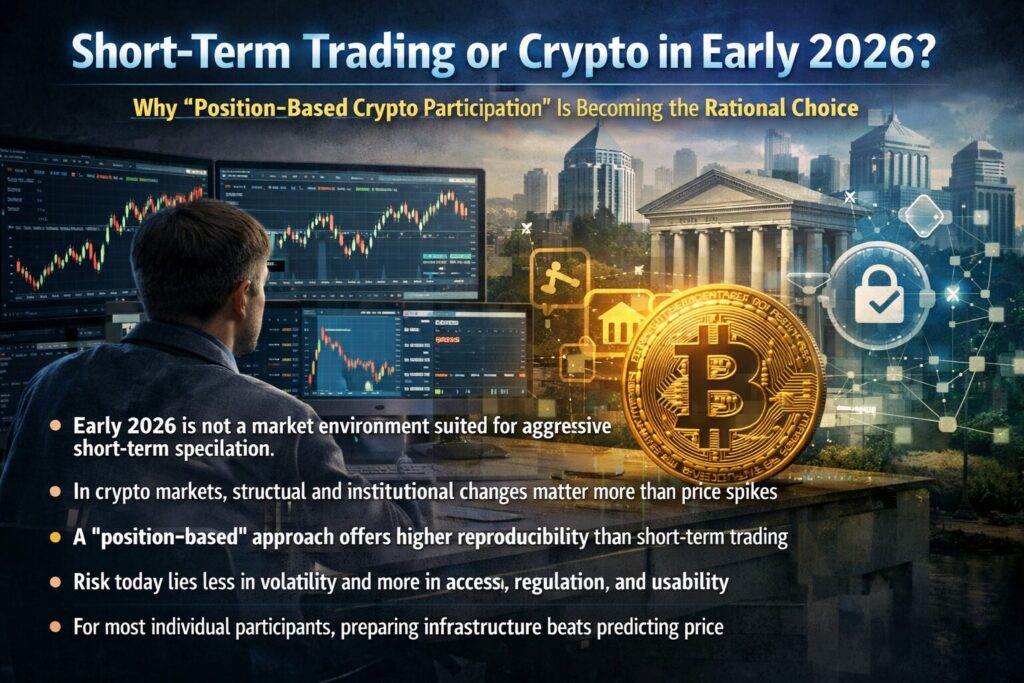
- Early 2026 is not a market environment suited for aggressive short-term speculation
- In crypto markets, structural and institutional changes matter more than price spikes
- A “position-based” approach to crypto participation offers higher reproducibility than short-term trading
- Risk today lies less in volatility and more in access, regulation, and usability
- For most individual participants, preparing infrastructure beats predicting price
Introduction: A Question Many Investors Are Asking in 2026
As we enter early 2026, many investors and market participants face a familiar but increasingly complex question:
Should we focus on short-term trading, or is cryptocurrency the better option right now?
At first glance, the question appears to be about asset choice. In reality, it is about market structure, reproducibility, and risk design.
Short-term trading has not disappeared. Opportunities still exist. However, the broader macro and informational environment has shifted in a way that makes “hitting the right direction” far more difficult than in past cycles.
At the same time, the cryptocurrency market is undergoing quiet but fundamental transformations—changes that do not immediately drive prices higher, but gradually reshape how crypto is used, regulated, and integrated into real economic activity.
This article argues that crypto, approached through a position-based participation strategy, is currently the more rational choice for most individuals seeking new assets, revenue opportunities, or practical blockchain use cases.
1. Why This Is No Longer a “Directional Bet” Market
1.1 Macro Conditions Limit Trend Continuation
In early 2026, global financial conditions remain relatively tight. Short-term interest rates, including U.S. Treasury Bills, hover around the 3% range, providing investors with a meaningful risk-free alternative.
In such an environment, markets struggle to sustain long, one-directional trends. Positive news does not automatically lead to persistent rallies, and negative news rarely produces prolonged sell-offs.
For short-term traders, this translates into:
- Faster headline pricing
- Frequent reversals
- Reduced follow-through after breakouts
As a result, short-term strategies require exceptional execution precision, strict stop-loss discipline, and careful position sizing. Reproducibility—the ability to repeat results consistently—has declined.
1.2 The Changing Nature of Market News
Another important shift lies in the quality of news driving markets.
In previous cycles, short-term traders benefited from:
- Clear regulatory announcements
- Binary outcomes (approval vs rejection)
- Sudden liquidity injections
Today’s crypto-related news increasingly focuses on:
- Where crypto can legally be used
- Which institutions are allowed to custody or settle assets
- How stablecoins integrate into payment systems
- Which chains and networks are supported by infrastructure providers
These developments are structural, not explosive. They rarely move prices overnight, but they significantly influence market durability over time.
2. The Real Difficulty of Short-Term Trading in This Phase
Short-term trading is not impossible in 2026—but its difficulty has objectively increased.
Key Challenges Include:
- Rapid information absorption: Headlines are priced in almost instantly
- Low trend persistence: Profitable moves often stall prematurely
- Algorithmic dominance: Automated strategies exploit micro-inefficiencies faster than humans
For individual traders, this means that short-term trading should be treated as:
- Capital-limited
- Frequency-controlled
- Experiment-driven rather than expectation-driven
In practical terms, short-term trading today resembles skill-intensive execution work, not a broadly accessible opportunity.
3. Why Crypto Is Moving on Structure, Not Price
3.1 Participant Diversification Is Changing the Market
One of the most important shifts in crypto markets is who participates.
Beyond speculative traders, we now see:
- Corporations holding Bitcoin as treasury assets
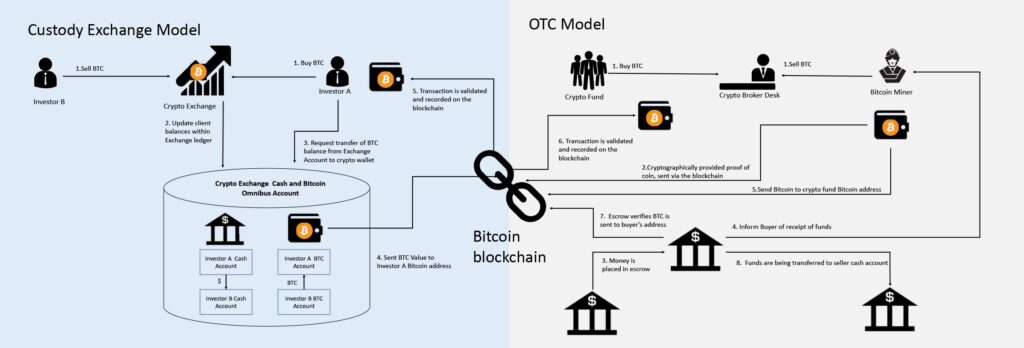
- Custodians, settlement providers, and payment processors entering the ecosystem
- Regulated entities participating under strict compliance frameworks
These participants are not seeking quick exits. Their capital is structurally sticky.
While such participation does not cause sudden price surges, it changes downside dynamics, improves liquidity resilience, and increases long-term survivability of the market.
[“Evolution of Crypto Market Participants (Speculators → Institutions → Infrastructure)”]
3.2 When Usability Becomes the Real Risk
Another underappreciated shift is that risk increasingly lies in access, not volatility.
Recent years have seen clearer restrictions related to:
- Jurisdiction-based trading limitations
- Supported blockchains and networks
- App distribution and update availability
- Fiat on-ramps and off-ramps
In many cases, the inability to trade, withdraw, or convert becomes more damaging than price movement itself.
This reality pushes rational participants to ask not:
“Will this asset go up?”
but rather:
“Can I reliably use, move, and settle this asset under real-world constraints?”
4. What “Position-Based Crypto Participation” Actually Means
A position-based approach to crypto does not rely on predicting price direction.
Instead, it focuses on:
- Small, diversified allocations
- Continuous monitoring of regulatory and infrastructure changes
- Verifying exchange access, custody, and settlement paths
- Gradually increasing exposure as usability improves
This strategy treats crypto as a developing financial layer, not a lottery ticket.
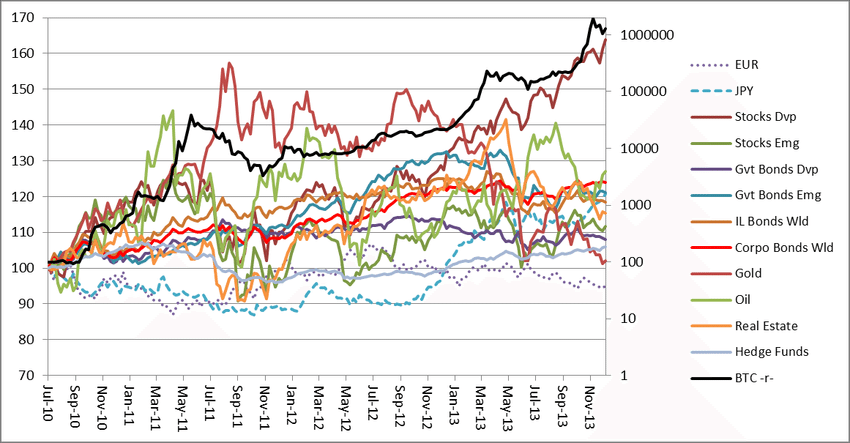
[“Price-Based vs Position-Based Crypto Participation Model”]
5. Practical Guidance for Reproducibility
Short-Term Trading
- Reduce position size
- Prioritize execution testing
- Accept lower trade frequency
Crypto Participation
- Allocate modest capital
- Diversify across assets and access routes
- Track regulatory and operational developments
- Separate “speculative capital” from “time-advantaged capital”
The most important principle is capital role separation—knowing which funds are meant to perform quickly and which benefit from structural time.
Conclusion: Which Is the Rational Choice Right Now?
In early 2026, the rational choice for most individuals is crypto participation through a position-based framework, not aggressive short-term trading.
Short-term trading has become:
- More competitive
- Less forgiving
- Harder to reproduce consistently
Crypto, by contrast, is experiencing:
- Institutional normalization
- Infrastructure maturation
- Regulatory clarification
- Expanding real-world use cases
This is not a phase for “hitting the jackpot.”
It is a phase for preparing positions as financial architecture evolves.
For those seeking new assets, future income sources, or practical blockchain exposure, not betting on price—but aligning with structure—offers the highest long-term rationality.
