
Main Points :
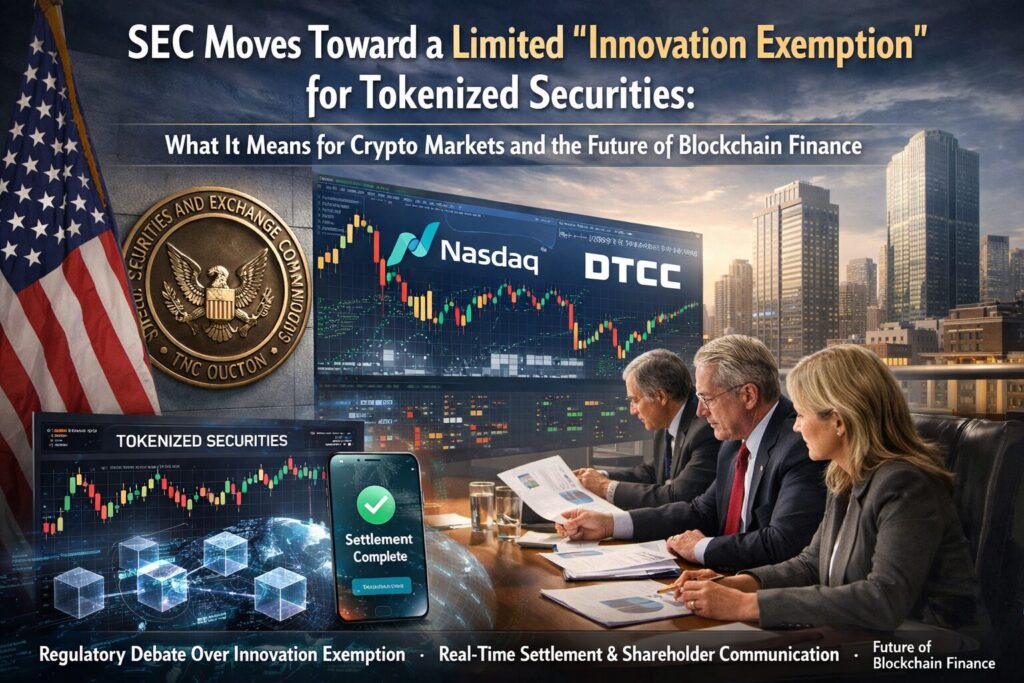
- The U.S. Securities and Exchange Commission (SEC) is preparing a limited “innovation exemption” to allow experimental trading of certain tokenized securities.
- The SEC Investor Advisory Committee (IAC) opposed a blanket exemption and instead recommended gradual rule-by-rule reform.
- Regulators recognize the benefits of tokenized securities such as atomic settlement and real-time shareholder communication, but remain cautious about investor protection.
- Traditional financial institutions such as Nasdaq, DTCC, and major exchanges are already experimenting with tokenized equities.
- The outcome of this exemption could significantly influence the next phase of blockchain-based capital markets and tokenized assets.
The SEC’s New Approach to Tokenized Securities
The global financial system is entering a transformative period as blockchain technology continues to challenge traditional market infrastructure. Among the most promising developments is the emergence of tokenized securities, which represent traditional financial assets such as stocks, bonds, or funds as digital tokens on blockchain networks.
On March 12, 2026, U.S. Securities and Exchange Commission (SEC) Commissioner Hester Peirce revealed that SEC staff are currently working on an “innovation exemption” framework that would allow limited trading of certain tokenized securities. The announcement was made during a meeting of the SEC’s Investor Advisory Committee (IAC).
However, the proposal is expected to be much narrower in scope than what some market participants had hoped for. Instead of introducing a sweeping regulatory exemption for tokenized assets, regulators are considering a carefully controlled experimental environment where blockchain-based securities trading models can be tested.
SEC Chairman Paul Atkins also stated during the meeting that the agency plans to formally consider the innovation exemption in the near future, indicating growing regulatory interest in accommodating blockchain innovation while maintaining investor protections.
This development signals a shift in how regulators approach digital assets—not simply through enforcement, but through structured experimentation within existing financial frameworks.
Why the SEC Rejected a Blanket Exemption
Earlier in February 2026, the SEC’s Investor Advisory Committee sent a letter recommending that regulators reject a “blanket exemption” for tokenized securities.
The committee’s Market Structure Subcommittee warned that granting broad exemptions from existing securities rules could undermine several core principles of investor protection.
These concerns include:
- Clear disclosure of ownership
- Supervision of market intermediaries
- Protection of order execution and market fairness
According to the committee, tokenized securities still operate within the broader capital markets ecosystem. Removing regulatory safeguards entirely could lead to market fragmentation, reduced transparency, and increased systemic risk.
Instead, the committee proposed a rule-by-rule reform process, allowing regulators to gradually adapt existing laws while gathering public feedback.
This cautious strategy reflects a broader regulatory philosophy: innovation should be encouraged, but not at the expense of investor protection or financial stability.
The Potential Benefits of Tokenized Securities
Despite their regulatory caution, both the SEC and the Investor Advisory Committee acknowledge that tokenized securities could deliver significant improvements to financial markets.
One of the most important innovations is atomic settlement.
Atomic Settlement
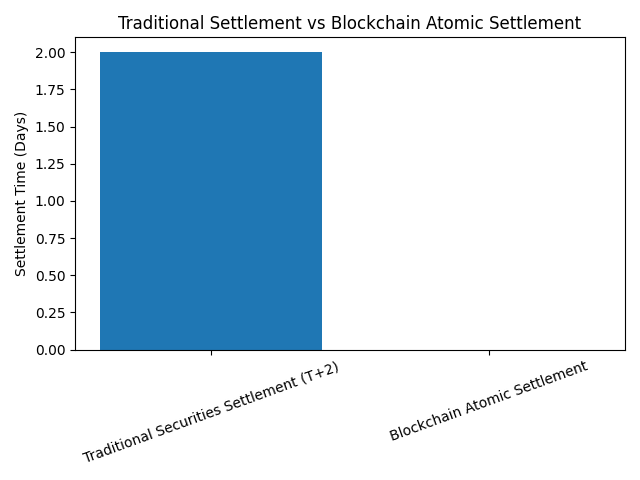
Traditional securities settlement typically occurs on a T+2 basis, meaning trades are finalized two business days after execution.
Blockchain systems can enable instant settlement, reducing counterparty risk and eliminating settlement delays.
“Traditional Settlement vs Blockchain Atomic Settlement”
Atomic settlement could dramatically reduce operational costs for exchanges, clearing houses, and custodians.
Real-Time Shareholder Communication
Another benefit is direct communication between companies and shareholders.
Tokenized securities could allow issuers to distribute information instantly to investors via blockchain networks. This would help eliminate information asymmetry between institutional investors and retail traders.
Corporate actions such as:
- Dividend payments
- Shareholder voting
- Earnings announcements
could all be handled through smart contracts.
Reduced Intermediaries
Tokenized securities also introduce the possibility of disintermediation, where many traditional financial intermediaries become unnecessary.
In traditional capital markets, transactions often require:
- Brokers
- Clearinghouses
- Custodians
- Settlement agents
Blockchain infrastructure could reduce these layers significantly.
However, regulators remain cautious about fully removing intermediaries, as they play an important role in market oversight and investor protection.
Industry Momentum Behind Tokenized Finance
Even without a full regulatory framework, the financial industry has already begun experimenting with tokenized securities.
Several major institutions are actively developing blockchain-based market infrastructure.
Nasdaq and Kraken Tokenized Equity Initiative
Nasdaq and the cryptocurrency exchange Kraken recently announced a partnership to build a tokenized equities trading platform.
The goal is to allow stocks to be represented as blockchain tokens that can be traded more efficiently and potentially 24 hours a day.
If successful, this model could blur the boundaries between traditional stock markets and cryptocurrency exchanges.
Canton Network and Tokenized Government Bonds
Another major development involves the Canton Network, which recently conducted a tokenized repo transaction using tokenized UK government bonds.
Participants included:
- Major financial institutions
- London Stock Exchange Group
- Global banking partners
The transaction demonstrated that blockchain-based collateral management could significantly improve liquidity in government bond markets.
“Growth of Tokenized Real-World Assets (RWA)”
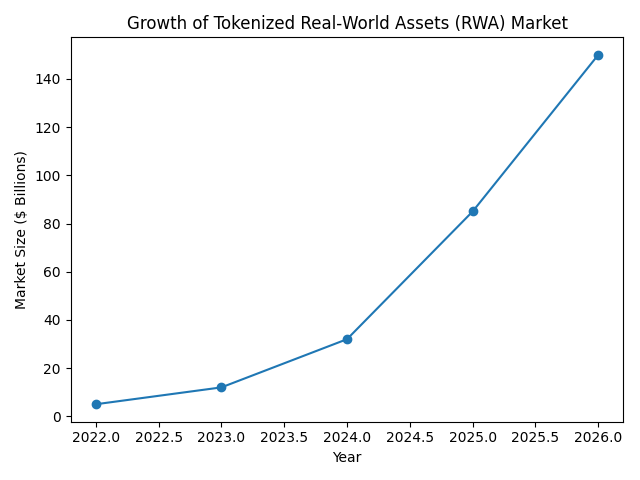
Industry analysts estimate that tokenized real-world assets could eventually grow into a $10 trillion market.
The Role of the SEC Crypto Task Force
The SEC has also established a crypto task force aimed at accelerating the development of digital asset regulation.
This task force is responsible for evaluating:
- Crypto custody rules
- Token classification
- Market structure reforms
- Blockchain-based securities trading
The proposed innovation exemption for tokenized securities is likely part of this broader initiative.
By allowing controlled experimentation, regulators hope to observe how blockchain trading systems behave under real market conditions.
This approach could lead to more informed policy decisions in the future.
Why This Matters for Crypto Investors and Builders
For entrepreneurs and investors searching for the next wave of blockchain opportunity, tokenized securities may represent one of the most important emerging sectors.
The tokenization trend could unlock several new opportunities:
1. Tokenized Stocks
Companies could issue shares directly on blockchain networks.
This would enable:
- Fractional ownership
- Global trading access
- 24/7 markets
2. Tokenized Bonds and Treasury Products
Government bonds and corporate debt could be tokenized to create programmable financial instruments.
Smart contracts could automate:
- Coupon payments
- collateral management
- repo transactions
3. Tokenized Private Markets
Private equity and venture capital assets could become more liquid through tokenization.
Currently, private investments are often locked up for years.
Blockchain-based tokenization could allow secondary trading of these assets.
The Regulatory Balancing Act
Regulators face a difficult balancing act.
On one hand, blockchain technology could modernize financial markets and reduce operational inefficiencies.
On the other hand, the collapse of several crypto platforms in previous years has made regulators wary of introducing excessive flexibility too quickly.
Commissioner Hester Peirce emphasized this tension during the meeting.
While she has long been seen as a pro-crypto voice within the SEC, she stressed that innovation must still operate within frameworks that protect investors.
The innovation exemption therefore represents a middle path.
Rather than fully deregulating tokenized securities, regulators want to allow experimentation while maintaining oversight.
The Global Race to Tokenize Capital Markets
The United States is not the only country exploring tokenized securities.
Several jurisdictions are moving aggressively in this direction.
Europe
The European Union has introduced DLT Pilot Regime regulations, allowing blockchain-based trading venues to experiment with tokenized financial instruments.
Singapore
Singapore’s Monetary Authority has been conducting Project Guardian, exploring tokenized bonds and cross-border settlement using blockchain.
Hong Kong
Hong Kong has issued tokenized green bonds and is developing regulatory frameworks for digital asset trading platforms.
Conclusion
The SEC’s exploration of a limited innovation exemption for tokenized securities marks a significant moment in the evolution of blockchain finance.
While regulators have rejected the idea of a sweeping exemption from securities laws, they are increasingly willing to allow controlled experimentation with blockchain-based trading models.
This cautious approach reflects the growing recognition that tokenization could transform capital markets by enabling:
- faster settlement
- greater transparency
- reduced intermediaries
- global investor access
At the same time, regulators remain focused on ensuring that these innovations do not undermine the fundamental principles of investor protection.
For blockchain entrepreneurs, investors, and developers, the coming years could determine whether tokenized securities become a niche experiment—or the foundation of a new global financial infrastructure.
