

Main Points :
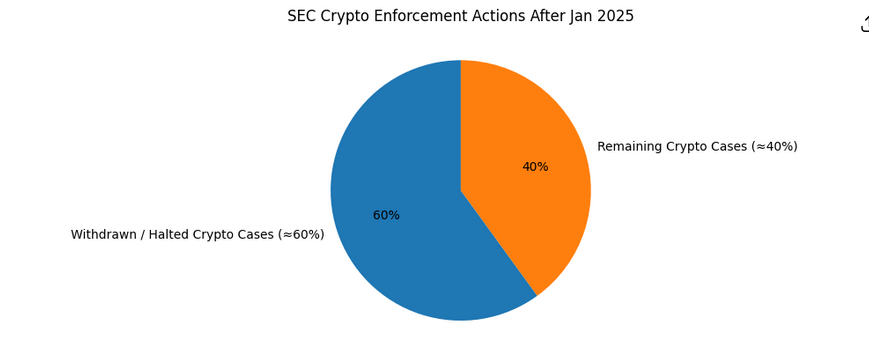
- Since January, the U.S. Securities and Exchange Commission (SEC) has reportedly withdrawn, paused, or dismissed nearly 60% of its crypto-related enforcement actions, a rate far higher than in other securities domains.
- The policy shift is unfolding alongside the Trump administration’s broader deregulatory posture and increasing political engagement with digital asset markets.
- High-profile cases involving firms such as Ripple Labs and Binance illustrate the magnitude of this enforcement rollback.
- Critics warn that regulatory relaxation may increase systemic risk, while proponents argue that prior enforcement was excessively punitive and legally incoherent.
- For investors and builders, this environment presents short-term opportunity but also medium- to long-term regulatory uncertainty.
1. A Sharp Shift in SEC Enforcement Priorities
According to reporting by The New York Times, the SEC has dramatically altered its approach to cryptocurrency enforcement since President Donald Trump returned to office in January. Roughly 60% of investigations and lawsuits involving crypto companies or projects have been halted, withdrawn, or dismissed, a stark contrast to enforcement trends in other securities-related sectors.
This retrenchment is notable not only for its scale but also for its selectivity. While the SEC continues to pursue cases in traditional financial markets, crypto-related actions appear disproportionately affected. High-profile lawsuits—such as those against Ripple Labs and Binance—have either slowed or been deprioritized, signaling a broader strategic recalibration.
The SEC has publicly denied that political considerations are influencing these decisions, asserting that each withdrawal is based on legal and policy grounds. Importantly, The New York Times also reported that it found no direct evidence of President Trump personally pressuring the SEC to abandon specific investigations.
2. Context: From Aggressive Crackdowns to Regulatory Retrenchment
To understand the significance of this shift, it is essential to recall the regulatory climate of the previous four years. Under earlier leadership, the SEC adopted an enforcement-first approach toward digital assets, frequently asserting that most tokens constituted unregistered securities. This strategy resulted in a wave of lawsuits, settlements, and compliance uncertainty across the industry.
Critics—including industry researchers and legal scholars—argued that this posture lacked clear statutory grounding and relied excessively on regulation by enforcement rather than rulemaking. Alex Thorn, Head of Firmwide Research at Galaxy Digital, characterized the earlier regime as “extremely unreasonable,” suggesting that the current pivot should be seen less as favoritism and more as a correction of regulatory overreach.
3. Political Economy: Trump-Linked Crypto Ventures and Perception Risks
Complicating the narrative is the Trump family’s expanding footprint in the digital asset space. Since early 2025, Trump-affiliated entities have launched or participated in several crypto-related initiatives, including:
- World Liberty Financial, a digital-asset-focused financial venture
- The “Official Trump (TRUMP)” meme coin, which rapidly attracted speculative interest
- American Bitcoin, a Bitcoin mining operation reportedly backed by the president’s sons
Although the SEC insists that enforcement decisions are insulated from political considerations, the coexistence of deregulatory actions and personal crypto involvement raises inevitable perception risks. Even absent explicit interference, market participants must contend with heightened scrutiny from international regulators and institutional investors concerned about governance standards.
4. Internal SEC Dynamics: The Departure of Democratic Commissioners
The regulatory shift is also occurring amid internal changes at the SEC. While Chairman Paul Atkins is expected to remain in his role for several more years, the commission is poised to lose its last remaining Democratic commissioner.
Caroline Crenshaw, whose term officially expired in 2024 but who continued serving under an extension, is expected to step down in January. She has been one of the most vocal critics of the SEC’s softer stance on digital assets, warning publicly that excessive deregulation could trigger cascading market disruptions.
Her departure would leave the SEC with a more ideologically uniform leadership, potentially accelerating the current policy trajectory.
5. Market Implications: Opportunity vs. Structural Risk

For Investors
In the short term, reduced enforcement pressure has buoyed market sentiment. Tokens previously considered legally risky have seen renewed interest, and venture capital activity has begun to recover from multi-year lows.
However, investors must recognize that enforcement retrenchment does not equal legal clarity. The absence of lawsuits does not constitute formal regulatory approval, and future administrations could reverse course abruptly.
For Builders and Operators
For startups and infrastructure providers, the current environment offers breathing room to innovate, particularly in areas such as:
- Tokenized real-world assets
- Stablecoin-based payment rails
- Bitcoin mining and energy integration
- Compliance-oriented middleware and analytics
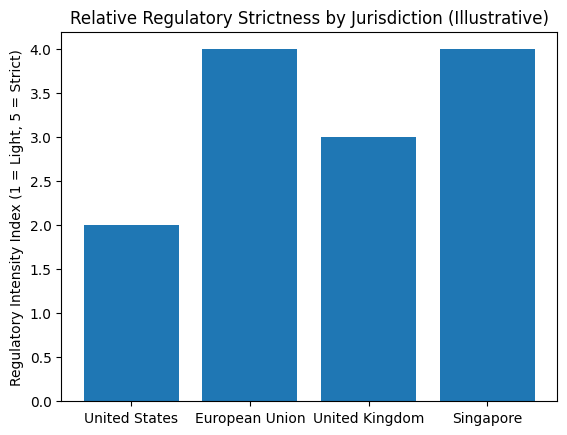
Yet builders should continue designing with multi-jurisdictional compliance in mind, especially as the European Union, United Kingdom, and parts of Asia maintain more prescriptive crypto frameworks.
6. Visualizing the Enforcement Shift
[Insert Image 1 here: “Illustrative Comparison of SEC Enforcement Intensity”]
This chart contrasts relative enforcement intensity between crypto and non-crypto cases before and after the Trump administration’s policy shift. While illustrative, it highlights the disproportionate reduction in crypto-related actions.
7. Global Perspective: The U.S. Is Not the Only Arbiter
While U.S. policy changes carry outsized influence, they do not exist in a vacuum. Recent global developments include:
- The EU’s MiCA framework, which introduces comprehensive licensing and disclosure requirements
- The UK’s push toward a regulated crypto promotion regime
- Asian jurisdictions such as Hong Kong and Singapore advancing licensed exchange models
For globally oriented projects, reliance on U.S. regulatory leniency alone is strategically insufficient.
8. Strategic Takeaways for Crypto-Native Entrepreneurs
For those seeking new digital assets, revenue streams, or blockchain applications, the current moment is best understood as a window of asymmetric opportunity:
- Regulatory pressure has eased, lowering entry barriers
- Institutional interest is cautiously returning
- Competition remains thinner than during bull-market peaks
At the same time, prudent operators should assume that regulatory cycles are political cycles. Durable success will favor projects that combine innovation with compliance-ready architecture.
Conclusion: A Temporary Thaw, Not a Permanent Settlement
The reported 60% pullback in SEC crypto enforcement under the Trump administration represents a profound, though potentially temporary, recalibration of U.S. digital asset policy. For markets, it has restored momentum; for builders, it has reopened paths once blocked by legal uncertainty.
Yet history suggests that regulatory tides shift with political winds. The most resilient crypto ventures will be those that treat the current environment not as a regulatory endgame, but as a strategic interval—a time to build, test, and prepare for the next phase of global financial integration.
