
Key Takeaways :
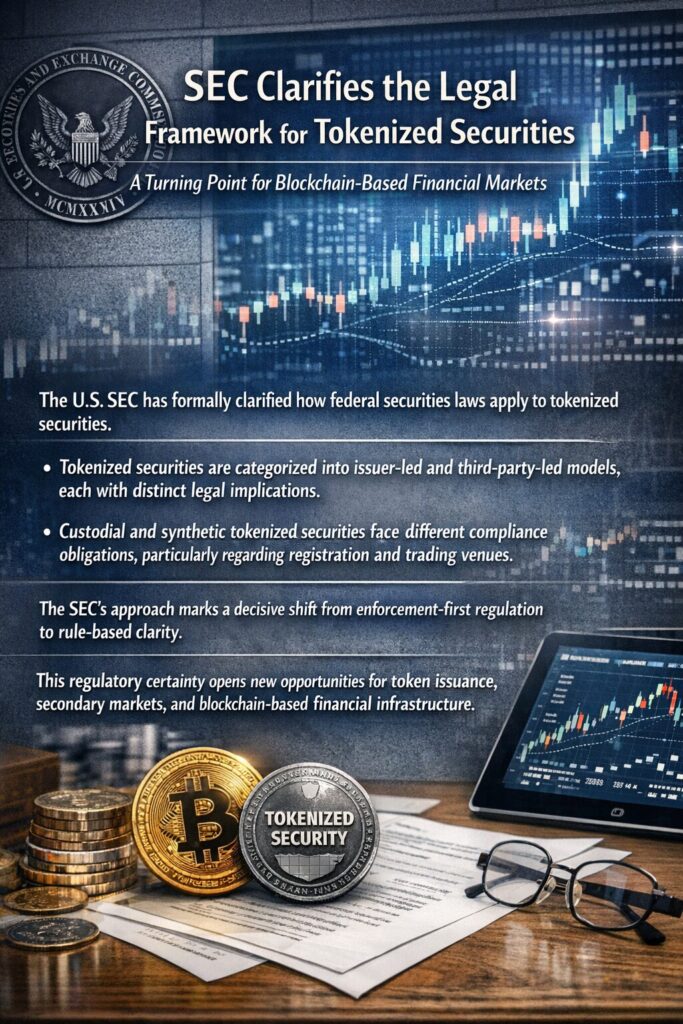
- The U.S. SEC has formally clarified how federal securities laws apply to tokenized securities.
- Tokenized securities are categorized into issuer-led and third-party-led models, each with distinct legal implications.
- Custodial and synthetic tokenized securities face different compliance obligations, particularly regarding registration and trading venues.
- The SEC’s approach marks a decisive shift from enforcement-first regulation to rule-based clarity.
- This regulatory certainty opens new opportunities for token issuance, secondary markets, and blockchain-based financial infrastructure.
1. Introduction: Why the SEC’s Statement Matters
On January 28, 2026, the U.S. Securities and Exchange Commission (U.S. Securities and Exchange Commission) released a landmark joint statement addressing the regulatory treatment of tokenized securities. Issued collaboratively by the Division of Corporation Finance, the Division of Investment Management, and the Division of Trading and Markets, the statement provides long-awaited clarity on how existing federal securities laws apply to securities represented and transferred via blockchain networks.
For years, market participants have struggled with regulatory uncertainty. Tokenization promised efficiency, programmability, and global accessibility, yet ambiguity around legal classification stalled institutional adoption. This statement is therefore not merely technical guidance; it is a structural signal that blockchain-based securities are no longer a regulatory gray zone but an accepted evolution of financial market infrastructure.
2. What Are Tokenized Securities?
Tokenized securities refer to traditional financial instruments—such as equities, bonds, or investment contracts—that fall under U.S. federal securities law but are represented as digital tokens on a blockchain. Ownership records are maintained and transferred using distributed ledger technology (DLT), rather than conventional centralized registries.
Importantly, the SEC emphasizes that tokenization does not alter the legal nature of the underlying security. Whether a share is recorded in a traditional ledger or represented by a blockchain-based token, it remains subject to the same disclosure, registration, and investor protection requirements.
3. Two Core Models: Issuer-Led vs. Third-Party Tokenization
3.1 Issuer-Led Tokenization
In the issuer-led model, the issuer itself integrates DLT into its shareholder or security-holder record system. Transfers of the token on a blockchain are directly synchronized with the issuer’s official records.
This model most closely resembles a technological upgrade of existing infrastructure rather than a new financial product. The SEC makes it explicit that, regardless of issuance format or record-keeping method, the full scope of federal securities laws continues to apply.
Implication:
For issuers, tokenization is permissible—but not a shortcut around compliance. Registration requirements, periodic disclosures, and transfer restrictions remain intact.
3.2 Third-Party Tokenization
Third-party tokenization occurs when an entity other than the issuer creates a blockchain-based representation linked to an existing security. The SEC identifies two distinct sub-models.
Custodial Tokenized Securities
In this structure, the original security is held in custody, while the token represents ownership or entitlement to that security. Economically, the token mirrors the underlying asset.
Synthetic Tokenized Securities
Synthetic models provide exposure to a reference security without direct ownership. These may take the form of linked securities or security-based swaps, offering price exposure rather than title transfer.
4. Regulatory Treatment of Synthetic Structures
The SEC draws a firm line regarding synthetic tokenized securities. If a crypto-asset functions economically as a security-based swap, it must comply with securities laws governing such instruments.
Sales to non–Eligible Contract Participants (ECPs) require registration, and trading must occur on a registered national securities exchange. The SEC reiterates that it evaluates products based on economic reality, not technological form.
Key message:
Tokenization does not neutralize regulatory obligations when the economic substance remains that of a regulated financial instrument.
5. A Strategic Shift: From Enforcement to Rulemaking
This statement represents a dramatic departure from the enforcement-centric posture of the previous SEC leadership. Under former Chair Gary Gensler, the SEC initiated approximately 125 enforcement actions against crypto-related firms, imposing nearly $6 billion in penalties. Industry participants reportedly spent over $400 million on legal defenses.
By contrast, current Chair Paul Atkins, who assumed office in April 2025, has prioritized regulatory clarity. In July 2025, the SEC launched “Project Crypto,” followed in November by a formal token classification framework dividing digital assets into four categories.
This evolution signals a recognition that sustainable market development requires rules, not retroactive punishment.
6. Market Impact: New Opportunities for Builders and Investors
Regulatory clarity is catalytic. With defined boundaries, issuers can design compliant tokenized securities, exchanges can plan regulated trading venues, and investors can assess risk with greater confidence.
For readers seeking new crypto assets or revenue opportunities, tokenized securities represent a convergence of traditional finance and blockchain innovation:
- Programmable dividends and coupons
- Near-instant settlement reducing counterparty risk
- Fractional ownership unlocking new investor segments
- Cross-border distribution with standardized compliance
7. Practical Use Cases Emerging in 2026
Tokenized securities are increasingly explored for:
- Private credit and real-world asset (RWA) tokenization
- Fund shares with automated NAV reporting
- On-chain collateral for institutional lending
- Regulated secondary markets for private equity interests
These applications are no longer speculative concepts but regulated design spaces.
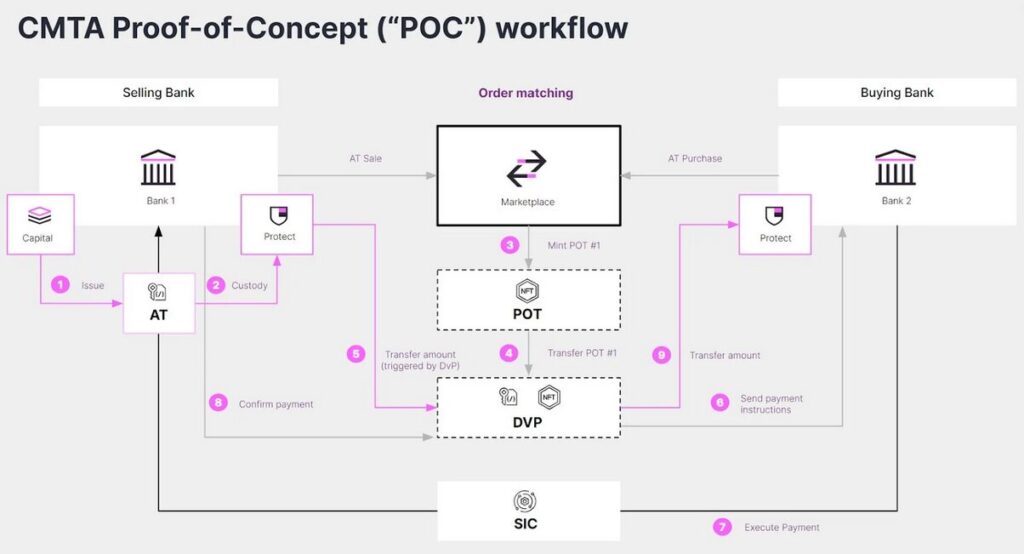
8. Visual Overview of Tokenized Securities Models
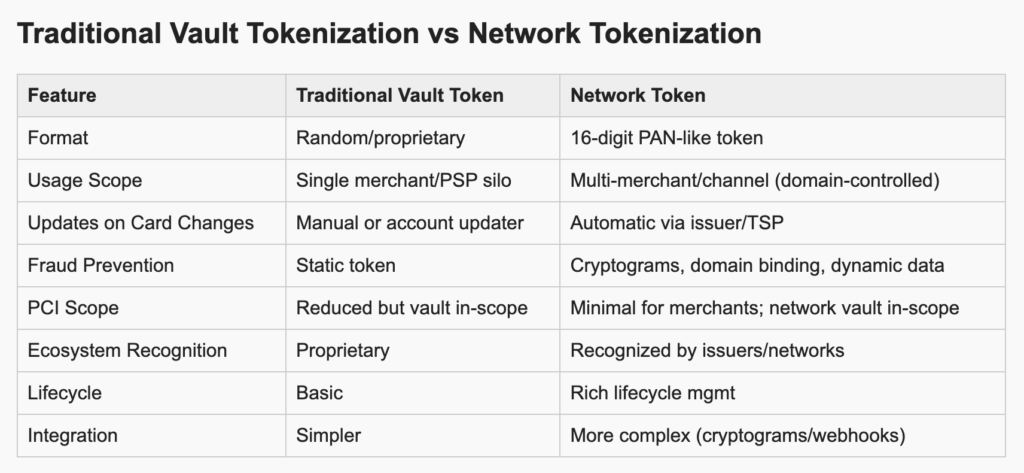
9. Comparative Regulatory Requirements
10. Conclusion: Tokenization Enters Its Regulatory Era
The SEC’s January 2026 statement marks a foundational moment for blockchain-based finance. By affirming that tokenization is compatible with existing securities law—without diluting investor protections—the Commission has effectively greenlit the next phase of financial infrastructure evolution.
For innovators, the message is clear: build boldly, but within the rules. For investors, tokenized securities offer a new frontier where blockchain efficiency meets legal certainty. And for the global financial system, this is a decisive step toward integrating decentralized technology into regulated markets.
