
Main Points :
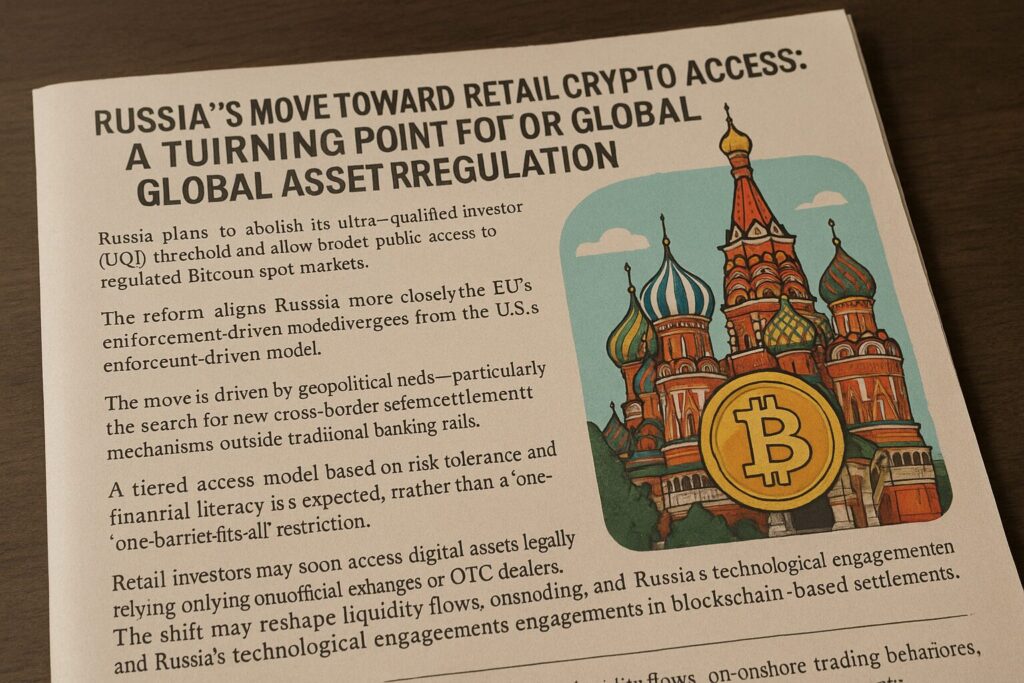
- Russia plans to abolish its ultra-qualified investor (HIV) threshold and allow broader public access to regulated Bitcoin spot markets.
- The reform aligns Russia more closely with the EU’s MiCA framework and diverges from the U.S.’s enforcement-driven model.
- The move is driven by geopolitical needs—particularly the search for new cross-border settlement mechanisms outside traditional banking rails.
- A tiered access model based on risk tolerance and financial literacy is expected, rather than a “one-barrier-fits-all” restriction.
- Retail investors may soon access digital assets legally without relying on unofficial exchanges or OTC dealers.
- The shift may reshape liquidity flows, onshore trading behaviors, and Russia’s technological engagements in blockchain-based settlements.
1. Introduction — Russia Signals a Major Regulatory Pivot
Russia’s decision to ease restrictions on retail participation in cryptocurrency markets marks one of the most significant policy shifts in its evolving digital-asset strategy. As the Central Bank of Russia (CBR) and the Ministry of Finance work toward an agreement reportedly expected by late December, discussions now center on eliminating the “ultra-qualified investor” requirement—previously one of the strictest filters in global crypto regulations.
Instead of limiting Bitcoin and other digital assets to Russia’s wealthiest citizens, policymakers appear ready to enable broader access through regulated platforms, granting new legitimacy to the domestic crypto economy.
This move represents more than simply relaxing capital thresholds. It is a reflection of geopolitical necessity, technological modernization, and a global trend toward embracing regulated digital-asset infrastructure.
2. Russia’s Ultra-Qualified Investor Rule — Origins, Structure, and Problems
What the Rule Required
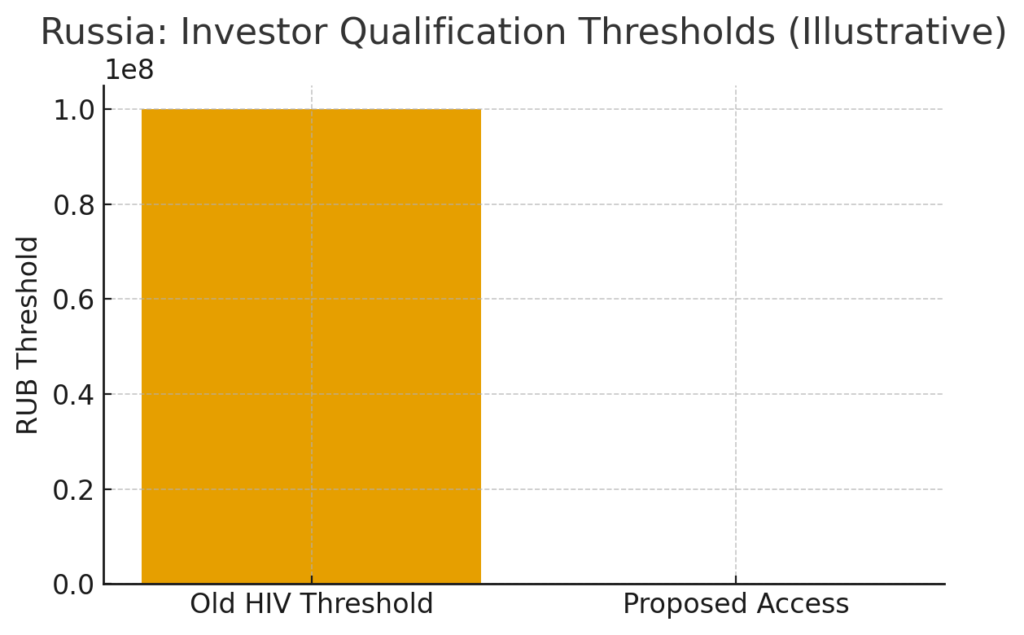
The ultra-qualified investor (HIV) category, introduced in early 2025, placed exceptionally high thresholds on individuals who wished to trade cryptocurrencies legally under Russia’s formal regulatory umbrella.
| Requirement | Amount |
|---|---|
| Net Assets | 100 million RUB+ (~$1.1 million) |
| Annual Income | 50 million RUB+ (~$560,000) |
These thresholds limited participation to a tiny fraction of Russia’s population—primarily ultra-high-net-worth individuals connected to the finance, technology, or political sectors.
Why the Rule Became Unsustainable
- Shadow Market Expansion
Retail users unable to access regulated venues turned to OTC desks, informal Telegram brokers, and decentralized exchanges, increasing risks of fraud and sanctions exposure. - Global Divergence
Other major economies—including the EU—were evolving toward supervised access, not restricting digital assets only to the top 0.1% of citizens. - Cross-Border Settlement Pressures
Since 2022, global sanctions have limited Russia’s reach in conventional finance. Cryptocurrencies emerged as an alternative channel for trade settlement, requiring a broader internal market. - Domestic Innovation Roadblocks
Restricting access slowed development for exchanges, custodians, settlement technologies, and blockchain-based corporate pilots.
Deputy Governor Vladimir Chistyukhin emphasized the importance of enabling new digital settlement mechanisms as Russia recalibrates its global financial strategies.
3. Russia’s New Direction — Tiered Access and Broad Public Participation
Instead of a single, strict qualification barrier, the CBR wants a tiered access model where:
- individuals with little experience may face limits on volume or leverage;
- those with medium knowledge may access spot markets freely;
- advanced users may engage in broader digital-asset activities.
This mirrors systems emerging in other jurisdictions where risk management—not wealth alone—determines the level of access.
Key Expected Outcomes
- Retail Investors Gain Legal Access
Russians will no longer need to rely on shadow channels. - Regulated Platforms Gain Liquidity
Domestic exchanges and custodians could grow rapidly under proper oversight. - Government Retains Strict Supervisory Control
Russia is not deregulating—it is replacing exclusivity with managed accessibility.
4. Comparison with the European Union — MiCA’s Influence
The European Union’s MiCA (Markets in Crypto-Assets) regulation now serves as one of the most comprehensive frameworks globally.
Key EU Requirements
- Exchanges and custodians must obtain a single EU license.
- Providers must comply with AML/CFT standards.
- Investors receive standardized risk disclosures.
- Stablecoin issuers face strict transparency requirements.
The EU’s approach is liberal in market access yet strict in supervision—exactly the direction Russia appears to be moving toward.
Where Russia Aligns with MiCA
- Regulated, supervised access for retail users.
- Licensing and compliance obligations for crypto service providers.
- Integration of digital assets into the financial system through formal channels.
Where Russia Differs
- Russia’s motivations are more geopolitical than purely market-driven.
- Settlement innovation is a national priority, whereas the EU focuses more on consumer protection and competition.
5. Comparison with the United States — Enforcement Instead of Legislation
While the EU has MiCA, the United States still relies on pre-existing securities and commodities laws.
The U.S. Model
- SEC regulates digital assets it deems securities.
- CFTC oversees certain tokens as commodities.
- Platforms face enforcement-driven compliance, often leading to litigation.
- Public access exists but is inconsistent due to classification uncertainties.
Where Russia Diverges
- Russia aims for clear, statute-based access rules, not enforcement-based ambiguity.
- The U.S. lacks a unified licensing model; Russia is attempting to create one.
- Russia’s regulatory push is top-down and national-strategic, whereas the U.S. regulatory environment evolves via market disputes and court rulings.
6. Recent Market Trends and External Analyses
Using supplementary data from Cointelegraph, Reuters, and Chainalysis (Nov–Dec 2025), the following developments provide context:
1. Growing Retail Demand in Emerging Markets
Countries under economic strain—including Turkey, Argentina, Nigeria, and Russia—continue to adopt crypto as a hedge against currency constraints and cross-border limitations.
2. Rising Interest in Bitcoin as Neutral Collateral
Across Asia and the Middle East, companies increasingly explore Bitcoin-collateralized trade finance. Russia’s reforms align with these global financial experiments.
3. Increasing Regulatory Clarity as a Market Catalyst
Over the last year, digital-asset inflows have consistently increased in jurisdictions that provide clear, accessible regulation.
Examples: France, Singapore, UAE.
4. Institutional Infrastructure Maturing Rapidly
Custody, stablecoin settlement rails, and tokenized asset markets are expanding. Russia is likely targeting a similar environment—especially for sanctioned or high-risk cross-border trade routes.
7. Strategic Implications for Russia and Global Markets
For Russia
- Economic Resilience:
Crypto may serve as an alternative channel for sanctioned trade or commodity exports. - Internal Innovation:
Domestic exchanges and custodians may flourish under official supervision. - Digital Sovereignty:
Russia can create a financial environment less dependent on SWIFT and Western banking infrastructure.
For Global Markets
- New Liquidity Flows:
Russian capital may re-enter the global crypto ecosystem through regulated gateways. - Competitive Regulatory Models:
Russia’s shift adds pressure on late-moving countries—especially the U.S.—to adopt comprehensive frameworks. - Cross-Border Settlement Experiments:
Emerging economies may follow Russia in exploring crypto-based payment networks.
8. Conclusion — Russia Opens the Door to a New Digital-Asset Era
Russia’s plan to abolish its ultra-qualified investor rule is more than a regulatory adjustment—it represents a profound strategic shift.
By enabling ordinary citizens to access Bitcoin and other digital assets through regulated channels, the country moves closer to global regulatory norms while simultaneously pursuing its geopolitical objectives.
The result is a hybrid model:
- Open to the public,
- Strict in oversight,
- Aligned with settlement innovation,
- Supportive of market development.
If successfully implemented, this reform could transform the Russian crypto market from a shadow-dependent ecosystem into one of the largest regulated retail markets globally.
