
Key Points :
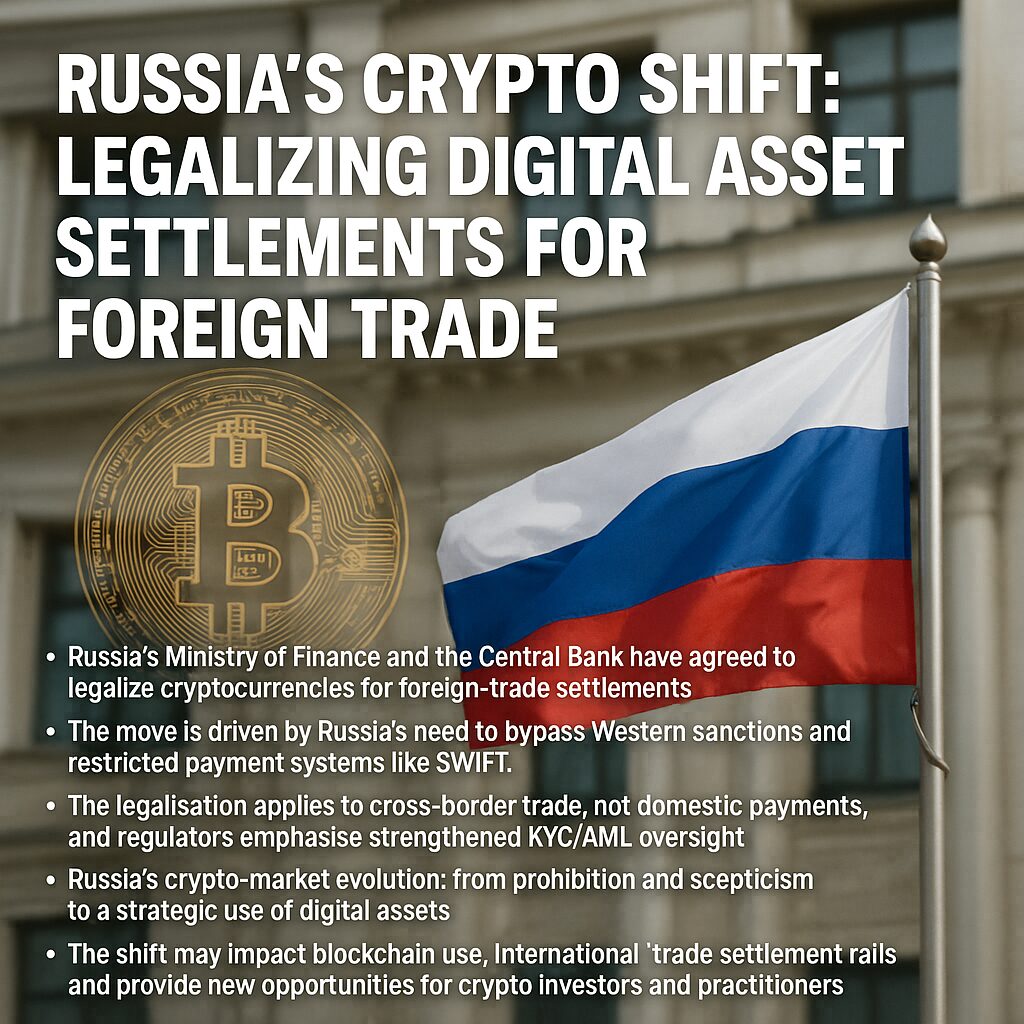
- Russia’s Ministry of Finance and the Central Bank have agreed to legalize cryptocurrencies for foreign-trade settlements.
- The move is driven by Russia’s need to bypass Western sanctions and restricted payment systems like SWIFT.
- The legalisation applies to cross-border trade, not domestic payments, and regulators emphasise strengthened KYC/AML oversight.
- Russia’s crypto-market evolution: from prohibition and scepticism to a strategic use of digital assets.
- The shift may impact blockchain use, international trade settlement rails, and provide new opportunities for crypto investors and practitioners.
- Challenges remain: regulatory control, currency volatility, enforcement of compliance amid sanction-risk and existing grey networks.
1. Background: From Ban to Legal Framework
Over the past several years, Russia has progressively changed its stance on cryptocurrencies. Previously, domestic usage was heavily restricted. According to recent reports, on October 22 2025 the Ministry of Finance of the Russian Federation and the Central Bank of Russia agreed to legalise the use of digital assets for cross-border trade settlements. The decision follows an earlier “experimental legal regime” (ELR) introduced in September 2025 to pilot crypto usage in export and import transactions.
The shift is motivated in large part by Russia’s severe restrictions in global banking systems due to Western sanctions, including limited access to SWIFT-based channels. Thus, the adoption of crypto for foreign trade signals not mere innovation but strategic necessity.
2. What the New Regulation Entails
The framework allows Russian businesses to use cryptocurrencies (including major ones like Bitcoin) for settling exports and imports. Key aspects include:
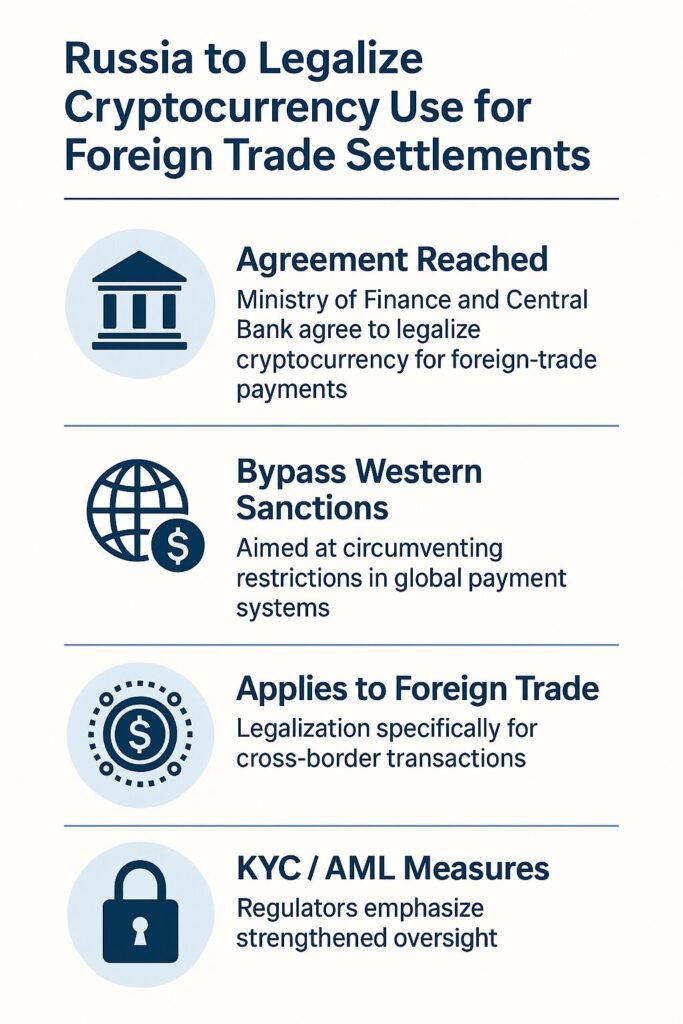
- The legalisation is only for foreign trade transactions, not for domestic payments or retail consumption.
- Transactions will be subject to enhanced oversight: KYC (Know Your Customer), AML (Anti-Money Laundering) and regulatory supervision by the Central Bank and other agencies.
- The regulatory move follows acknowledgement from Finance Minister Anton Siluanov that while cryptocurrencies facilitate payments, they also enable movement of funds abroad — hence the need for formal regulation.
- Existing grey-market usage of tokens like the ruble-backed A7A5 stablecoin (linked to sanctioned Russian entities) is cited as background for this regulatory change.
3. Strategic Motivations & Global Implications
Avoiding Sanctions and Payment Bottlenecks
By legalising crypto in foreign trade, Russia seeks to circumvent the constraints imposed by Western banking intermediaries and sanctions. Crypto provides a borderless settlement mechanism that can permit trade flows even under restricted access to traditional rails. The measure is framed by officials as “essential” for maintaining trade continuity and economic efficiency.
Dedollarisation and Shift in Reserve-Asset Logic
The move can also be seen as part of a broader “dedollarisation” drive: reducing reliance on US dollar-based systems and exploring alternative settlement frameworks. In that sense, Bitcoin and other digital assets may increasingly be viewed not just as speculative instruments but as functional settlement rails or even reserve-asset substitutes — at least in geopolitically constrained economies.
Broader Ripple Effects for Blockchain, Altcoins & Emerging Markets
For practitioners in blockchain and crypto seeking new opportunities, this policy shift suggests several areas of interest:
- Settlement-layer protocols and tokens may see increased attention as trade settlement rails evolve.
- Emerging markets or sanctioned states might follow suit, increasing global demand for regulated cross-border crypto flows.
- Traders and investors may start considering how digital-asset infrastructure (not just price speculation) becomes strategically relevant in real-economy contexts. For example, some analysts highlight tokens like $HYPER, $BEST, or $ASTER as potential winners in this settlement-ecosystem shift.
4. Risks & Practical Considerations for Crypto Investors and Practitioners
Volatility and Settlement Risk
Even though crypto enables borderless settlement, volatility remains a major risk. If a trade invoice is denominated in Bitcoin or another coin, price swings can create mismatches and hedging challenges for exporters/importers.
Regulatory and Compliance Overhang
While Russia is legalising crypto usage in one domain, it is simultaneously tightening domestic controls: for example, banning certain transactions between residents outside the ELR framework. This means regulatory clarity is still evolving and compliance risk remains high.
Sanction Evasion Concerns & Transparency
Given that some crypto flows in Russia-related transactions have involved sanction-evading networks (e.g., A7A5 stablecoin) the legitimacy and oversight of the new regime will be closely watched by international regulators. Entities operating in this environment will need rigorous on-chain transparency, auditability, and AML/KYC compliance to avoid legal and reputational risk.
Geopolitical Counter-Responses
As Russia pursues this crypto-settlement strategy, its partners (and adversaries) might respond with regulatory, sanction or technical measures (e.g., blocking exchanges, enhancing tracing). This could introduce additional counter-party and network risk for users and investors.
5. Practical Implications for Blockchain Utilisation & New Revenue Sources
For professionals seeking to exploit blockchain / crypto from a practical usage standpoint, this development opens several vectors:
- Cross-border settlement platforms: There may be demand for blockchain-based systems tailored to international trade, especially between Russia and partner states (such as China, India, Turkey).
- Tokenised settlement rails: Stablecoins, settlement tokens, or protocols enabling instant cross-border value transfer may gain adoption in trade flows.
- Crypto-mining & energy arbitrage linkage: Russia’s existing Bitcoin-mining infrastructure (particularly in Siberia) may become more integrated into export-oriented finance, linking energy, crypto and trade.
- Compliance-service niches: As regulation tightens, services that provide on-chain monitoring, transaction tracing, KYC/AML compliance for cross-border crypto settlements may be in demand.
- Investment thesis refinement: Investors can consider not just “which crypto will gain price” but “which protocol or token becomes the settlement layer in new international trade rails”. The Russian regulatory shift supports this broader framing.
6. What to Watch Next
- Implementation details: How exactly Russia operationalises the framework — approved coins, participant eligibility, trade volumes, oversight vessels, tax treatment.
- Volume of trade settled in crypto: Early estimates suggested crypto-payments between Russia and trade partners approached ~1 trillion rubles (~US$12.7 billion) in 2025 prior to formal legalisation.
- Partner-country responses: How countries trading with Russia respond. Will China, India, Turkey join such rails? Will they develop interoperable settlement systems?
- Technology-protocol shifts: Which blockchain protocols or stablecoins may get adopted for trade settlement? Could Bitcoin become a “neutral” settlement asset in new rails?
- Global regulatory reaction: How will Western regulators respond to state-level crypto settlement systems being used partly to circumvent sanctions? Might there be new frameworks for transparency, traceability or sanctions enforcement via blockchain?
Conclusion
In summary, Russia’s decision to legalise cryptocurrency use for foreign-trade settlements represents a major strategic pivot — not just for Russia’s economy, but for how blockchain and digital-asset infrastructures may be used in international trade. For crypto investors and practitioners focused on new revenue sources and real-economy applications of blockchain, this shift underscores the importance of seeing crypto not only as speculative instruments but as evolving settlement rails, compliant infrastructures, and trade-finance enablers.
That said, the path ahead is complex: volatility, compliance risks, sanction issues and regulatory clarity will determine how smoothly this transition unfolds. For those seeking to engage in this space, the message is clear: focus on protocols and services that enable regulated, transparent cross-border flows; track how partnerships and trade-networks adopt these rails; and maintain rigor in regulatory/AML posture.
By embracing crypto for trade-settlement, Russia may well be heralding a new era in which blockchain becomes a functional component of international commerce — and savvy participants who understand this shift early may find meaningful opportunities in the years ahead.
