
Main Points :
- Russia has formally reiterated that cryptocurrencies such as Bitcoin and Ethereum will not be permitted as domestic payment instruments; the Russian ruble remains the sole legal means of settlement inside the country.
- Cryptocurrencies are legally tolerated only as investment assets, while their use in cross-border trade settlements is allowed under an experimental legal framework.
- Despite the payment ban, Russia is quietly expanding its crypto ecosystem through mining, tokenized financial products, DeFi experiments, and bank-led digital asset services.
- Major Russian banks such as Sberbank and VTB are actively testing decentralized finance and crypto-linked investment products, signaling institutional demand.
- For global investors and blockchain operators, Russia represents a hybrid regulatory model: restrictive domestically, pragmatic internationally, and strategically aligned with de-dollarization.
Introduction: A Familiar Yet Strategic Rejection
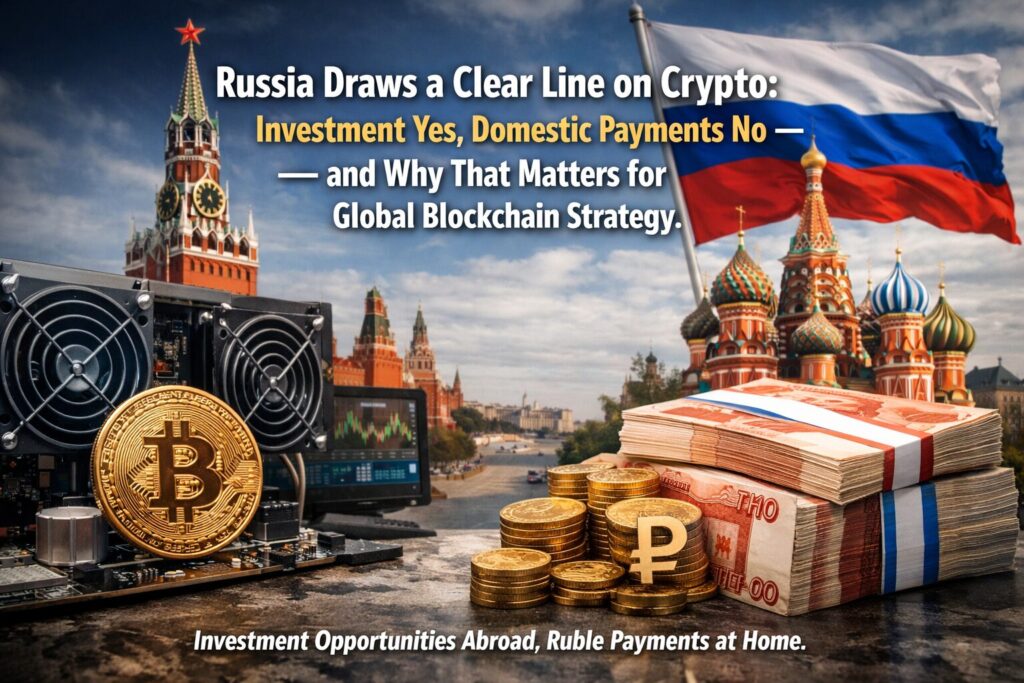
On December 15, Anatoly Aksakov, Chairman of the Russian State Duma Committee on Financial Markets, made a definitive statement during a press briefing with TASS: cryptocurrencies like Bitcoin (BTC) and Ethereum (ETH) will not become a means of domestic payment in Russia. Instead, crypto assets are confined to the role of investment instruments, while domestic transactions must continue to be settled exclusively in the Russian ruble.
At first glance, this position may appear conservative or even anti-crypto. However, when viewed in the broader context of Russia’s evolving financial strategy, the policy reflects a deliberate separation between monetary sovereignty and digital asset utility. This article explores what Russia’s stance truly means, how it aligns with recent developments, and why it matters for those seeking new crypto assets, yield opportunities, and real-world blockchain use cases.
Russia’s Legal Position: Ruble Sovereignty Above All
Russia’s rejection of crypto for domestic payments is not new. In 2020, legislation explicitly banned the use of digital assets for payment inside the country. Since then, a prolonged regulatory tug-of-war unfolded between the Ministry of Finance and the Central Bank of Russia.
Central Bank Governor Elvira Nabiullina reaffirmed this stance in October during a plenary session of the State Duma, emphasizing that allowing crypto payments could undermine monetary control, capital flow management, and financial stability. For the Central Bank, crypto is a volatile, unbacked asset — unsuitable as money.
In this sense, Russia’s policy mirrors that of many sovereign states:
- Crypto is not money
- Fiat currency remains the exclusive unit of account
What is distinctive, however, is what Russia allows outside its borders.
The Exception That Matters: Crypto for Cross-Border Trade
While domestic payments are prohibited, Russia has established an experimental legal framework permitting the use of cryptocurrencies in foreign trade settlements. This nuance is critical.
Facing ongoing sanctions and restricted access to traditional dollar-based financial rails, Russia has strong incentives to explore alternative settlement mechanisms. According to statements from Aksakov himself, Russian companies are already using cryptocurrencies to settle international trade worth several billion dollars annually, entirely outside domestic retail payment systems.
Strategic Implications
This model allows Russia to:
- Preserve ruble dominance at home
- Reduce reliance on USD and SWIFT abroad
- Leverage crypto as a neutral, censorship-resistant settlement layer
For blockchain professionals, this reinforces a key insight: crypto adoption often begins with trade finance, not retail payments.
From Ban to Pragmatism: The Shift in Regulatory Tone
Historically, the Central Bank of Russia advocated for a near-total ban on crypto trading, exchanges, and mining. That position has softened noticeably.
Recent signals suggest that the Ministry of Finance’s pragmatic approach is gaining traction. President Vladimir Putin himself has spoken positively about the growth of Russia’s mining industry, acknowledging its contribution to economic activity.
Mining as a “Hidden Export”
Russia’s vast energy resources and cold climate make it an ideal mining hub. Policymakers are now considering whether mining revenues — potentially worth several billion dollars annually — should be reflected in official export statistics.
This framing positions mining not as a threat, but as a digital commodity export, aligning neatly with Russia’s resource-based economic model.
Institutional Adoption: Banks Step Into DeFi
One of the most underreported developments is the role of Russia’s largest financial institutions.
Sberbank: Testing DeFi in a Controlled Environment
According to RBC, Sberbank has begun testing decentralized finance products while working closely with regulators. Rather than opposing DeFi, the bank envisions a future where traditional banking services integrate with blockchain-based financial primitives.
This includes:
- Tokenized assets
- Smart-contract-based settlement
- Regulated digital asset custody
VTB: Real Demand for Spot Crypto Exposure
VTB, another major bank, stated that clients increasingly want direct ownership of cryptocurrencies, not merely derivatives. Responding to this demand, Russian financial institutions in 2024 launched:
- Crypto-linked investment funds
- Bonds tied to BTC and ETH prices
- Index products tracking major digital assets
All values and performance metrics are reported in USD equivalents, reinforcing crypto’s role as a global asset class rather than a domestic currency substitute.
Comparative Perspective: Russia vs. the Global Trend
Globally, we see three dominant regulatory models:
- Payment-Friendly (e.g., El Salvador)
- Investment-Only (e.g., Russia, partially Japan)
- Hybrid / Regulated Payment (e.g., EU under MiCA)
Russia’s model is firmly in the second category. Yet unlike some jurisdictions, Russia actively supports:
- Mining
- Institutional investment products
- Cross-border crypto settlement
This combination makes Russia neither “anti-crypto” nor “crypto-friendly” — but strategically selective.
What This Means for Investors and Builders
For readers seeking new crypto assets and revenue streams, Russia’s approach offers several lessons:
- Payments are political; settlement is strategic
- Institutional demand often precedes retail adoption
- Mining and infrastructure can thrive even under payment bans
- DeFi does not require retail crypto payments to be valuable
Blockchain projects targeting trade finance, tokenization, mining infrastructure, or institutional DeFi may find Russia-aligned models increasingly relevant — especially in sanctioned or capital-controlled economies.
Suggested Graphs and Visuals
Title: “Permitted vs Prohibited Uses of Cryptocurrency in Russia”
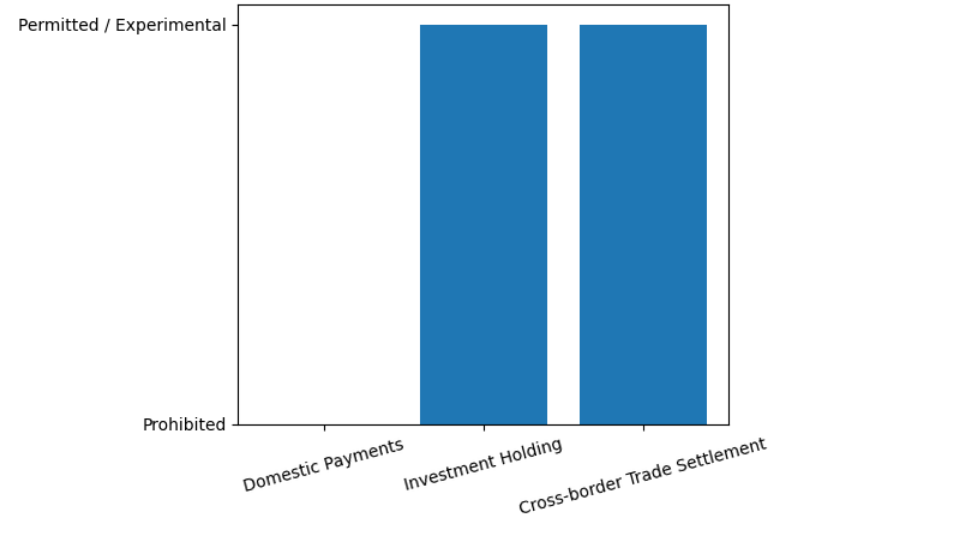
- Domestic payments: Prohibited
- Investment holding: Permitted
- Cross-border trade settlement: Experimental / Permitted
Title: “Estimated Annual Crypto-Related Economic Activity in Russia (USD)”
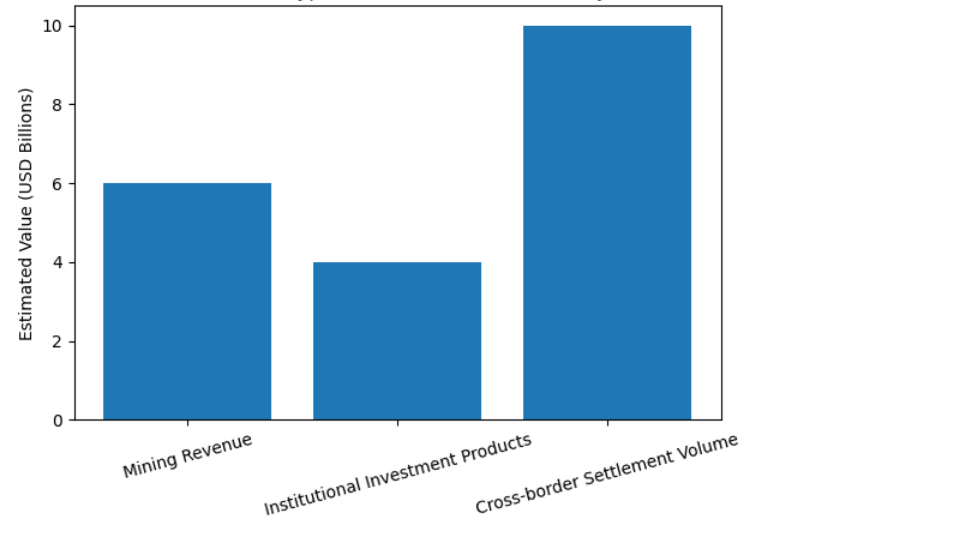
- Mining revenue
- Institutional investment products
- Cross-border settlement volume
(These graphs should be provided as standalone image files for clarity and reuse.)
Conclusion: A Calculated Embrace of Crypto Without Monetary Surrender
Russia’s reaffirmation that cryptocurrencies will not be used for domestic payments is not a rejection of blockchain technology — it is a declaration of monetary sovereignty. At the same time, Russia is actively integrating crypto into mining, investment, banking, and international trade.
For the global crypto industry, this signals a mature phase of adoption where utility, not ideology, determines acceptance. Bitcoin and Ethereum may never buy a coffee in Moscow, but they are already reshaping how value moves in and out of the country — measured, as always, in US dollars.
