
Main Points :
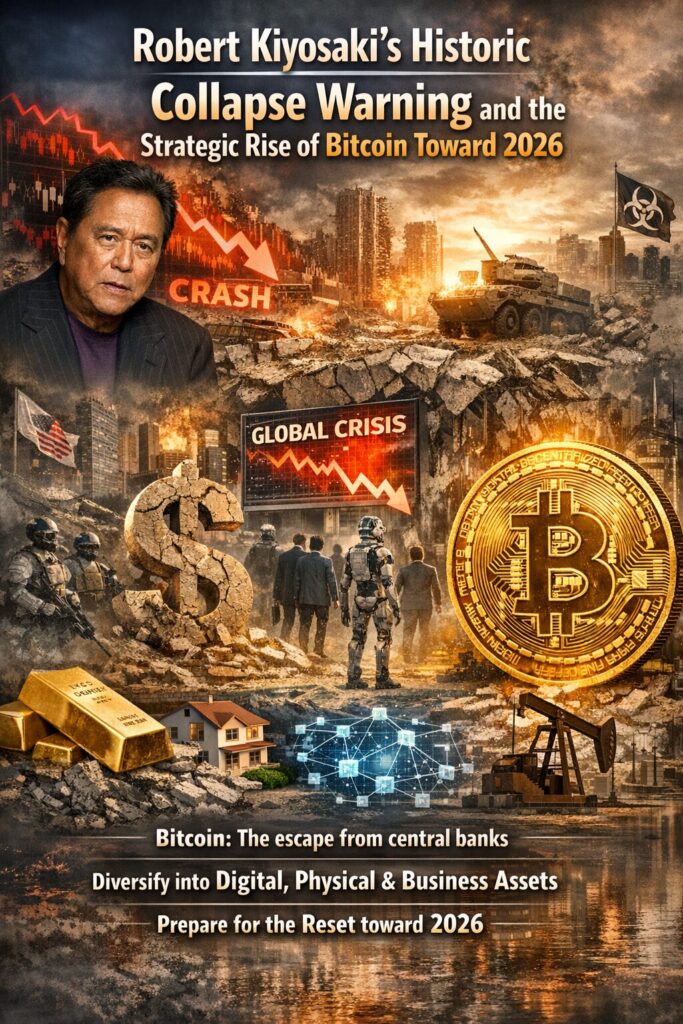
- Robert Kiyosaki warns that a historic, synchronized global market collapse is unfolding, driven by more than a decade of debt expansion, ultra-low interest rates, and quantitative easing after 2008.
- He argues that current stress is structural rather than cyclical, intensified by sovereign debt, liquidity tightening, AI-driven job displacement, and geopolitical realignment.
- In this environment, Bitcoin is positioned not as a speculative trade, but as a monetary escape valve independent from central banks.
- Kiyosaki promotes diversification into productive, resilient assets—digital, physical, and business-based—as markets reset toward 2026.
- For investors seeking new crypto assets, yield opportunities, and real-world blockchain use, the message is less about price prediction and more about positioning for systemic change.
Introduction: A Familiar Voice in an Unfamiliar Moment
Few financial commentators have maintained a presence across multiple economic cycles quite like Robert Kiyosaki, author of Rich Dad Poor Dad. For over a decade, Kiyosaki has warned that the global financial system—built increasingly on leverage, debt monetization, and central bank intervention—was drifting toward an unavoidable reckoning.
As 2025 progressed and attention turned toward 2026, Kiyosaki intensified these warnings. This time, however, the narrative is not framed as a localized recession or a traditional bear market. Instead, he describes a historic, global, multi-asset collapse unfolding simultaneously across the United States, Europe, and Asia.
At the same time, he has grown increasingly vocal about Bitcoin’s role in this transition—calling it not merely an investment, but a structural alternative to fiat money itself.
This article summarizes Kiyosaki’s thesis, expands it with recent macro and crypto market developments, and interprets its implications for readers seeking new digital assets, revenue streams, and practical blockchain applications.
The Anatomy of a “Historic” Global Collapse
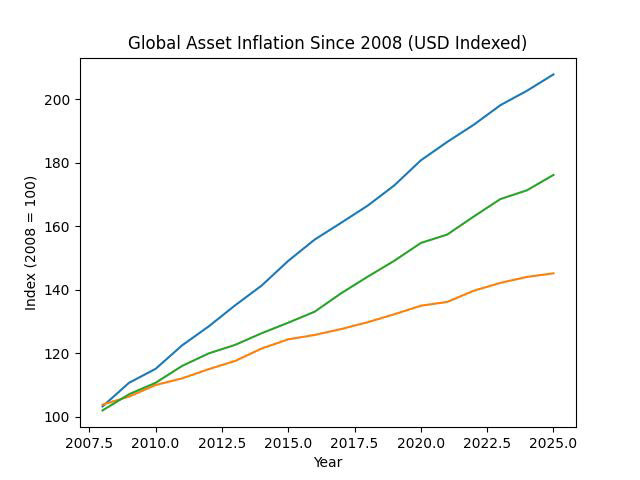
Kiyosaki’s core argument begins with policy decisions made in the aftermath of the 2008 global financial crisis. According to him, governments and central banks did not solve the underlying problem—they postponed it.
Post-2008 Policy Legacy
After 2008, central banks globally adopted:
- Quantitative easing (QE) on an unprecedented scale
- Near-zero or negative interest rates
- Aggressive debt issuance across public and private sectors
These measures stabilized markets in the short term, but they also inflated asset prices across stocks, bonds, and real estate simultaneously. In Kiyosaki’s view, this created a fragile system where nearly all major asset classes became dependent on continuous liquidity injections.
When inflation surged and central banks were forced to tighten liquidity, that artificial support began to unwind.
Why This Cycle Is Different
Kiyosaki emphasizes that this downturn differs fundamentally from prior recessions:
- Liquidity is contracting, not expanding.
- Debt levels are far higher than in 2008, especially sovereign debt.
- Multiple asset bubbles are deflating at once, reducing diversification benefits.
- Policy flexibility is limited because inflation constrains stimulus.
Critics often note that Kiyosaki has issued warnings for years. His response is blunt: earlier warnings were early, not wrong. What has changed is the scale and simultaneity of risks now converging.
Structural Stress Beyond the Business Cycle
In recent interviews and social media posts, Kiyosaki has highlighted indicators that extend beyond normal economic downturns.
Sovereign Debt and Currency Risk
Government debt in major economies has reached levels that make future monetary debasement increasingly likely. Servicing this debt without inflation, he argues, is mathematically implausible.
AI and Employment Disruption
Artificial intelligence is accelerating productivity while displacing traditional white-collar and service jobs. This structural shift weakens wage growth and tax bases, increasing reliance on deficit spending.
Geopolitical Fragmentation
Supply chains are regionalizing, reserve currencies are being questioned, and financial alliances are shifting. These changes add friction to a system already burdened by leverage.
Together, these factors suggest a re-ordering of global finance, not a temporary slowdown.
Bitcoin as “People’s Money” in a Failing Fiat System
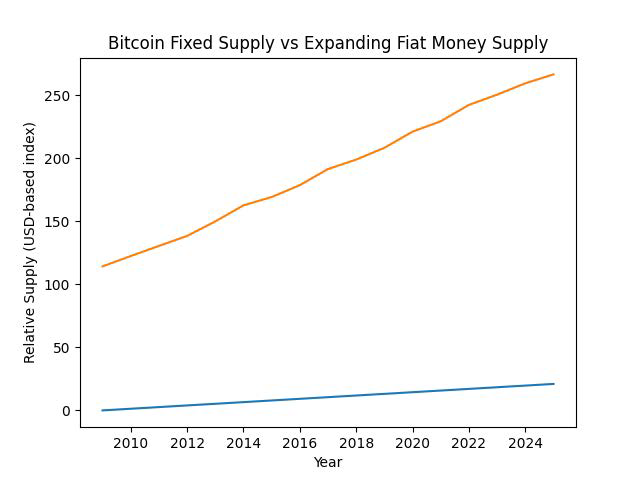
Parallel to his collapse thesis, Kiyosaki consistently elevates Bitcoin as a solution emerging from monetary dysfunction.
Why Bitcoin, According to Kiyosaki
Kiyosaki describes Bitcoin as:
- Finite: capped at 21 million units
- Decentralized: outside central bank control
- Programmatic: immune to political discretion
In contrast to fiat currencies, whose supply expands in response to fiscal pressure, Bitcoin’s issuance is transparent and fixed.
He frequently refers to Bitcoin as “people’s money,” emphasizing that it requires no trust in governments, banks, or intermediaries.
Long-Term Holding, Tactical Selling
While often portrayed as a maximalist, Kiyosaki has acknowledged selling portions of his Bitcoin holdings. Importantly, he frames these sales not as loss of conviction, but as capital recycling—redeploying gains into cash-flow-generating businesses and essential-sector assets.
This distinction matters for investors evaluating Bitcoin not just as a store of value, but as a liquidity reserve within a broader portfolio strategy.
Diversification Reimagined: Digital, Physical, and Productive Assets
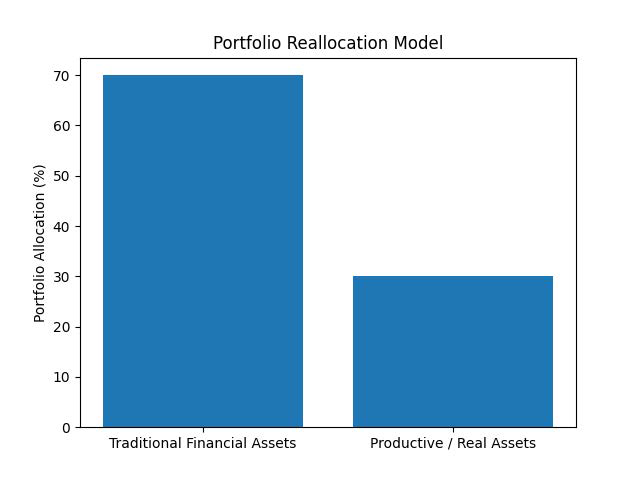
Rather than advocating a single “safe haven,” Kiyosaki emphasizes functional diversification.
Digital Assets
- Bitcoin as monetary hedge
- Ethereum and smart-contract platforms as infrastructure layers
Physical Assets
- Gold and silver as historical stores of value
- Energy and resource exposure as inflation hedges
Productive Businesses
- Healthcare services
- Food production and logistics
- Energy generation and distribution
- Essential services with inelastic demand
The unifying theme is cash flow and resilience, not speculative appreciation.
Implications for Crypto and Blockchain Practitioners
For readers interested in practical blockchain use, Kiyosaki’s framework aligns with several emerging trends:
- Tokenization of real-world assets, linking digital rails to physical value
- Stablecoin-based payments as alternatives to legacy banking systems
- Decentralized custody and self-sovereign finance, reducing counterparty risk
- Blockchain-enabled treasury management for businesses navigating currency volatility
In this context, crypto is less about “number go up” and more about financial survivability and operational efficiency.Insert Suggested Graphs and Visuals
Conclusion: Preparing for 2026 Is About Structure, Not Timing
Robert Kiyosaki’s message heading into 2026 is not a call for panic, nor a short-term trading signal. It is a structural critique of a global financial system stretched by debt, distorted by policy, and disrupted by technology.
Bitcoin, in this narrative, is not merely an asset—it is a counter-system. Alongside productive businesses and essential real-world assets, it forms part of a strategy designed to endure systemic change rather than predict its timing.
For investors, builders, and operators searching for new crypto assets, sustainable income, and real-world blockchain applications, the lesson is clear: the next phase of opportunity will belong to those who understand why the system is changing, not just how prices move.
