
Main Points :
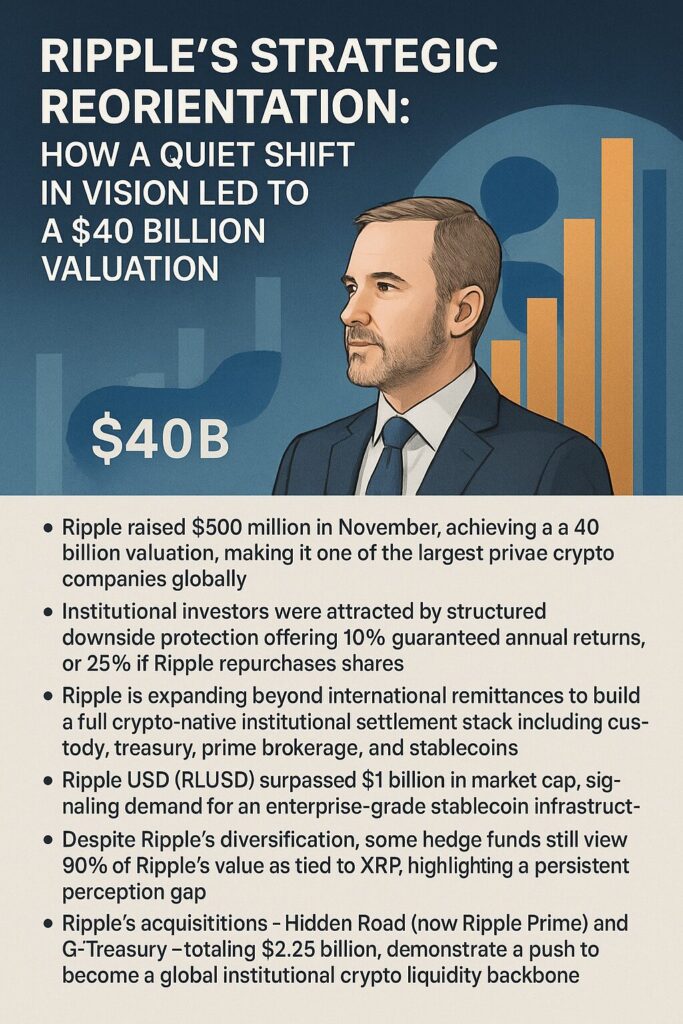
- Ripple raised $500 million in November, achieving a $40 billion valuation, making it one of the largest private crypto companies globally.
- Institutional investors were attracted by structured downside protection offering 10% guaranteed annual returns, or 25% if Ripple repurchases shares.
- Ripple is expanding beyond international remittances to build a full crypto-native institutional settlement stack including custody, treasury, prime brokerage, and stablecoins.
- Ripple USD (RLUSD) surpassed $1 billion in market cap, signaling demand for an enterprise-grade stablecoin infrastructure.
- Despite Ripple’s diversification, some hedge funds still view 90% of Ripple’s value as tied to XRP, highlighting a persistent perception gap.
- Ripple’s acquisitions—Hidden Road (now Ripple Prime) and G-Treasury—totaling $2.25 billion, demonstrate a push to become a global institutional crypto liquidity backbone.
- Broader market context—growing institutionalization, stablecoin regulation, and renewed investment appetite—strengthens Ripple’s outlook.
I. Introduction — A Company Reinvented After Regulatory Winter
Ripple’s $500 million capital raise in November stands out not only for its scale but also for what it represents: a strategic rebirth. For years, Ripple battled the U.S. Securities and Exchange Commission (SEC), which clouded investor confidence and stalled its institutional expansion. But as the legal pressure softened and regulatory clarity improved, Ripple executed a quiet yet profound realignment of its business strategy.
This shift—away from being perceived solely as an XRP-dependent remittance company—has repositioned Ripple as a full digital-asset infrastructure provider with ambitions far beyond cross-border payments. The result: its valuation has surged to $40 billion, drawing heavyweights like Citadel Securities, Fortress Investment Group, Galaxy Digital, Pantera Capital, and Brevan Howard–linked funds.
Ripple did not simply raise capital. It rebuilt its narrative.
II. Why Wall Street Came Back: Structuring the Deal to Guarantee Returns
A Rare Offering: Guaranteed Annual Returns for Investors
Bloomberg’s coverage revealed that Ripple approached investors with unusually favorable downside protection. Participating funds were granted:
- The right to sell their Ripple shares back to the company after 3–4 years
- A guaranteed annual return of ~10%
- If Ripple elects to repurchase the shares early, investors receive a 25% annual return
This structure effectively de-risks participation in a private crypto company—something nearly unheard of in late-stage venture financing. For investors still cautious after 2022’s crypto market turmoil, it was a compelling proposal.
Ripple also retains the right to buy back shares, which signals internal confidence about future liquidity and public-listing potential. If Ripple goes public before the three-year window, the downside-protection clause is void.
This structure tells us two things:
- Ripple believes strongly in its long-term market position.
- Institutional investors are increasingly willing to hold digital-asset exposure—if the risk is mathematically controlled.
III. Ripple Expands Beyond Remittances Toward a Full Crypto Settlement Stack
Ripple USD (RLUSD) Reaches $1 Billion Market Cap
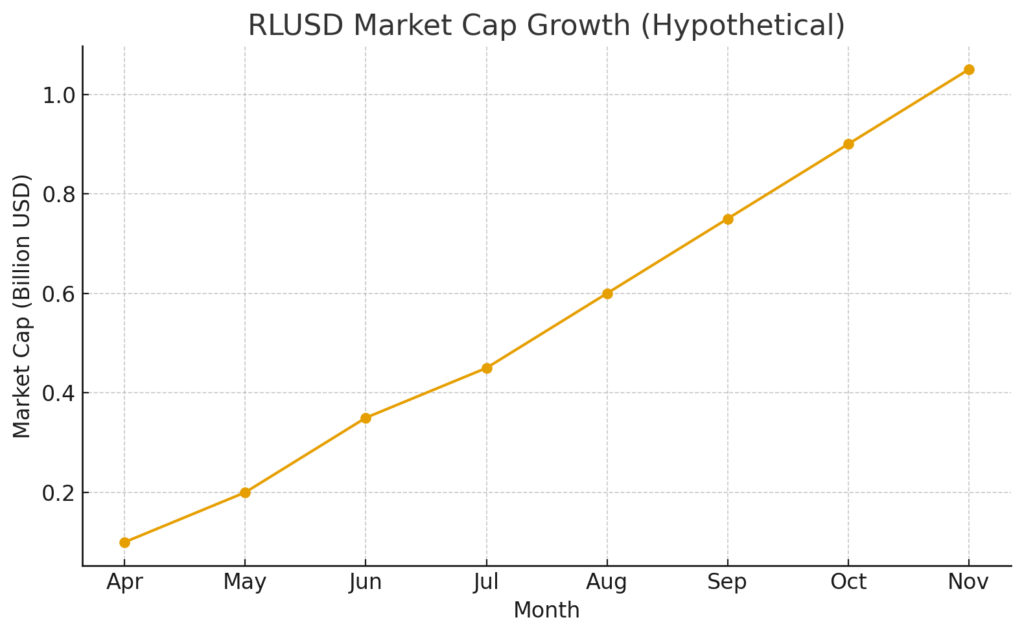
Ripple’s stablecoin, Ripple USD (RLUSD), surpassed a $1 billion supply—indicating successful early institutional adoption. This marks Ripple’s entry into the hyper-competitive stablecoin market, where USDT and USDC currently dominate.
RLUSD differentiates itself as:
- Fully reserved, appealing to regulated institutions
- Integrated into Ripple’s infrastructure, enabling stable settlements across custody, treasury, and trading workflows
- Designed as an enterprise-grade, on-ledger USD rail
Given the regulatory tightening around stablecoins in the U.S. and EU (MiCA), RLUSD arrives at a moment when institutions are seeking compliant, audit-friendly alternatives.
IV. Investors Still See Ripple Through the Lens of XRP — And Why That Matters
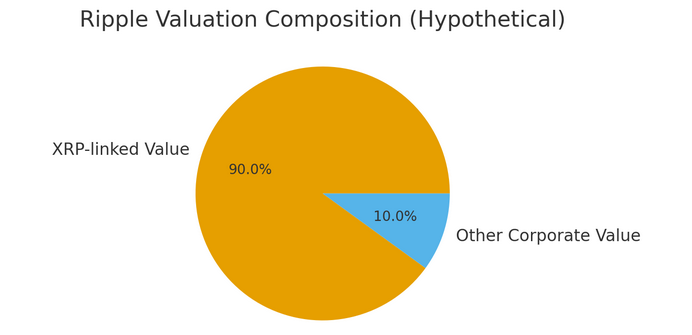
Bloomberg notes that two large institutional funds concluded that ~90% of Ripple’s net asset value (NAV) is still tied to XRP, despite Ripple’s insistence that XRP is an independent, decentralized asset outside its control.
This perception has strategic implications:
- Investors believe Ripple’s enterprise value is heavily correlated with XRP price cycles.
- XRP volatility may still influence Ripple’s ability to raise capital or pursue M&A.
- Ripple must continuously demonstrate diversified revenue streams to correct the perception.
The company’s expansion into stablecoins, prime brokerage, and treasury solutions is clearly designed to rebalance this narrative.
V. Ripple’s Institutional Infrastructure Strategy: A $2.25B Bet on the Future
To build a full-service institutional settlement ecosystem, Ripple acquired two major companies:
1. Hidden Road (Rebranded as Ripple Prime)
- A major non-bank crypto prime broker
- Enables institutional access to spot liquidity, derivatives, and credit intermediation
2. G-Treasury (Treasury management software provider)
- Adds a corporate-grade suite of tools for cash, liquidity, and risk management
Total Acquisition Value: $2.25 billion
These acquisitions position Ripple to serve:
- Hedge funds
- Financial institutions
- Corporate treasuries
- Global remittance operators
- Market makers
- OTC desks
Ripple’s new stack can now offer:
- Custody
- Treasury operations
- Settlement
- Stablecoin rails
- Prime brokerage
- Liquidity management
This elevates Ripple from a single-product fintech to a multi-layer financial infrastructure provider.
VI. Recent Market Trends Supporting Ripple’s Strategic Direction
To broaden analysis beyond the source article, here are relevant macro crypto trends:
1. Institutionalization of Crypto Accelerates (2023–2025)
Following the approval of spot Bitcoin ETFs, large institutions such as BlackRock, Fidelity, and Franklin Templeton expanded exploration into tokenization and stablecoin-based transactions. Ripple’s infrastructure focus aligns perfectly with this new institutional wave.
2. Stablecoin Regulation Is Tightening Worldwide
- MiCA (EU) requires full reserves, audit transparency, and issuer licensing.
- U.S. Stablecoin Bills increasingly demand bank-level compliance.
RLUSD—structured as a fully reserved, institution-friendly stablecoin—fits emerging regulatory frameworks better than some current incumbents.
3. Tokenization of Real-World Assets (RWA) Is Becoming a Multi-Trillion Opportunity
Ripple’s treasury and prime brokerage acquisitions position it for:
- On-chain corporate liquidity management
- Tokenized cash instruments
- Institutional settlement workflows
This parallels recent moves by JPMorgan (Onyx), Citi, and HSBC.
4. XRP Price Cycles Remain Decoupled from Ripple’s Corporate Moves
Despite Ripple’s diversification, XRP continues to respond primarily to:
- Market liquidity cycles
- SEC lawsuit developments
- Overall altcoin trends
This perception gap may hinder Ripple’s future valuation unless new revenue streams mature into substantial contributors.
VII. Strategic Assessment: Why Ripple’s Positioning Works
Ripple’s rebranding toward institutional digital-asset infrastructure makes strategic sense because:
- High-margin institutional services (custody, treasury, prime brokerage) create durable revenue.
- Stablecoins provide predictable cash flows, especially when used in enterprise settlement networks.
- Diversification reduces reliance on XRP, addressing investor concerns.
- M&A strengthens product offering, accelerating time-to-market.
- Regulatory clarity opens the path toward potential IPO readiness.
The $40B valuation reflects not just Ripple’s current financials, but also the market’s belief that institutional demand for digital asset infrastructure will grow dramatically.
VIII. Conclusion — The Quiet Repositioning That Changed Everything
Ripple did not achieve a $40B valuation solely because its legal troubles diminished. It achieved it because:
- It engineered a highly investor-friendly fundraising structure.
- It expanded into a multi-layer institutional infrastructure provider.
- It capitalized on a global shift toward regulated digital asset markets.
- It introduced RLUSD at the perfect regulatory moment.
- It executed strategic acquisitions to strengthen its institutional offering.
While some investors still associate Ripple overwhelmingly with XRP, the company’s repositioning suggests a broader vision: becoming a foundational liquidity and settlement layer for institutional crypto and tokenized finance.
Ripple is no longer just a remittance company.
It is quietly becoming one of the pillars of institutional digital asset infrastructure.
