
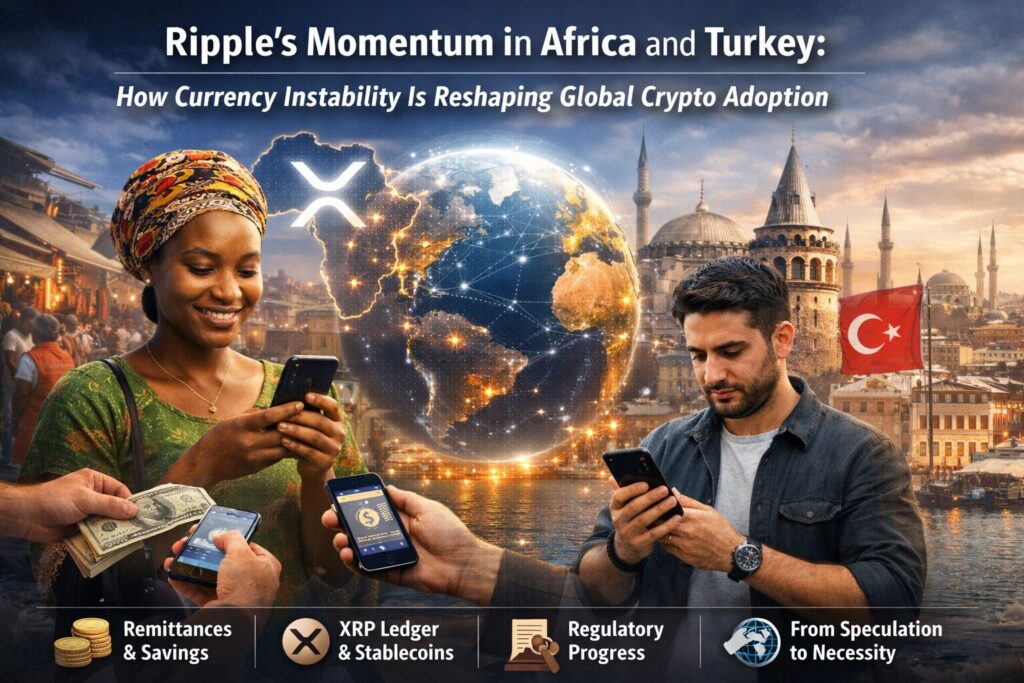
Key Takeaways :
- Sub-Saharan Africa and Turkey are emerging as two of the fastest-growing crypto adoption regions globally, driven by inflation, currency devaluation, and financial exclusion.
- Stablecoins dominate real-world usage, especially for remittances, savings, and daily transactions.
- Ripple’s XRP Ledger (XRPL) and stablecoin-based payment solutions are increasingly positioned as infrastructure rather than speculative assets.
- Regulatory maturation in both regions is accelerating institutional and enterprise-level blockchain adoption.
- These markets provide a real-world blueprint for how crypto evolves from speculation into necessity.
1. Introduction: Crypto as a Financial Necessity, Not a Trend
For much of the developed world, cryptocurrencies are still framed primarily as speculative instruments—volatile assets traded for profit or portfolio diversification. However, in emerging economies facing persistent inflation, currency depreciation, and limited access to traditional banking, crypto plays a fundamentally different role.
Ripple executive Reece Merrick recently highlighted this divergence, pointing to Sub-Saharan Africa and Turkey as regions where crypto adoption is accelerating faster than almost anywhere else. His observation underscores a broader global shift: when fiat systems struggle, blockchain-based alternatives are no longer optional experiments—they become practical financial tools.
This article expands on Merrick’s remarks by contextualizing them within broader market data, regulatory developments, and real-world use cases. We examine why these two regions are moving so quickly, how Ripple fits into this transformation, and what it means for investors and builders seeking the next phase of blockchain-driven growth.
2. Sub-Saharan Africa: Grassroots Adoption at Scale
[Growth of Crypto Transaction Volume in Sub-Saharan Africa]
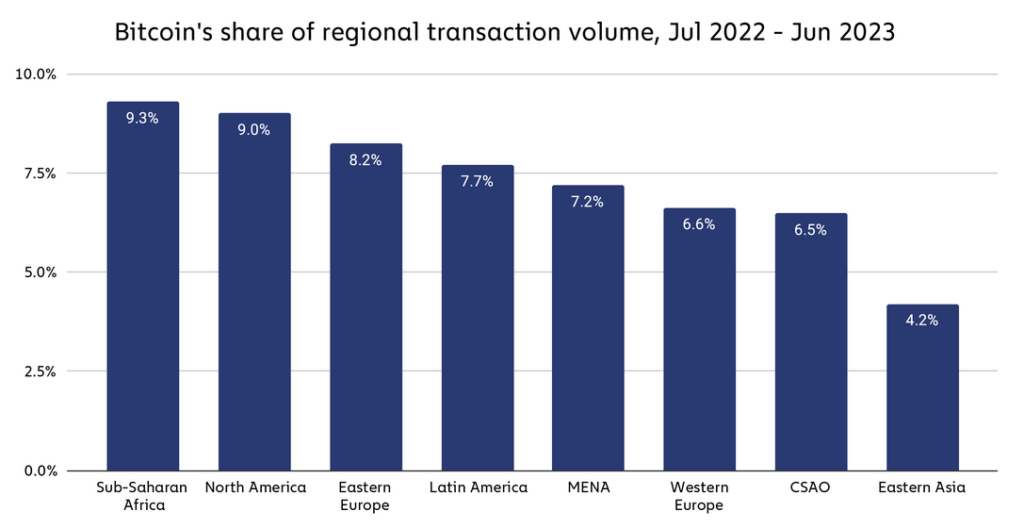
According to blockchain analytics data referenced by Merrick, Sub-Saharan Africa recorded more than $205 billion in on-chain transaction value between July 2024 and June 2025. This represents a 52% year-over-year increase, making it the third-fastest growing crypto region globally, following APAC and Latin America.
What distinguishes Africa’s growth is not speculative trading but everyday financial utility. Approximately 43% of total transaction volume is driven by stablecoins, reflecting demand for assets that preserve purchasing power in volatile monetary environments.
Several structural factors explain this rapid adoption:
- Inflation pressures: Countries such as Nigeria have experienced inflation exceeding 30% annually, eroding household savings.
- Currency instability: Local currencies frequently depreciate against the US dollar, increasing reliance on dollar-pegged digital assets.
- Financial exclusion: Over 50% of adults remain unbanked, making mobile-first crypto wallets more accessible than traditional bank accounts.
In this context, stablecoins function less like “crypto assets” and more like digital dollars—used for remittances, salary payments, cross-border trade, and daily expenses.
3. Turkey: Inflation Shock and Mass Retail Adoption
[Turkish Lira Devaluation vs Crypto Adoption Growth]
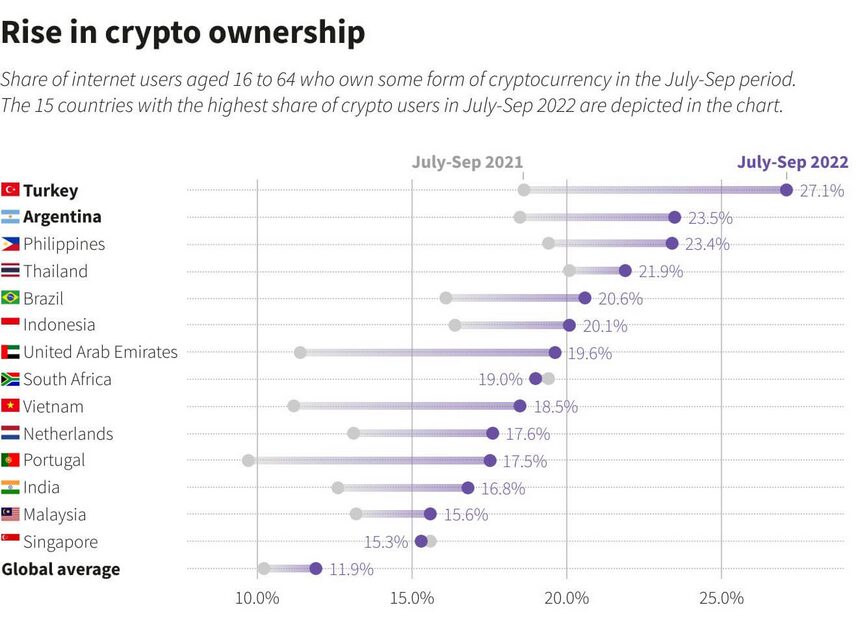
Turkey presents a different, yet equally compelling, case study. Since 2021, the Turkish lira has lost approximately 80% of its value, while inflation has reached levels near 70% at its peak. This rapid erosion of purchasing power has pushed citizens toward alternative stores of value.
Reports suggest that over 50% of Turkish adults now own or have used cryptocurrency, placing Turkey among the highest crypto adoption rates worldwide.
Unlike Sub-Saharan Africa, where adoption is driven by financial access, Turkey’s shift is primarily about wealth preservation. Crypto—particularly Bitcoin, Ethereum, and stablecoins—offers an escape from domestic monetary instability and capital controls.
Local exchanges, crypto payment apps, and blockchain-based savings tools have flourished, turning Turkey into a mature retail crypto market rather than an emerging one.
4. Why Stablecoins Are the Real Engine of Adoption
[Stablecoin-Based Remittance and Payment Flow]
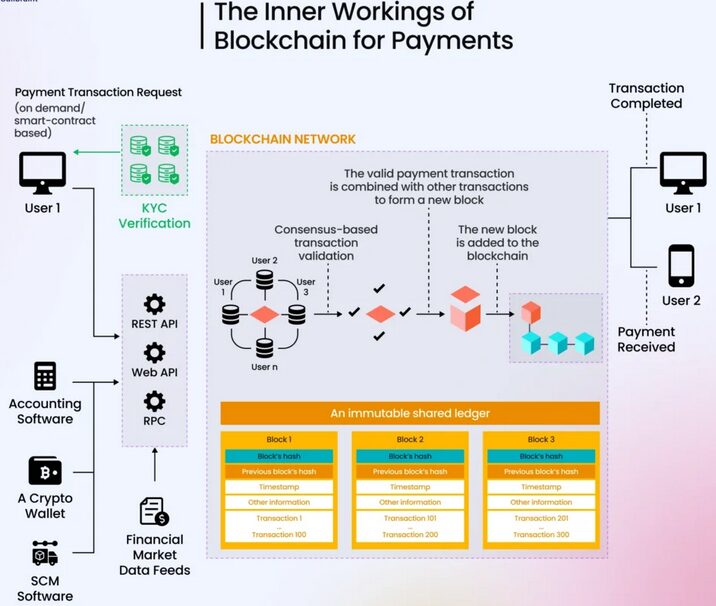
Across both regions, one trend is unmistakable: stablecoins dominate real usage.
While critics often emphasize crypto volatility, users in Africa and Turkey are increasingly bypassing volatility altogether by relying on USD-pegged assets. These tokens provide:
- Protection against local currency depreciation
- Faster and cheaper cross-border transfers
- 24/7 settlement without reliance on correspondent banks
This is where Ripple’s strategy becomes particularly relevant. Rather than positioning XRP or XRPL as speculative instruments, Ripple focuses on payments infrastructure, liquidity provisioning, and compliance-ready solutions for financial institutions.
The XRP Ledger’s speed, low transaction cost, and growing support for stablecoins make it well-suited for high-volume remittance corridors—precisely the use cases driving adoption in these markets.
5. Regulation: From Barrier to Catalyst
Both Sub-Saharan Africa and Turkey are undergoing regulatory evolution, which is critical for sustainable growth.
Historically, regulatory uncertainty discouraged institutional participation. Today, clearer frameworks—covering licensing, AML compliance, and consumer protection—are emerging. This transition is transforming crypto from a parallel system into an integrated financial layer.
Ripple’s executives emphasize that regulatory progress has directly contributed to their recent momentum. As compliance becomes standardized, banks, payment providers, and fintech companies can safely deploy blockchain-based solutions at scale.
This regulatory maturation also reduces counterparty risk, making these regions more attractive for foreign investment and enterprise adoption.
6. Implications for Investors and Builders
For investors seeking the “next wave” of crypto growth, Africa and Turkey illustrate an important lesson: real adoption follows real problems.
Markets facing monetary stress often adopt crypto earlier and more deeply than stable economies. This creates opportunities not only in native tokens but also in infrastructure plays—wallets, payment rails, compliance tooling, and stablecoin ecosystems.
For builders, these regions offer live testing grounds for blockchain applications with genuine demand. Products that succeed here are likely robust enough to scale globally.
7. Conclusion: Crypto’s Future Is Being Written on the Margins
The accelerating adoption of crypto in Sub-Saharan Africa and Turkey confirms a broader truth about blockchain’s evolution. While speculation may dominate headlines, necessity drives permanence.
Ripple’s growing presence in these regions highlights how crypto infrastructure—particularly stablecoin-based payment networks—can address systemic financial challenges. As regulation matures and usage expands, these markets are no longer peripheral; they are central to crypto’s future trajectory.
For those searching for new assets, new revenue models, or practical blockchain applications, the lesson is clear: watch where crypto solves real problems. That is where long-term value is created.
