
Key Takeaways :
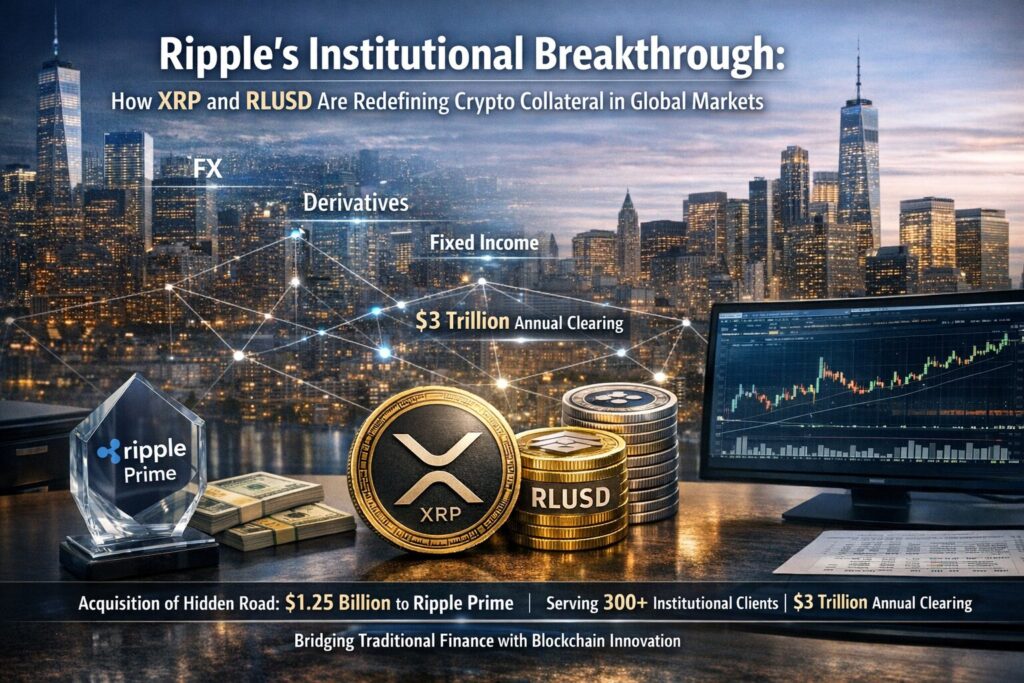
- Ripple is rapidly expanding its institutional footprint by positioning XRP and RLUSD as professional-grade collateral assets.
- The acquisition of Hidden Road for $1.25 billion, now rebranded as Ripple Prime, marks the first time a crypto-native firm owns a global multi-asset prime broker.
- Ripple Prime supports over 300 institutional clients and clears approximately $3 trillion annually across FX, digital assets, derivatives, and fixed income.
- XRP Ledger–based settlement and RLUSD’s role as collateral bridge traditional finance and blockchain infrastructure.
- This move signals a structural shift in how crypto assets are integrated into institutional liquidity, financing, and clearing systems.
1. Ripple’s Strategic Pivot Toward Institutional Infrastructure
Ripple has long been known as a blockchain company focused on cross-border payments, but its latest strategic moves signal a decisive pivot toward institutional market infrastructure. The company’s plan to deploy XRP and RLUSD as collateral for professional and institutional clients reflects a broader transformation occurring across global financial markets: the normalization of digital assets as functional components of liquidity and risk management.
Unlike earlier crypto adoption phases, which were driven largely by retail speculation, the current wave is defined by practical use cases—clearing, margining, settlement, and collateral optimization. Ripple’s leadership has explicitly framed XRP and RLUSD not as speculative instruments, but as productive financial tools designed to operate alongside FX, derivatives, and fixed-income markets.
This evolution aligns closely with institutional demand. As traditional financial institutions face increasing capital efficiency pressures, they are actively exploring digital assets that can reduce settlement times, free trapped liquidity, and function across asset classes.
2. The $1.25 Billion Acquisition That Changed Ripple’s Trajectory
In October, Ripple completed its $1.25 billion acquisition of Hidden Road, a global multi-asset prime broker. Shortly after the acquisition, the firm was rebranded as Ripple Prime, symbolizing its integration into Ripple’s long-term vision.
Hidden Road was already a major institutional player prior to the acquisition, providing clearing, financing, and brokerage services to more than 300 institutional clients. Its platform spans FX, digital assets, derivatives, and fixed income—areas traditionally dominated by large Wall Street prime brokers.
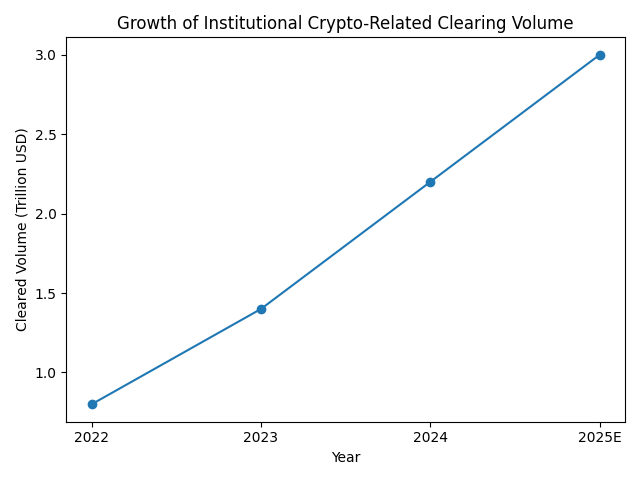
According to Reese Merrick, Ripple’s Senior Executive Officer and Managing Director for the Middle East and Africa, Ripple Prime currently supports approximately $3 trillion in annual clearing volume across all markets. This scale places Ripple in direct competition with established financial infrastructure providers, a position previously unimaginable for a crypto-native company
Growth of Institutional Crypto-Related Clearing Volume
3. XRP and RLUSD as Institutional-Grade Collateral
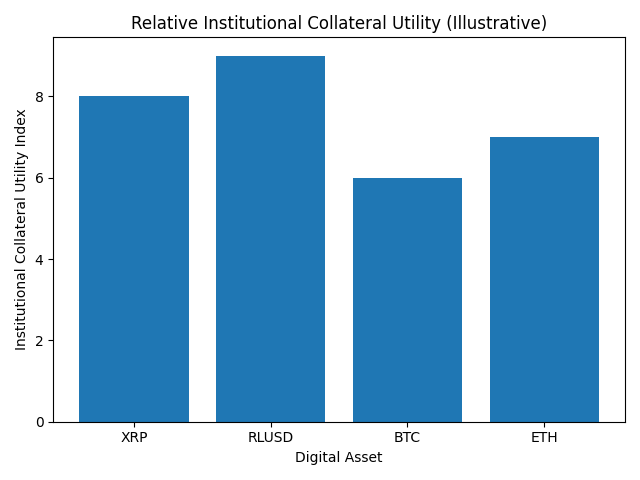
The most significant implication of Ripple Prime’s expansion is the use of XRP and RLUSD as collateral assets for institutional clients. In traditional finance, collateral determines access to liquidity. Assets that can be posted efficiently, valued transparently, and settled rapidly gain disproportionate strategic importance.
RLUSD, Ripple’s U.S. dollar-denominated stablecoin, is particularly well-suited for this role. Its price stability, combined with on-chain settlement via the XRP Ledger, allows it to function as a digital equivalent of cash collateral. XRP, meanwhile, offers liquidity and settlement speed, enabling institutions to optimize margin requirements across markets.
By integrating these assets into prime brokerage workflows, Ripple is effectively transforming crypto from a peripheral investment into a core balance-sheet instrument for institutions.
4. Bridging Traditional Finance and Blockchain Settlement
One of Ripple Prime’s defining characteristics is its hybrid infrastructure. The platform combines traditional prime brokerage functions—such as margin financing and clearing—with blockchain-based settlement using the XRP Ledger.
This approach addresses one of the biggest inefficiencies in global finance: fragmented settlement systems. Traditional markets rely on delayed settlement cycles, often locking up capital for days. Blockchain-based settlement, by contrast, enables near-real-time finality.
Ripple’s strategy does not seek to replace traditional finance outright. Instead, it positions blockchain as an invisible efficiency layer, enhancing speed, transparency, and capital efficiency without disrupting existing institutional workflows.
5. Market Growth and Institutional Demand for Crypto Liquidity
Institutional demand for crypto-based liquidity has expanded rapidly over the past three years. Hedge funds, proprietary trading firms, and asset managers increasingly require cross-margining between digital and traditional assets.
Ripple Prime’s reported tripling of business scale since the acquisition underscores this trend. Institutions are not merely trading crypto; they are using it operationally—as collateral, as a settlement rail, and as a liquidity bridge.
Relative Institutional Collateral Utility (Illustrative)
6. Implications for Investors and Builders
For investors searching for new crypto assets with real revenue potential, Ripple’s strategy offers an important signal. Assets that integrate deeply into institutional infrastructure—rather than relying solely on retail narratives—are more likely to achieve long-term relevance.
For builders and enterprises, Ripple Prime demonstrates a viable model for crypto-native financial infrastructure that meets institutional compliance, scale, and reliability requirements. This model is particularly relevant for VASPs, EMIs, and fintech firms seeking regulated growth.
7. Conclusion: A Structural Shift, Not a Marketing Story
Ripple’s expansion through Ripple Prime represents more than corporate growth—it marks a structural shift in the role of crypto within global finance. By embedding XRP and RLUSD into the mechanics of clearing, financing, and collateral management, Ripple is redefining how digital assets are perceived and used.
The institutional era of crypto is no longer theoretical. It is operational, capitalized, and increasingly interconnected with traditional markets. Ripple’s trajectory suggests that the next phase of crypto adoption will be driven not by hype, but by infrastructure, liquidity, and execution.
