
Main Points :
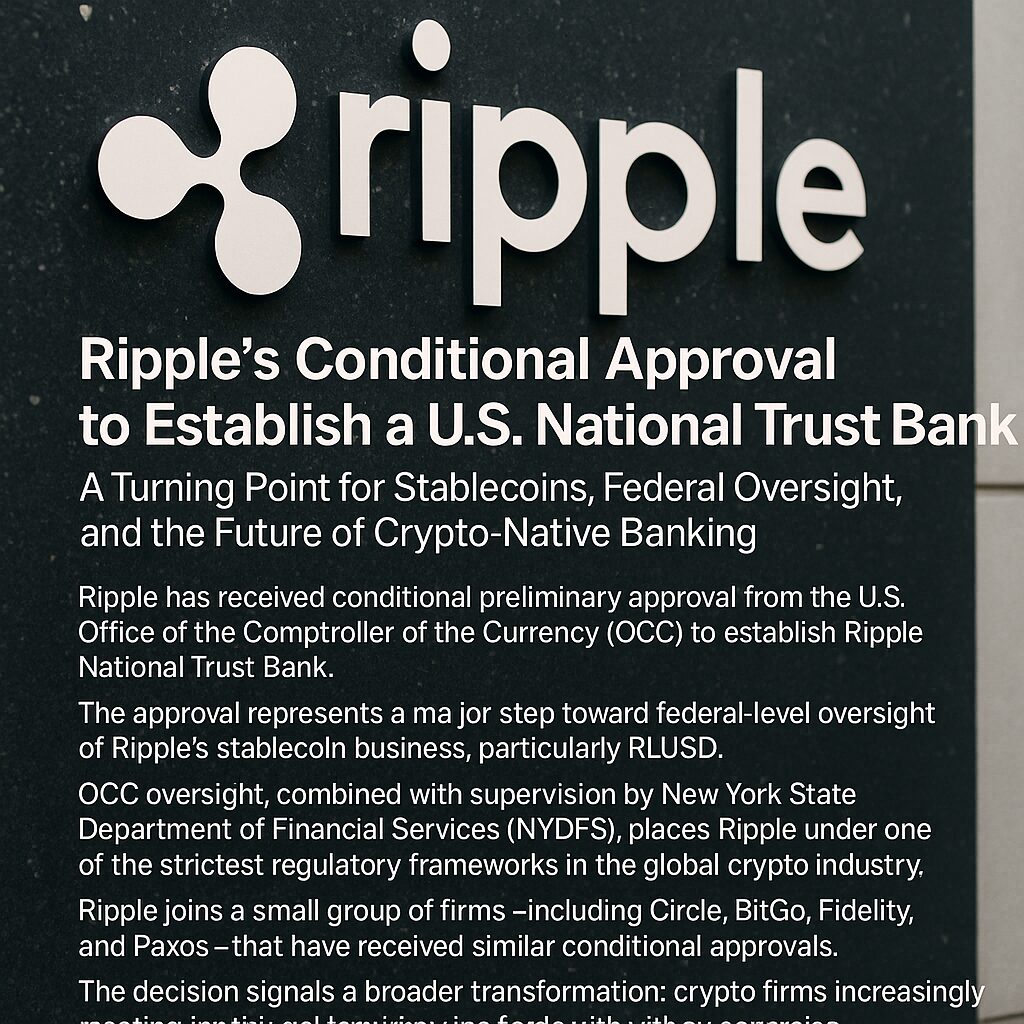
- Ripple has received conditional preliminary approval from the U.S. Office of the Comptroller of the Currency (OCC) to establish Ripple National Trust Bank.
- The approval represents a major step toward federal-level oversight of Ripple’s stablecoin business, particularly RLUSD.
- OCC oversight, combined with supervision by New York State Department of Financial Services (NYDFS), places Ripple under one of the strictest regulatory frameworks in the global crypto industry.
- This move aligns with recent U.S. regulatory shifts, including updates related to the GENIUS Act, clarifying the long-term legal environment for stablecoins.
- Ripple joins a small group of firms—including Circle, BitGo, Fidelity, and Paxos—that have received similar conditional approvals.
- The decision signals a broader transformation: crypto firms increasingly meeting traditional banking standards rather than operating in regulatory gray zones.
1. Introduction: Why Ripple’s OCC Approval Matters
Ripple’s conditional approval from the U.S. Office of the Comptroller of the Currency (OCC) to establish a national trust bank marks one of the most significant regulatory milestones in the history of the cryptocurrency industry. Unlike typical crypto licensing announcements, this decision places Ripple directly within the U.S. federal banking framework—a domain traditionally reserved for long-established financial institutions.
For readers seeking new digital assets, emerging revenue opportunities, and practical blockchain applications, this development is more than corporate news. It represents a structural shift in how stablecoins, custody, and crypto-financial infrastructure may operate in the United States and beyond.
Ripple’s move signals that the future of crypto adoption will not be built solely on decentralization rhetoric, but increasingly on regulatory integration, institutional trust, and compliance-driven scalability.
2. What Exactly Did the OCC Approve?
The OCC granted Ripple conditional preliminary approval to establish Ripple National Trust Bank, a federally chartered trust bank in the United States. Importantly, the OCC emphasized that this approval does not authorize Ripple to commence banking operations immediately.
Instead, Ripple must satisfy a comprehensive list of pre-opening conditions, including:
- Capital adequacy requirements
- Governance and internal controls
- Risk management frameworks
- Compliance with federal banking laws
- Operational readiness reviews
The OCC explicitly reserves the right to modify, suspend, or revoke the approval if circumstances change or if Ripple fails to meet the required conditions.
If fully approved, Ripple would join approximately 60 national trust banks currently operating under OCC supervision.
3. Strategic Implications for RLUSD and Stablecoins
One of the most critical aspects of this approval concerns RLUSD, Ripple’s U.S. dollar–denominated stablecoin.
Why a National Trust Bank Matters for Stablecoins
Operating a stablecoin under a national trust bank framework offers several advantages:
- Federal clarity: Stablecoin issuance aligns with federal banking standards rather than fragmented state-by-state rules.
- Enhanced credibility: Institutional investors and enterprise clients gain confidence from OCC oversight.
- Balance sheet neutrality: According to recent OCC guidance, national banks may facilitate certain low-risk crypto transactions without holding crypto assets on their balance sheets.
- Regulatory longevity: RLUSD gains a clearer path to long-term operation under evolving U.S. law.
Ripple CEO Brad Garlinghouse highlighted that opposition from traditional banking institutions has often stemmed from regulatory ambiguity. Federal supervision, he argues, reduces systemic risk while leveling the playing field.
4. Dual Oversight: OCC and NYDFS
Ripple’s regulatory positioning is unique in that it involves dual oversight:
- OCC (Federal) – Governs national trust bank operations
- NYDFS (State) – Oversees virtual currency activities, including stablecoin issuance
This dual framework places Ripple under one of the most stringent compliance environments in the crypto industry. While costly and complex, it creates a regulatory moat that few competitors can replicate.
From a strategic perspective, this may discourage lightly regulated competitors while accelerating institutional partnerships.
5. The GENIUS Act and the Shifting U.S. Regulatory Landscape
Ripple’s approval coincides with recent developments related to the GENIUS Act, which has contributed to clearer definitions and regulatory pathways for stablecoins and digital asset intermediaries.
Key regulatory trends include:
- Recognition of stablecoins as a distinct financial category
- Formal separation between custody, issuance, and trading
- Clarification of permissible crypto activities for federally regulated banks
- Increased emphasis on consumer protection and systemic risk controls
These changes reflect a broader U.S. policy shift—from enforcement-driven uncertainty to structured integration.
6. Ripple Is Not Alone: The Other Approved Firms
Ripple is one of five firms to receive conditional approval in this latest OCC decision cycle. Notably:
- Circle – Conditionally approved for First National Digital Currency Bank
- BitGo – Approved for conversion to a national trust bank
- Fidelity Digital Assets – Approved for national trust bank conversion
- Paxos – Approved for national trust bank conversion
This grouping reveals an emerging class of crypto-native but institutionally compliant financial entities.
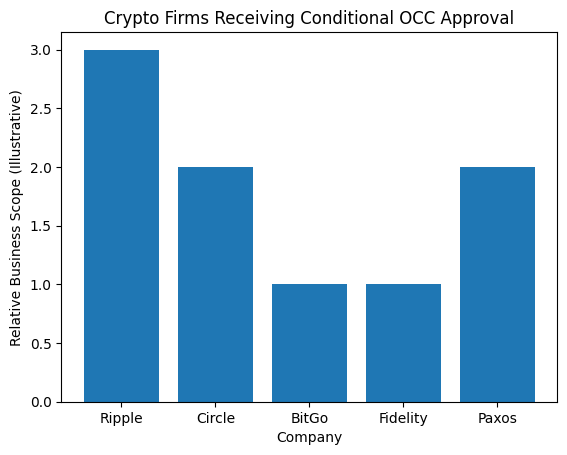
Title: “Crypto Firms Receiving Conditional OCC Approval”
Description: A comparative chart showing Ripple, Circle, BitGo, Fidelity, and Paxos, with columns for business focus (stablecoin, custody, brokerage), regulator coverage, and approval status. 7. What This Means for Crypto Investors and Builders
For investors seeking new assets and revenue models, Ripple’s approval sends several signals:
- Regulatory arbitrage is ending
Long-term winners will be firms that embrace regulation rather than avoid it. - Stablecoins are becoming financial infrastructure
Not speculative instruments, but programmable settlement layers. - Banking and crypto are converging
The distinction between “crypto company” and “financial institution” is eroding. - Compliance-first strategies create defensibility
Barriers to entry will rise, favoring early movers like Ripple.
8. Risks and Remaining Uncertainties
Despite the positive momentum, risks remain:
- Conditional approval is not final authorization
- Regulatory standards may tighten further
- Political shifts could alter regulatory priorities
- Operational costs for compliance-heavy models are high
The OCC’s explicit language underscores that approval can be withdrawn if conditions are not met.
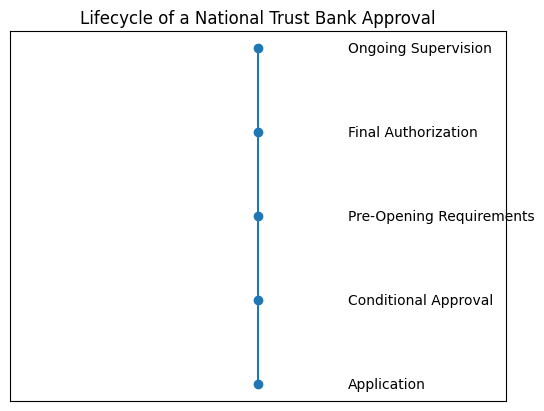
Title: “Lifecycle of a National Trust Bank Approval”
Description: A flow diagram showing stages from application → conditional approval → pre-opening requirements → final authorization → ongoing supervision.
9. Broader Market Impact: A Blueprint for Global Crypto Regulation
Ripple’s case may serve as a global reference model. Regulators in Asia, Europe, and the Middle East are closely observing how the U.S. integrates crypto firms into its banking system.
For jurisdictions like Japan, Singapore, and the Philippines, this reinforces a trend toward:
- Functional regulation over asset classification
- Risk-based supervision
- Alignment with FATF and BIS principles
10. Conclusion: A Structural Turning Point
Ripple’s conditional approval to establish a U.S. national trust bank is not merely a corporate milestone—it is a structural turning point for the digital asset industry.
It demonstrates that crypto firms can meet the same standards as traditional financial institutions, while still leveraging blockchain technology to create new forms of value transfer, liquidity, and financial inclusion.
For readers exploring new crypto assets, revenue opportunities, and practical blockchain use cases, the message is clear:
The next phase of crypto growth will be built not in regulatory shadows, but in regulated daylight.
