
Main Points :
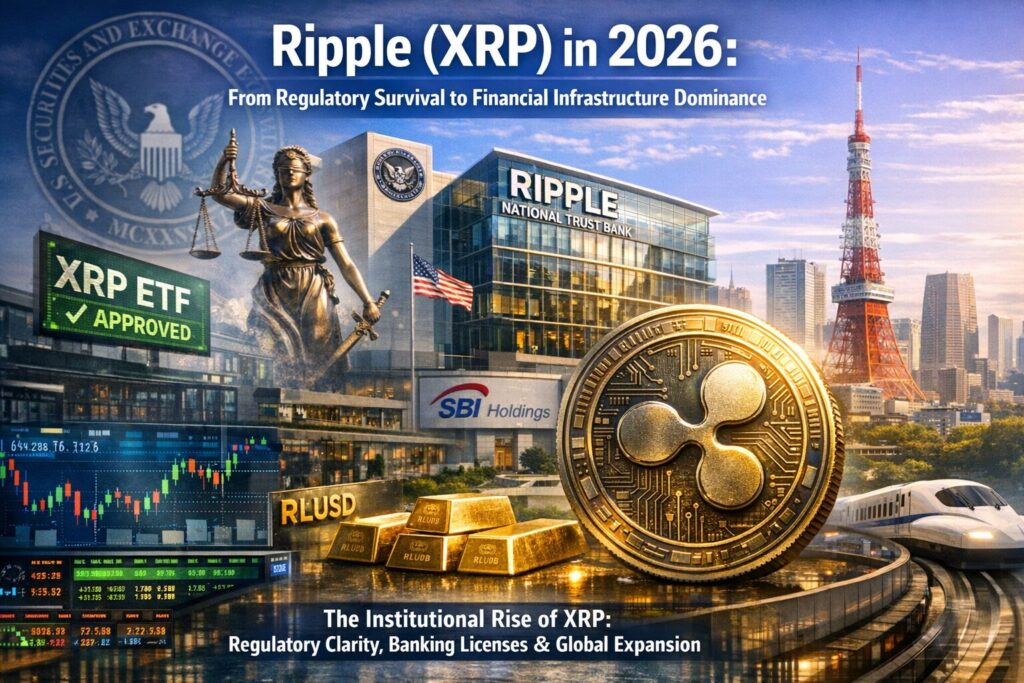
- 2025 marked a historic institutional turning point for Ripple and the XRP ecosystem, with regulatory clarity, banking licensure, and ETF approvals converging.
- The final resolution of the SEC lawsuit removed XRP’s core legal overhang, redefining it as a non-security in secondary markets.
- Ripple’s transformation into a federally recognized financial infrastructure provider was cemented through the approval of Ripple National Trust Bank by the OCC.
- Spot XRP ETFs and the launch of RLUSD fundamentally altered XRP’s market structure and supply dynamics.
- Japan and Asia emerged as strategic expansion hubs, particularly through Ripple’s deepening partnership with SBI Holdings.
- 2026 is widely viewed as the “execution year”, when infrastructure investments begin translating into real transaction volume, institutional flows, and potential price repricing.
Introduction: The End of Uncertainty, the Beginning of Scale
For more than half a decade, Ripple and its native asset XRP existed under a cloud of regulatory ambiguity. While Ripple’s technology quietly embedded itself in global payment corridors, legal risk suppressed institutional adoption, distorted valuation, and limited XRP’s role to speculative trading rather than structural finance.
That era ended decisively in 2025.
What followed was not merely regulatory relief, but a full institutional realignment: lawsuit resolution, stablecoin legislation, federal banking approval, ETF launches, and the rollout of a compliant U.S. dollar stablecoin. Together, these developments repositioned Ripple from a “crypto company defending itself” into a regulated financial infrastructure provider.
As 2026 approaches, market participants are increasingly asking not if XRP will matter, but how much of the global payments stack it can realistically absorb.
1. The SEC Lawsuit Resolution and Regulatory Normalization
A Legal Chapter Closed
The single most important catalyst of 2025 was the formal conclusion of Ripple’s long-running dispute with the U.S. Securities and Exchange Commission. The final settlement confirmed that secondary-market XRP transactions do not constitute securities transactions, extinguishing the core legal risk that had deterred U.S. exchanges and institutional investors.
The originally demanded penalty—nearly $2,000,000,000—was reduced to $50,000,000, paired with forward-looking compliance commitments rather than punitive restrictions. From a financial perspective, the settlement was immaterial. From a signaling perspective, it was transformative.
This outcome coincided with a broader shift in U.S. political and regulatory posture following the January 2025 administration change. The appointment of Paul Atkins as SEC Chair and the passage of the GENIUS Act, which clarified stablecoin regulatory standards, created an environment where compliance became a pathway to growth rather than an obstacle.
2. Ripple National Trust Bank: Becoming Part of the U.S. Financial Core
From Tech Vendor to Regulated Institution
In December 2025, Ripple received conditional approval from the Office of the Comptroller of the Currency to establish Ripple National Trust Bank (RNTB). This milestone placed Ripple in a category few crypto-native firms have reached: federally supervised financial institutions.
Unlike state-level money transmitter licenses, an OCC charter enables nationwide operations under a unified regulatory framework. This allows Ripple to provide:
- Digital asset custody
- Settlement and clearing services
- Stablecoin reserve management
- Institutional-grade compliance and reporting
Strategic acquisitions—such as Standard Custody and Hidden Road—had already laid the groundwork. The OCC approval effectively connected those capabilities into a single regulated balance-sheet entity.
For institutional clients, this matters far more than token price. It defines counterparty trust, regulatory certainty, and long-term survivability.
3. XRP Spot ETFs and Structural Market Transformation
ETF Approval as a Supply Shock Mechanism
Following the lawsuit’s conclusion, a wave of spot XRP ETFs launched in late 2025, led by firms such as Bitwise and Canary Capital. These products enabled institutional and retirement-account exposure to XRP without direct custody risks.
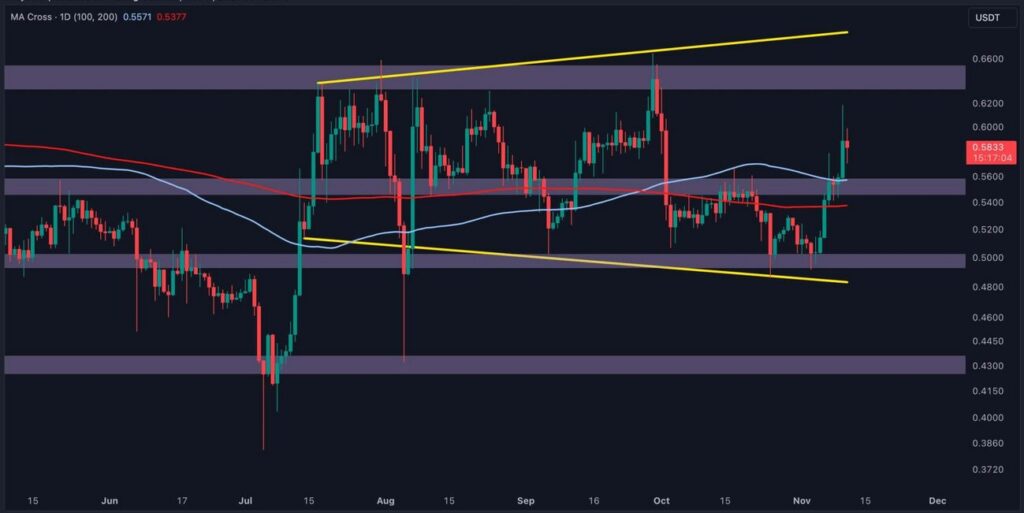
The mechanical effect was immediate: large quantities of spot XRP were locked into custodial ETF wallets, reducing circulating supply. Notably, XRP maintained a strong $2.00 price support even during broader crypto market pullbacks—an early sign of decoupling driven by structural demand rather than speculative leverage.
This mirrors early Bitcoin ETF dynamics, but with one critical difference: XRP’s primary value proposition is transactional utility, not store-of-value scarcity alone.
4. RLUSD: Stablecoins as the Missing Link
A Compliance-First Dollar Token
In 2025, Ripple launched RLUSD, a U.S. dollar-pegged stablecoin fully backed by short-term U.S. Treasuries and cash equivalents. By December, RLUSD reached a $1,000,000,000 market capitalization, signaling rapid institutional uptake.
RLUSD is designed not to compete with XRP, but to complement it:
- RLUSD provides price-stable settlement
- XRP functions as liquidity bridge and transaction rail
- XRPL enables near-instant, low-cost finality
This architecture positions Ripple to serve banks, fintechs, and enterprises that require both regulatory clarity and blockchain efficiency.
5. Japan and Asia: Strategic Expansion Beyond the U.S.
Japan as a Model Market
Ripple’s partnership with SBI Holdings has long been one of its most important alliances. In 2025, that relationship deepened as SBI VC Trade announced plans to support RLUSD distribution in Japan.
Japan’s regulatory environment—clear, conservative, and enforcement-driven—makes it an ideal proving ground for compliant blockchain finance. If RLUSD succeeds in Japan, it strengthens Ripple’s case across Asia-Pacific markets, where cross-border settlement efficiency is economically critical.
6. Looking Ahead to 2026: Execution Over Narrative
Why Analysts Are Increasingly Bullish
By 2026, Ripple will no longer be judged on promises, but on throughput. Analysts point to several potential catalysts:
- Partial migration of SWIFT-based flows to XRPL-enabled corridors
- Increased ETF inflows as compliance costs decline
- Reduced friction under anticipated legislation such as the Clarity Act
- Expansion of bank-to-bank stablecoin settlement using RLUSD
While price forecasts vary widely, the underlying thesis is consistent: XRP’s valuation may increasingly reflect infrastructure usage rather than speculative cycles.
Conclusion: XRP’s Second Act Has Begun
Ripple’s journey through 2025 represents one of the most significant transformations in crypto history. From regulatory exile to institutional acceptance, the company has rebuilt itself into a regulated, bank-adjacent infrastructure provider.
For investors and operators focused on real-world blockchain adoption, XRP’s story is no longer about legal survival. It is about scale, compliance, and execution.
If 2025 was the year Ripple earned its license to operate, 2026 may be the year it proves why that license matters.
