

Main Points :
- Quantum computing is not an existential threat to Bitcoin, but a catalyst for protocol evolution.
- A transition to quantum-resistant cryptography can significantly enhance network security.
- Lost and inactive coins that fail to migrate may be frozen, effectively reducing Bitcoin’s circulating supply.
- Reduced effective supply increases scarcity, reinforcing Bitcoin’s deflationary nature.
- Bitcoin’s adaptive governance model demonstrates its anti-fragile characteristics in the face of technological disruption.
- For long-term investors and blockchain practitioners, quantum risk may paradoxically strengthen Bitcoin’s economic fundamentals.
Introduction: The Quantum Question Facing Bitcoin
As quantum computing advances from theory toward practical implementation, concerns about its impact on cryptographic systems have intensified. Bitcoin, which relies on elliptic curve cryptography (ECDSA) for transaction signatures, is often cited as vulnerable to sufficiently powerful quantum machines.
However, Michael Saylor, Chairman of Strategy and one of Bitcoin’s most prominent advocates, has proposed a radically different perspective. On December 17, 2025, Saylor stated that quantum computing would not destroy Bitcoin. Instead, it would force a “Bitcoin Quantum Leap”—an evolutionary upgrade that strengthens the network, improves security, and reduces effective supply.
This article expands on Saylor’s thesis, incorporates broader industry research, and examines why quantum computing may ultimately reinforce Bitcoin’s position as the most resilient digital asset ever created.
1. The Concept of the “Bitcoin Quantum Leap”
Michael Saylor frames Bitcoin not as static software, but as an evolving digital organism governed by consensus. In his view, technological threats do not weaken Bitcoin; they pressure it to adapt.
Quantum computing, rather than enabling mass theft, would trigger a network-wide upgrade to quantum-resistant cryptography. Active participants would migrate their coins to new secure address formats, while abandoned or inaccessible coins would remain locked.
This evolutionary pressure mirrors natural selection: only coins with active stewardship survive. The result is a leaner, more secure, and more scarce monetary system.
Saylor summarized this idea succinctly:
“Quantum computing will not break Bitcoin. It will strengthen it.”
2. Quantum Resistance and Protocol Upgrades
Why Quantum Computing Matters
Quantum computers threaten classical cryptography by exploiting Shor’s algorithm, which can theoretically break elliptic curve signatures. While today’s quantum machines are far from capable of such attacks, the long-term risk is undeniable.
Bitcoin, however, is not frozen in time.
Upgradeable by Design
Bitcoin’s protocol can evolve through community consensus, typically via soft forks. Quantum-resistant signature schemes—such as lattice-based or hash-based cryptography—are already being researched by the broader cryptographic community and standardized by organizations like NIST.
Once a viable standard emerges, Bitcoin developers could propose:
- New quantum-resistant address formats
- A migration period for users to move funds
- Backward compatibility rules to protect the network
This approach preserves decentralization while upgrading security.
3. Active Coins Migrate, Lost Coins Freeze
One of the most controversial and economically significant aspects of Saylor’s thesis is what happens to unmigrated coins.
The Migration Mechanism
- Active holders move BTC to quantum-resistant addresses.
- Coins that remain in legacy formats beyond a defined period are effectively frozen.
- This prevents quantum attackers from exploiting old keys.
- Lost coins—already inaccessible—remain permanently locked.
Security and Economics Combined
This process simultaneously:
- Raises the cost of attack dramatically
- Prevents quantum theft
- Removes dormant supply from circulation
Rather than reviving lost coins, quantum resistance may permanently eliminate them from the effective supply.
Illustrative Bitcoin Effective Supply After Quantum Migration
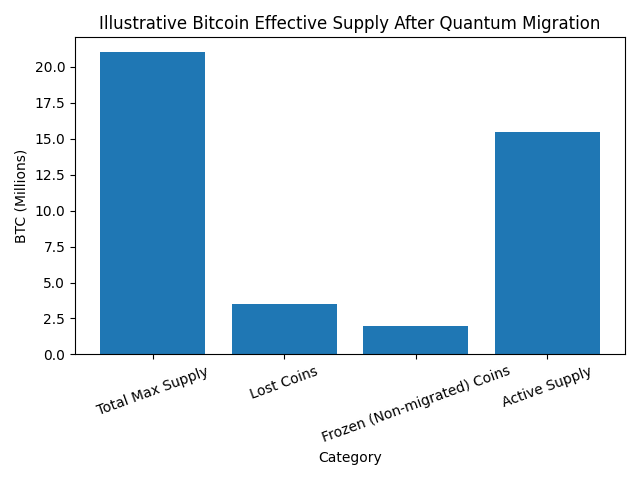
This chart illustrates how total supply differs from effective circulating supply once lost and non-migrated coins are excluded.
4. Supply Reduction and Scarcity Amplification
Bitcoin’s maximum supply is capped at 21 million BTC. However, multiple studies estimate that 3–4 million BTC are already lost due to forgotten keys, early mining mistakes, or destroyed wallets.
Quantum-era migration could add another layer of supply reduction:
- Coins not migrated become non-spendable
- Effective supply shrinks further
- Remaining BTC become more scarce
From an economic perspective, this resembles an unplanned but protocol-enforced “burn,” strengthening Bitcoin’s deflationary properties.
5. Bitcoin as an Anti-Fragile System
The concept of anti-fragility—systems that gain from disorder—applies uniquely well to Bitcoin.
- Regulatory pressure improves compliance tooling
- Market crashes harden investor conviction
- Technological threats force protocol upgrades
Quantum computing fits this pattern perfectly. Instead of collapsing under pressure, Bitcoin adapts, upgrades, and emerges stronger.
Saylor often describes Bitcoin as “digital energy.” In this framing, quantum computing is not a weapon but a refining force—burning away weak elements and increasing purity.
6. Broader Industry Perspectives and Recent Developments
Beyond Saylor, the crypto industry has increasingly acknowledged quantum risk without panic:
- NIST has finalized multiple post-quantum cryptography standards.
- Ethereum researchers are exploring quantum-resistant account models.
- Hardware wallet manufacturers are researching future-proof signing schemes.
Importantly, no credible roadmap suggests quantum computers capable of breaking Bitcoin will appear suddenly. The transition window is likely measured in decades, not years.
This gives Bitcoin ample time to evolve deliberately.
Illustrative Timeline: Bitcoin Quantum Resistance Evolution
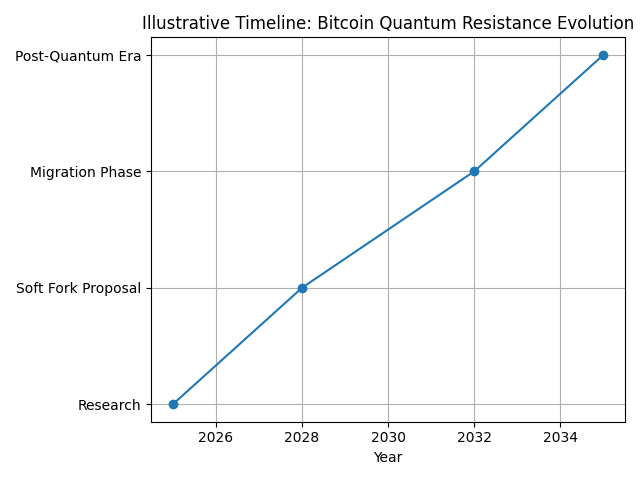
This timeline shows a plausible multi-stage path from research to post-quantum Bitcoin.
7. Implications for Investors and Builders
For investors seeking new digital assets and long-term value preservation, Saylor’s thesis reframes quantum risk as opportunity:
- Reduced effective supply supports higher long-term valuation
- Stronger cryptography reinforces Bitcoin’s security premium
- Network upgrades validate Bitcoin’s adaptability
For builders and blockchain practitioners:
- Quantum resistance research becomes a strategic priority
- Wallet UX around migration will matter
- Governance and consensus mechanisms gain renewed importance
Bitcoin’s response to quantum computing may become a blueprint for how decentralized systems survive paradigm shifts.
Conclusion: Quantum Computing as Bitcoin’s Unexpected Ally
The fear that quantum computing will “kill Bitcoin” misunderstands Bitcoin’s nature. Bitcoin is not a brittle algorithm frozen in time. It is a living protocol governed by economic incentives, human coordination, and technological adaptability.
Michael Saylor’s “Bitcoin Quantum Leap” thesis highlights a counterintuitive truth: the very forces that appear most dangerous to Bitcoin may end up reinforcing its strongest attributes—scarcity, security, and resilience.
If quantum computing accelerates Bitcoin’s evolution, reduces effective supply, and strengthens trust in its long-term viability, then the quantum era may mark not Bitcoin’s downfall, but its maturation into the most robust monetary network humanity has ever built.
