
Main Points :
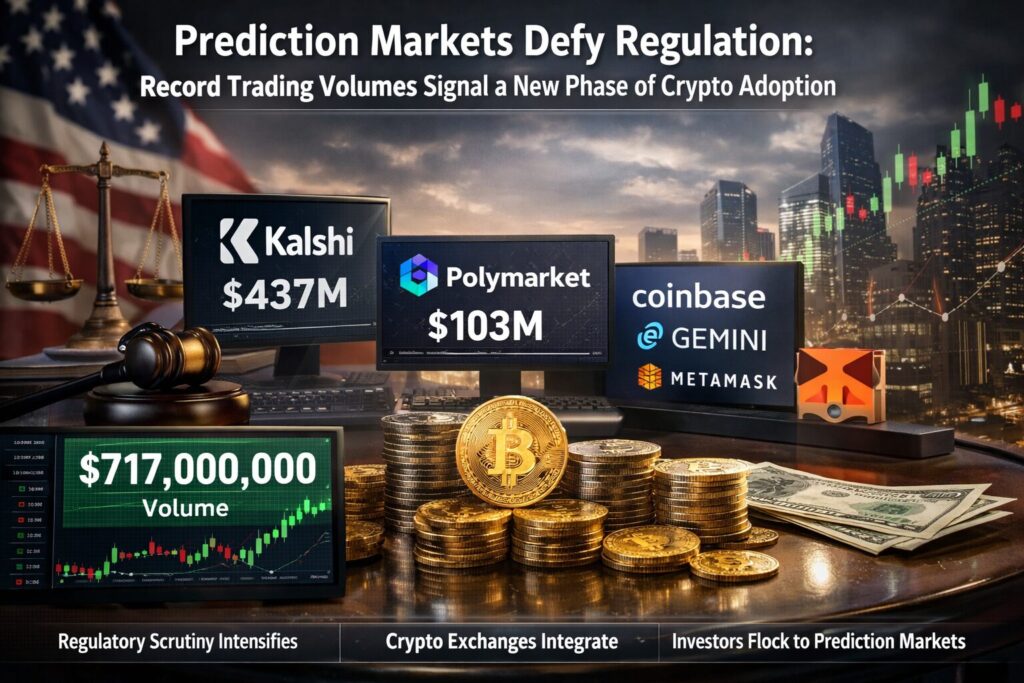
- Prediction markets recorded an all-time high daily trading volume of approximately $717 million in early 2026, despite tightening regulatory scrutiny in the United States and abroad.
- Kalshi accounted for roughly two-thirds of total volume, while Polymarket and other competitors each contributed around $100 million in daily trades.
- Major crypto exchanges and wallets—including Coinbase, Gemini, and MetaMask—are actively integrating prediction market functionality, accelerating mainstream adoption.
- Regulatory pressure is intensifying due to concerns around insider information, gambling classification, and political sensitivity, yet courts and market demand continue to support growth.
- For investors and builders, prediction markets are emerging as one of the most practical, revenue-generating real-world blockchain use cases.
Introduction: When Regulation Meets Market Demand
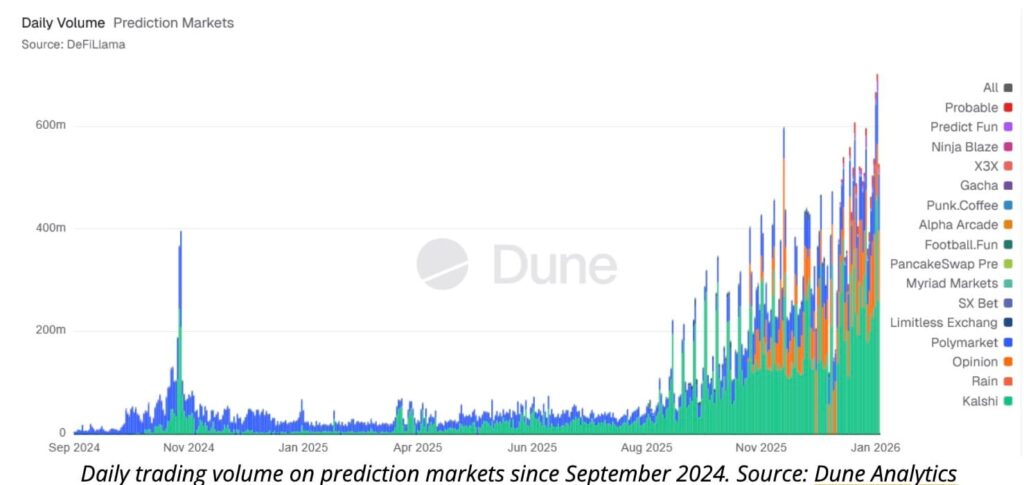
In early 2026, prediction markets delivered a clear and unexpected message to regulators: demand is not slowing down. Even as lawmakers and regulators across the United States and other jurisdictions attempt to curb or tightly define these platforms, trading activity has surged to unprecedented levels. According to aggregated on-chain and platform data compiled by Gate Research using Dune Analytics, daily trading volume reached a record $717 million, surpassing the previous high of approximately $666 million set just one day earlier.
This growth is not occurring in a vacuum. Prediction markets have quietly transformed from niche experiments into one of the most compelling applications of blockchain technology. They combine financial incentives, collective intelligence, and transparent settlement mechanisms—elements that resonate strongly with traders, institutions, and developers searching for new crypto-native revenue models.
Record-Breaking Numbers: Who Is Driving the Volume?
Kalshi Takes the Lead
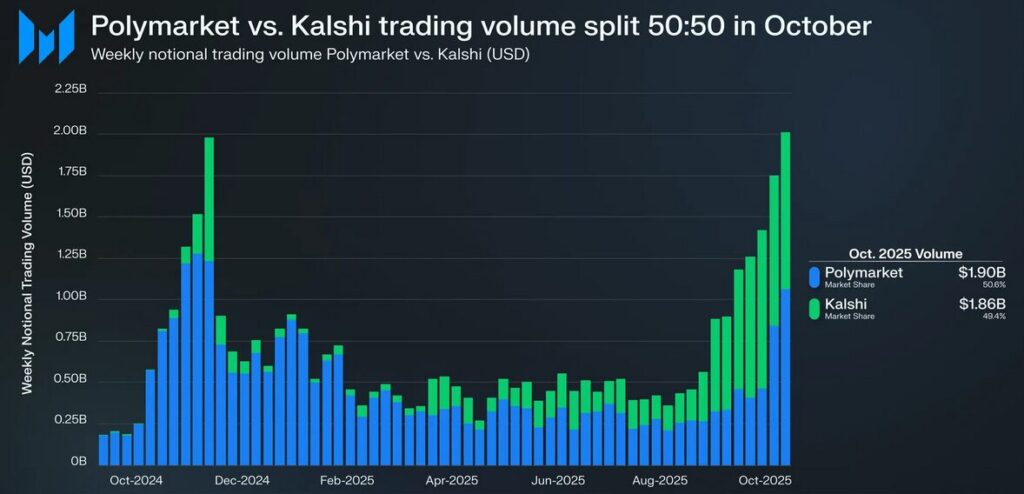
The most striking feature of the recent surge is the dominance of Kalshi. Out of the total $717 million in daily trading volume, Kalshi accounted for approximately $465.9 million, or nearly two-thirds of all activity. This gap mirrors the previous day’s figures and suggests not a one-off spike, but sustained leadership.
Kalshi’s appeal lies in its regulated approach and its focus on event-based contracts that resemble financial derivatives rather than pure gambling instruments. This positioning has helped it attract both retail and sophisticated participants, even as regulatory scrutiny increases.
Polymarket and Emerging Competitors
Behind Kalshi, Polymarket recorded around $100 million in daily volume, with other platforms such as Opinion contributing similar figures. While smaller in absolute terms, these competitors play a critical role in expanding the overall ecosystem, offering diverse market structures, topics, and user experiences.
Together, these platforms demonstrate that prediction markets are no longer a single-platform phenomenon but a rapidly expanding sector with multiple viable players.
From Niche to Mainstream: Integration Across Crypto Infrastructure
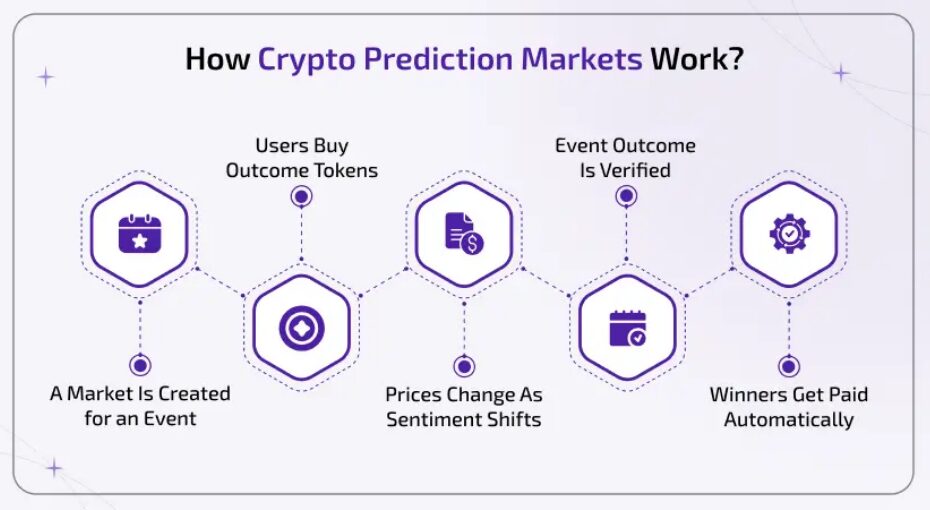
One of the most important trends accelerating adoption is deep integration into existing crypto infrastructure. Several major exchanges and wallets are either rolling out or planning to roll out prediction market features.
- Coinbase and Gemini have both explored or announced integrations that allow users to access prediction markets directly from familiar trading interfaces.
- Self-custodial wallets such as MetaMask are also moving in this direction, lowering friction for users who prefer non-custodial control.
These integrations matter because they transform prediction markets from standalone platforms into embedded financial primitives. Users no longer need to learn new systems or move funds across multiple applications. Instead, prediction contracts become just another asset class—alongside spot crypto, derivatives, and stablecoins.
Why Prediction Markets Are Exploding Now
Exponential Adoption Since 2024
Data shows that daily trading volumes have grown exponentially since late 2024. What began as a gradual increase has turned into a near-vertical curve since August of that year. This pattern mirrors earlier crypto adoption cycles, where infrastructure maturity and narrative alignment triggered sudden growth.
Prediction markets benefit from several converging forces:
- Increased on-chain liquidity
- Better UX and wallet integration
- Growing interest in alternative yield and information-based trading strategies
A Compelling Real-World Use Case
Unlike many speculative crypto products, prediction markets solve a clear, real-world problem: aggregating distributed information into actionable price signals. Whether forecasting elections, macroeconomic indicators, sports outcomes, or geopolitical events, these markets often outperform traditional polling or expert forecasts.
For traders, this translates into tangible opportunities for alpha. For institutions, it offers a new class of data and risk-hedging tools.
Regulatory Spotlight Returns
Insider Information Concerns
In early January, prediction markets once again drew regulatory attention after reports surfaced that an anonymous user on Polymarket placed approximately $30,000 on the downfall of Venezuelan President Nicolás Maduro just hours before his detention became public. The position reportedly paid out over $400,000, raising concerns about potential insider information.
While no definitive wrongdoing was proven, the incident highlighted a fundamental regulatory challenge: how to police information asymmetry in decentralized or semi-decentralized markets.
State-Level Restrictions in the United States
Several U.S. states—including New York, Connecticut, Nevada, and New Jersey—have attempted to restrict or ban certain types of prediction markets, particularly those tied to politics, sports, or equities. In New York, lawmakers are preparing to debate legislation aimed at prohibiting these markets altogether.
Operators have responded aggressively, often pursuing legal action to challenge state authority. In Tennessee, for example, Kalshi was ordered to halt sports-related contracts. However, a federal court temporarily blocked the state regulator’s decision, underscoring the ongoing legal ambiguity surrounding these platforms.
International Developments
Regulatory pressure is not limited to the United States. Ukraine recently blocked access to Polymarket, classifying prediction markets as gambling under local law. Similar debates are unfolding in Europe and Asia, where regulators struggle to fit prediction markets into existing legal frameworks.
Wall Street Takes Notice
Despite—or perhaps because of—regulatory tension, traditional finance is paying close attention. Both Kalshi and Polymarket have reportedly achieved multi-billion-dollar valuations, reflecting expectations that prediction markets could become core financial infrastructure rather than fringe products.
For institutional investors, these platforms resemble a hybrid of derivatives exchanges, data providers, and alternative asset markets. The potential to monetize information itself is a powerful proposition, especially in an era dominated by macro uncertainty and rapid information flow.
Implications for Crypto Investors and Builders
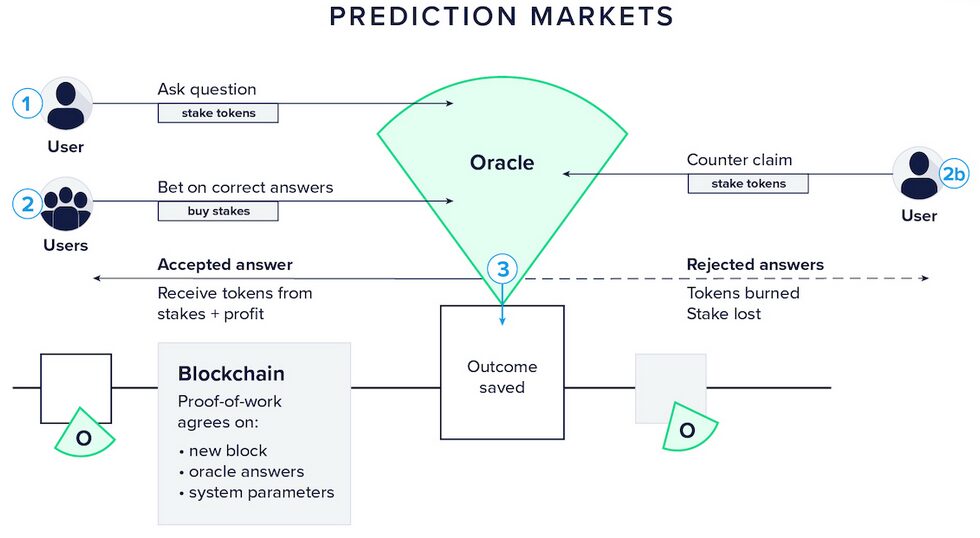
For readers searching for new crypto assets, revenue streams, and practical blockchain applications, prediction markets deserve close attention.
- Investors can view prediction markets as both a trading venue and an indirect bet on the future of decentralized information finance.
- Builders can explore opportunities in tooling, data analytics, compliance layers, and cross-platform integrations.
- Institutions may leverage these markets for hedging, forecasting, or even internal decision-making.
The key insight is that prediction markets are no longer speculative side projects. They are evolving into serious financial infrastructure, capable of attracting liquidity, talent, and regulatory debate at scale.
Conclusion: A Market That Refuses to Slow Down
The record $717 million daily trading volume in early 2026 marks a turning point for prediction markets. Even as regulators attempt to rein them in, user demand, technological integration, and institutional interest continue to push the sector forward.
History suggests that when regulation and innovation collide, the outcome is rarely simple suppression. More often, it leads to adaptation, clearer frameworks, and ultimately broader adoption. Prediction markets appear to be entering exactly such a phase—one where their economic utility is too compelling to ignore.
For the crypto ecosystem as a whole, this surge signals something deeper: blockchain is moving beyond speculation and into functional, information-driven finance.
