
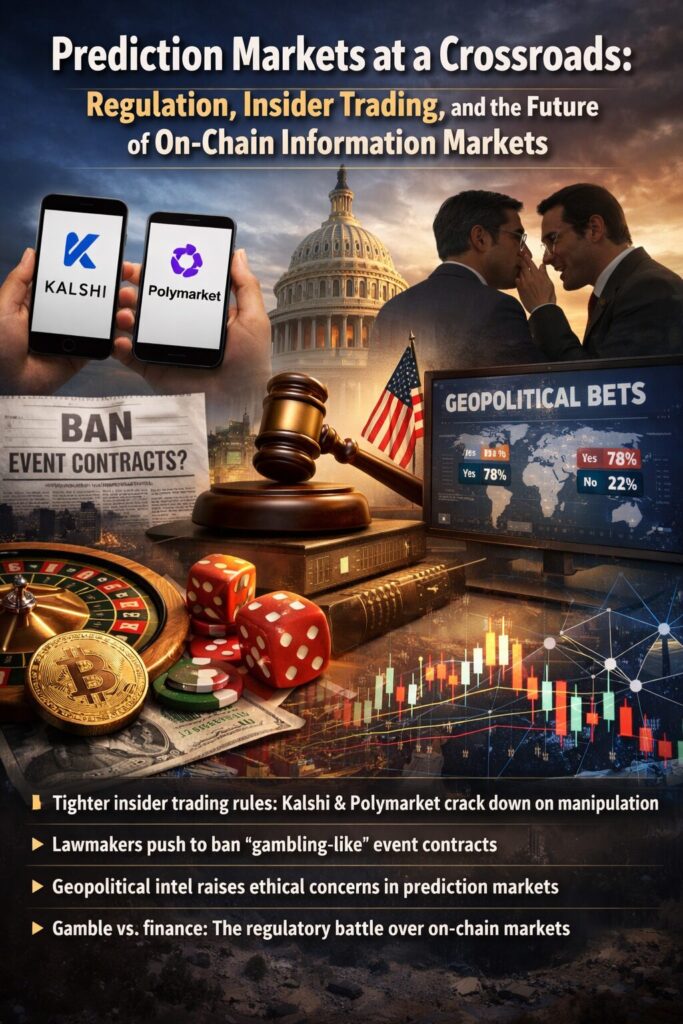
Key Points :
- Prediction markets like Kalshi and Polymarket are tightening insider trading rules amid manipulation concerns
- U.S. lawmakers are proposing a bipartisan bill to ban “gambling-like” event contracts
- Insider information in geopolitical bets has raised credibility and ethical concerns
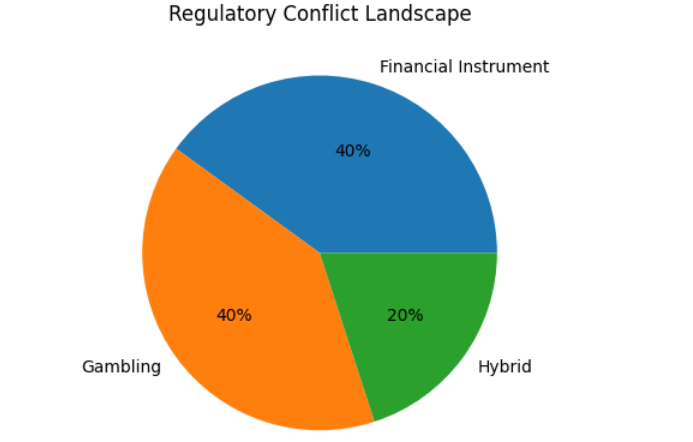
- Regulatory conflict centers on whether prediction markets are gambling or financial instruments
- The future of prediction markets may reshape crypto, finance, and information discovery
1. Introduction: The Rise of Prediction Markets as a Financial Primitive
Prediction markets have rapidly evolved from niche experimental platforms into a significant component of the broader crypto-financial ecosystem. Platforms such as Kalshi and Polymarket allow users to trade on the probability of real-world events—ranging from elections and economic indicators to geopolitical conflicts—by buying and selling event-based contracts.
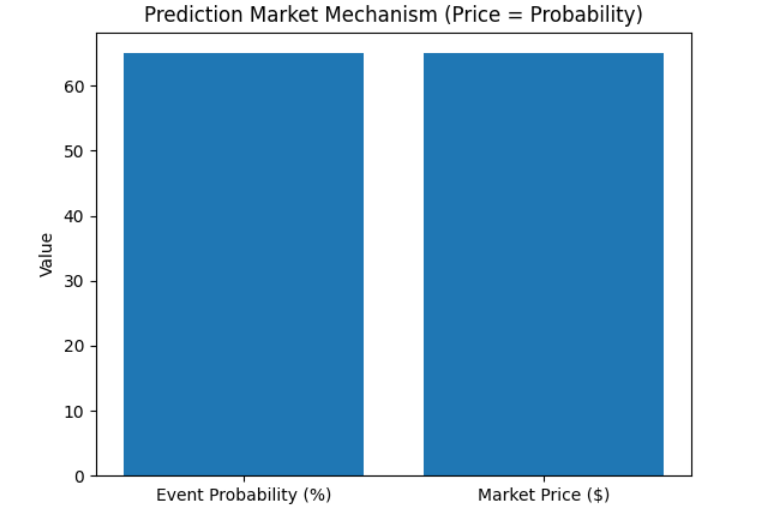
Unlike traditional betting systems, these markets present themselves as information aggregation mechanisms, where prices reflect collective expectations. A contract priced at $0.65 implies a 65% probability of an event occurring. This model has attracted not only retail participants but also institutional observers who view prediction markets as superior forecasting tools compared to traditional polling or analyst reports.
However, as these markets grow in size and influence, they increasingly face scrutiny from regulators, policymakers, and financial authorities. The recent developments in insider trading controls and proposed U.S. legislation mark a critical turning point.
Prediction Market Mechanism (Price = Probability)
2. Insider Trading Concerns: When Information Becomes Power
Recent controversies have highlighted a fundamental vulnerability in prediction markets: information asymmetry.
In several high-profile cases, including bets related to a hypothetical U.S.-Israel military action against Iran or a potential capture operation involving Venezuela’s President Nicolás Maduro, unusual trading patterns suggested that some participants may have had access to privileged or insider information.
Analysts observed:
- Trades executed at market prices rather than exploiting spreads
- Use of multiple accounts to obscure identity
- Timing of trades aligned closely with real-world developments
Ben Yorke, a former research analyst, noted that such behavior strongly indicates the presence of individuals trading based on non-public information.
This creates a paradox. Prediction markets are supposed to reward informed participants, yet when information is obtained illegally or unethically, the system risks losing legitimacy.
3. Platform Response: Kalshi and Polymarket Tighten Controls
In response to mounting criticism, both Kalshi and Polymarket announced new measures aimed at preventing insider trading and market manipulation.
Kalshi’s Measures
- Prohibition of election candidates trading on their own races
- Restrictions on athletes, referees, and insiders participating in sports-related contracts
Polymarket’s Expanded Rules
- Ban on trading using stolen or confidential information
- Restrictions on users who can influence market outcomes
- Enforcement mechanisms targeting multi-account abuse
These measures represent a shift toward self-regulation, mirroring traditional financial markets where insider trading laws are strictly enforced.
Importantly, Kalshi emphasized that these policies had been under development for months, suggesting that platforms anticipated regulatory pressure and sought to act proactively.
4. Legislative Pressure: The “Prediction Market Gambling Ban”
On the same day these platform changes were announced, U.S. lawmakers introduced a bipartisan bill aimed at restricting prediction markets.
The proposed legislation, informally referred to as the “Prediction Market Gambling Act,” seeks to:
- Prohibit event contracts that resemble sports betting or casino games
- Restrict platforms registered under the Commodity Futures Trading Commission (CFTC)
- Clarify jurisdiction between federal regulators and state gambling authorities
Representative Adam Schiff argued that many prediction contracts are indistinguishable from gambling, stating that they effectively bypass state and federal laws.
Meanwhile, Senator John Curtis emphasized that the bill is designed to preserve state authority over gambling regulation.
Regulatory Conflict Landscape
5. Industry Pushback: Innovation vs. Protectionism
Industry leaders have strongly opposed the proposed legislation. Kalshi CEO Tarek Mansour criticized the bill as being driven by lobbying from the casino industry rather than genuine consumer protection concerns.
From the industry’s perspective:
- Prediction markets are financial tools, not gambling platforms
- They contribute to price discovery and information efficiency
- Overregulation could stifle innovation in decentralized finance
This debate echoes earlier conflicts in crypto history, such as the classification of tokens as securities versus commodities.
6. Legal Battles: State vs. Federal Authority
Prediction market platforms, including Kalshi, Polymarket, and even major crypto firms like Coinbase, are currently engaged in legal disputes across multiple U.S. states.
Key Legal Questions:
- Are event contracts equivalent to gambling?
- Do states or federal regulators have jurisdiction?
- Should prediction markets fall under financial derivatives regulation?
States argue that these contracts require gambling licenses, while platforms maintain that they are regulated financial products under the CFTC.
This jurisdictional ambiguity creates operational risk for companies and uncertainty for investors.
7. Broader Implications: The Future of Crypto-Native Markets
Prediction markets represent a broader trend toward tokenized information markets.
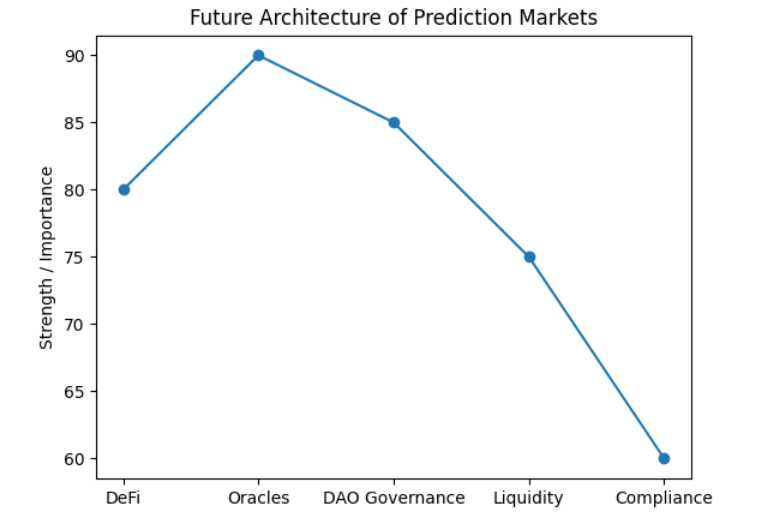
In the crypto ecosystem, these platforms can be integrated with:
- DeFi protocols (for liquidity and leverage)
- Oracles (for outcome verification)
- DAOs (for governance and dispute resolution)
If properly regulated, prediction markets could become:
- A new asset class
- A tool for hedging geopolitical risk
- A mechanism for decentralized forecasting
However, if heavily restricted, innovation may migrate offshore or into fully decentralized, unregulated environments.
Future Architecture of Prediction Markets
8. Investment Perspective: Opportunity and Risk
For investors seeking new revenue streams, prediction markets present both opportunities and risks.
Opportunities
- Arbitrage between platforms
- Early access to market sentiment
- Participation in emerging financial primitives
Risks
- Regulatory shutdowns
- Insider-driven market distortions
- Liquidity fragmentation
In USD terms, transaction costs, regulatory compliance, and potential legal exposure must all be factored into strategy.
Conclusion: A Defining Moment for Prediction Markets
Prediction markets are at a pivotal moment. The convergence of insider trading concerns, regulatory scrutiny, and political pressure is forcing the industry to mature rapidly.
The outcome of current legislative and legal battles will determine whether prediction markets evolve into a recognized financial sector or are relegated to the fringes of the crypto ecosystem.
For builders, investors, and regulators alike, the challenge is to strike a balance between innovation and integrity. If successful, prediction markets could become one of the most transformative applications of blockchain technology—turning collective intelligence into a tradable, transparent, and globally accessible asset.
