
Main Points :
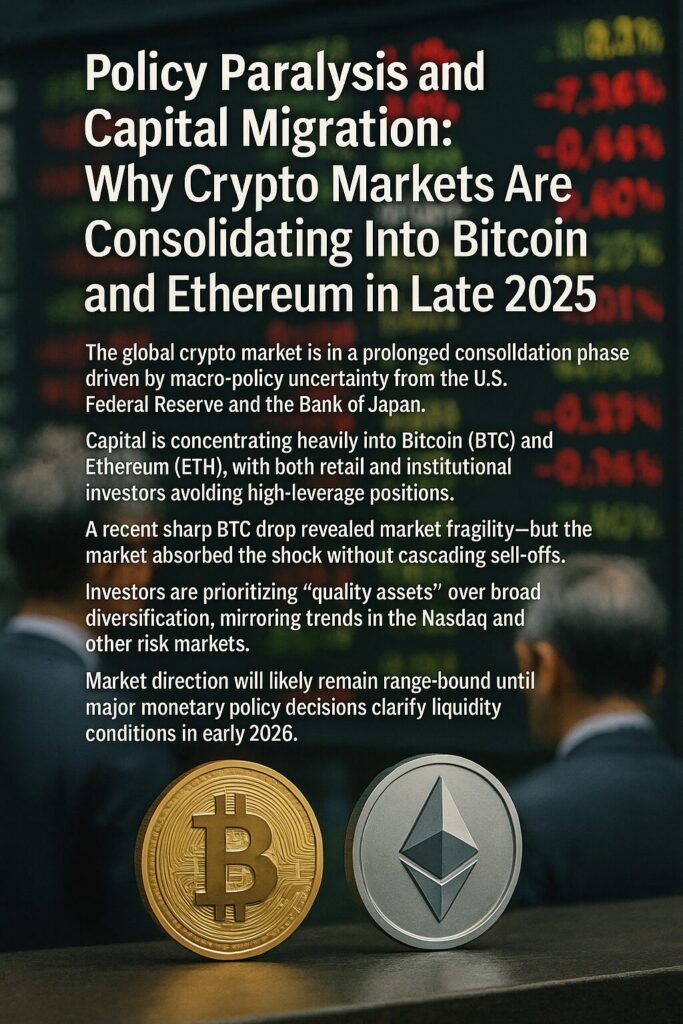
- The global crypto market is in a prolonged consolidation phase driven by macro-policy uncertainty from the U.S. Federal Reserve and the Bank of Japan.
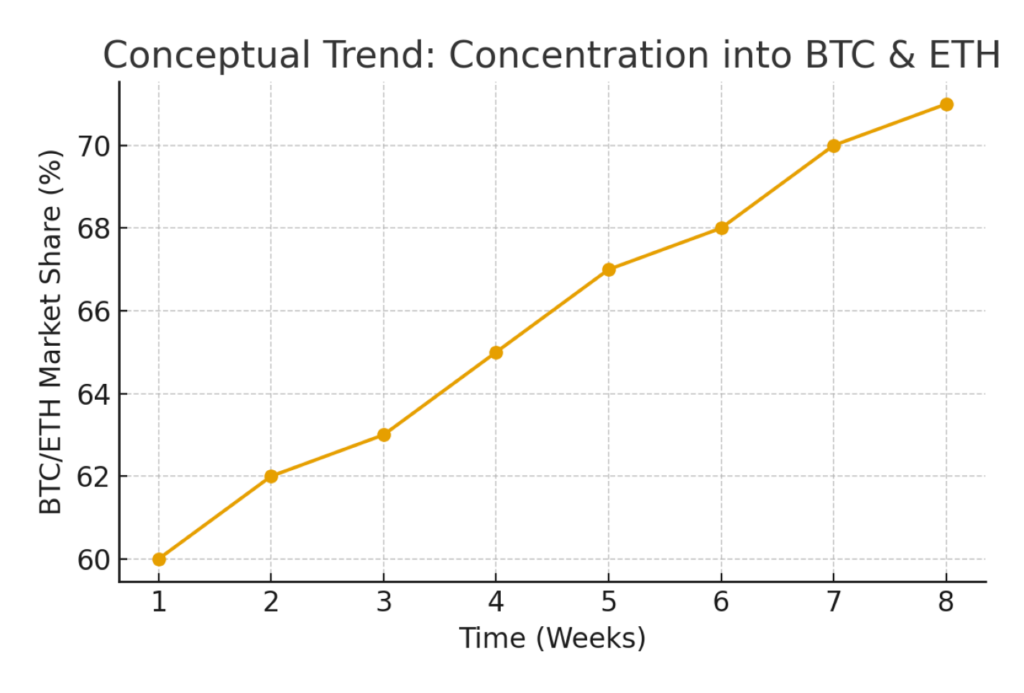
- Capital is concentrating heavily into Bitcoin (BTC) and Ethereum (ETH), with both retail and institutional investors avoiding high-leverage positions.
- A recent sharp BTC drop revealed market fragility—but the market absorbed the shock without cascading sell-offs.
- Investors are prioritizing “quality assets” over broad diversification, mirroring trends in the Nasdaq and other risk markets.
- Market direction will likely remain range-bound until major monetary policy decisions clarify liquidity conditions in early 2026.
1. A Market Waiting for Policy Clarity
Throughout late 2025, the crypto market has remained confined in a narrow consolidation band. According to a new analytical report released by Wintermute on December 8, the industry is experiencing a period of collective hesitation: investors are reluctant to commit to high-risk or high-leverage trades until the world’s major central banks confirm their next moves.
The U.S. Federal Reserve (Fed) and the Bank of Japan (BOJ) are the two most influential institutions in this phase. The Fed’s December meeting—expected to reveal the central bank’s stance on early-2026 rate policy—will directly influence global liquidity. Meanwhile, the BOJ’s upcoming meeting carries unusual weight because shifts in its long-standing yen policies could destabilize or unwind multi-year carry trades. Any volatility in the foreign exchange market tends to affect Bitcoin liquidity, especially across Asia.
Wintermute’s analysis argues that the last two months have introduced significant macroeconomic ambiguity. Inflation surprises, shifting energy prices, and divergent policy expectations have created a steady background of uncertainty. Although the market has become more resilient to negative news, traders are still unwilling to take directional risks until policy expectations stabilize.
This cautious environment has produced a predictable behavioral pattern:
capital is concentrating into the highest-quality digital assets—Bitcoin and Ethereum.
2. How BTC and ETH Became the Safe Havens of Crypto Again
BTC and ETH have regained dominance as the preferred assets during uncertain economic periods. As of early December, Bitcoin has recovered to around $92,000, while the broader market has rebounded to a total capitalization of $3.25 trillion.
Across both retail traders and institutional funds, flows have aligned decisively toward BTC and ETH. Wintermute observes three emerging characteristics:
- Low leverage:
Investors prefer spot allocations and lightly margined derivative positions. Markets fear unexpected policy shocks, so high leverage—normally a driver of volatility—has decreased significantly. - Simultaneous inflows from retail and institutions:
This dual participation is usually a bullish long-term signal. It indicates convergence in risk perception and reduces the likelihood of isolated sell-off cycles from over-leveraged retail positions. - Defensive positioning:
Even those who are bullish prefer the assets with the strongest liquidity, longest track records, and most predictable regulatory treatment.
With hundreds of alternative layer-1 and DeFi tokens underperforming, Bitcoin and Ethereum have once again become the default stores of value during macroeconomic ambiguity.
3. BTC’s Sudden $4,000 Drop: Fragility Revealed, Confidence Restored
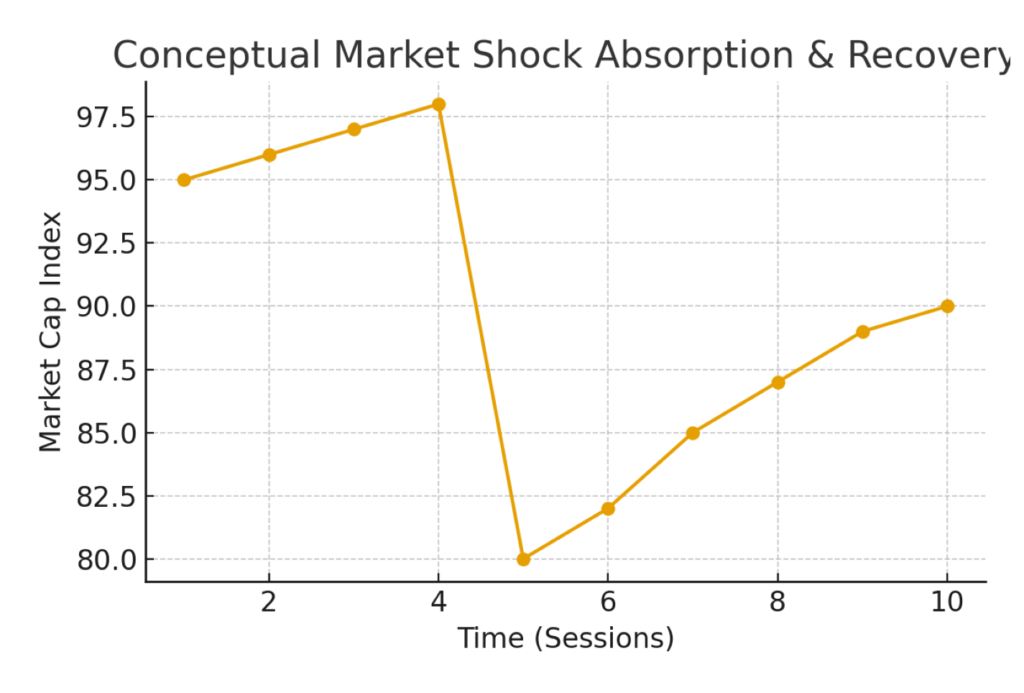
On the first Friday of December, Bitcoin abruptly plunged by roughly $4,000, triggering nearly $2 billion in liquidations within an hour. But what looked like the beginning of a catastrophic unwind did not escalate.
Wintermute emphasizes a crucial observation:
the market absorbed the shock without additional selling pressure.
This resilience has several implications:
(1) Liquidity Depth Remains Strong in Major Pairs
Even during the drop, BTC/USDC and BTC/USD maintained reasonable order-book depth at leading exchanges. Automated market makers (AMMs) and centralized market makers stepped in quickly to tighten spreads.
(2) Fear Dominates but Does Not Escalate
A high-leverage environment would typically trigger cascading liquidations. Instead, liquidation volume stabilized quickly, showing that leverage levels remain far below speculative peaks seen in previous cycles.
(3) Investors Still View BTC & ETH as Core Holdings
Even risk-averse investors treat these assets as strategic positions. The shock was interpreted as a buying opportunity rather than a structural failure.
Many analysts argue that this stability reinforces the narrative that Bitcoin and Ethereum will continue capturing disproportionate value during periods of macroeconomic turbulence.
4. Quality Over Quantity: Selective Risk-Taking Defines Late 2025
A striking parallel emerges between traditional equities and the crypto market.
In the Nasdaq, investors have shifted capital away from broad diversification and into the strongest companies—particularly large-cap technology stocks. Wintermute reports a similar shift within crypto: investors prefer assets with high liquidity, reputable developer ecosystems, and predictable risk parameters.
This behavior is driven by three global factors:
- Cooling AI-related equity momentum
As AI-tech valuations plateau, risk appetite across sectors becomes more selective. - Uncertainty over 2026 global liquidity conditions
Markets cannot yet determine whether next year will bring rate cuts, continued tightening, or mixed policy signals. - Growing institutional adoption of BTC and ETH
Pension funds, sovereign entities, and global corporates increasingly engage with BTC and ETH rather than speculative altcoins.
In such an environment, speculation intensifies on fewer assets, causing capital to cluster in the strongest sectors. This creates the illusion of market strength even while most altcoins stagnate.
5. Will Crypto Stay Range-Bound? Wintermute’s 2026 Outlook
Wintermute argues that unless a major global economic shift occurs, crypto will remain in a defined trading range for the next several months. Factors influencing this projection include:
- Liquidity considerations:
Crypto price performance increasingly correlates with global liquidity injections or withdrawals. - Monetary policy decisions (Fed & BOJ):
The earliest major directional shift could come in Q1 2026. - Investor behavior:
With caution dominating sentiment, the market is unlikely to witness aggressive breakout rallies.
The firm stresses that—at this stage—crypto prices are guided more by capital flow than by fundamentals such as protocol revenue, adoption metrics, or technological advancement. This underscores a key investment theme: until central banks clarify monetary policy, the crypto market will remain a macro-driven asset class.
6. What These Trends Mean for Investors Seeking New Opportunities
For readers interested in new crypto assets, yield strategies, and practical blockchain integration, the present environment offers both opportunities and challenges.
Opportunity 1: Strategic Accumulation
Periods of consolidation historically precede directional breakouts. Accumulating quality assets—BTC, ETH, and select blue-chip infrastructure tokens—remains a rational long-term strategy.
Opportunity 2: Undervalued Infrastructure Projects
With capital concentrated in majors, many infrastructure-layer tokens, real-world asset (RWA) projects, and cross-chain liquidity solutions may be mispriced relative to their fundamentals.
Opportunity 3: Yield Products Without Directional Leverage
Low-leverage market conditions favor structured yield products such as:
- covered calls on BTC/ETH
- delta-neutral liquidity provisioning
- basis trading on futures curves
These allow income generation without requiring extreme directional bets.
Risk 1: False Breakouts
Range-bound markets often create misleading price movements. Investors should monitor funding rates, open interest, and correlation with macro indicators.
Risk 2: Policy Shock Events
Major surprises from the Fed or BOJ could trigger volatility before the market fully adapts.
Conclusion: A Market Hardened but Hesitant
Wintermute’s analysis reveals a market that is stronger than many assume—but also frozen in anticipation. Bitcoin and Ethereum now serve as both risk assets and safe havens, attracting capital from across the investment spectrum.
The next major price cycle will begin only when global policy becomes clearer. Until then, investors must navigate a market where liquidity, selectivity, and resilience matter more than speculative momentum.
For those seeking long-term opportunities, this consolidation period may ultimately prove to be one of the most strategic accumulation phases before the next structural rally.
