

Main Points:
- PNC Bank becomes the first major U.S. bank to offer direct, spot Bitcoin trading inside customer accounts, without routing users to external exchanges.
- Service launches initially for PNC Private Bank clients, targeting high-net-worth individuals.
- Integration is powered by Coinbase’s Crypto-as-a-Service (CaaS) infrastructure, combining custodial security, trade execution, and compliance rails.
- Signals a turning point in TradFi’s acceptance of Bitcoin, potentially accelerating institutional adoption.
- Other major banks are now under pressure to follow, as customer demand for digital assets increases.
- The move reflects a shift from ETF-based exposure to true spot Bitcoin ownership inside regulated banking environments.
Introduction
The announcement that PNC Bank, one of the top ten largest banking institutions in the United States, has begun offering direct spot Bitcoin (BTC) trading marks a watershed moment in the evolution of institutional crypto adoption. Enabled through its expanded partnership with Coinbase, this development moves beyond ETFs, beyond external exchanges, and directly into the heart of traditional banking infrastructure.
For readers who are seeking new digital asset opportunities, emerging revenue models, or practical blockchain integration, this move represents a critical shift: the merging of conservative, regulated banking with natively decentralized digital assets—an intersection many believed would take years to materialize.
This article summarizes the key themes of the original Japanese report, adds broader market context from recent global trends, and provides a complete analytical view of why PNC’s step may reshape the future trajectory of crypto markets.
1. Coinbase Partnership Enables Seamless Direct Bitcoin Trading
PNC Bank’s expanded partnership with Coinbase, announced on December 9, 2025, activates a feature that U.S. banking customers have long requested but were never offered—the ability to buy, sell, and custody spot Bitcoin directly inside their bank account, using the same digital banking interface they already rely on.
Until now, Americans wanting exposure to Bitcoin typically had to:
- Create external accounts with crypto exchanges
- Transfer funds through multiple intermediaries
- Rely on Bitcoin ETFs, which offer price exposure but not real ownership
By integrating Coinbase’s Crypto-as-a-Service (CaaS), PNC Bank eliminates the historical frictions of onboarding to digital assets. Customers can now access Bitcoin without leaving the bank interface—an evolution similar to when stocks first became available inside modern banking apps.
Coinbase’s CaaS handles:
- Trade execution (market orders, liquidity aggregation, routing)
- Cold-storage grade custody for Bitcoin
- Compliance and security, including AML and regulatory controls
This architecture allows PNC Bank to offer crypto without developing its own blockchain infrastructure, accelerating adoption while maintaining regulatory compliance and risk control.
2. Launch Begins with PNC Private Bank Clients
The service will first roll out to customers of PNC Private Bank, the institution’s wealth-management division serving affluent households.
This demographic has shown heightened interest in diversifying portfolios with alternative assets—including Bitcoin, tokenized assets, private credit, and digital-native yield products. Wealth segments often act as early adopters of new financial instruments, so PNC’s strategy aligns with historical patterns in financial innovation.
PNC Private Bank clients will be able to:
- Manage Bitcoin alongside traditional assets (stocks, bonds, funds)
- Monitor performance inside unified dashboards
- Avoid external transfers or self-custody wallets
- Operate within a security model trusted by legacy finance
PNC CEO William Demchak emphasized that rising client demand made this expansion both necessary and inevitable, framing digital assets as “part of the modern financial life cycle.”
3. Why This Is a Historic Step for Institutional Crypto Adoption
Even though hundreds of U.S. regional banks explored crypto custody pilots in previous years, no major U.S. bank had ever taken the step of enabling customers to hold spot Bitcoin directly inside their banking account. Regulatory ambiguity had discouraged meaningful progress.
But PNC Bank’s move represents a shift driven by three factors:
3.1. Normalization of Bitcoin as a strategic asset
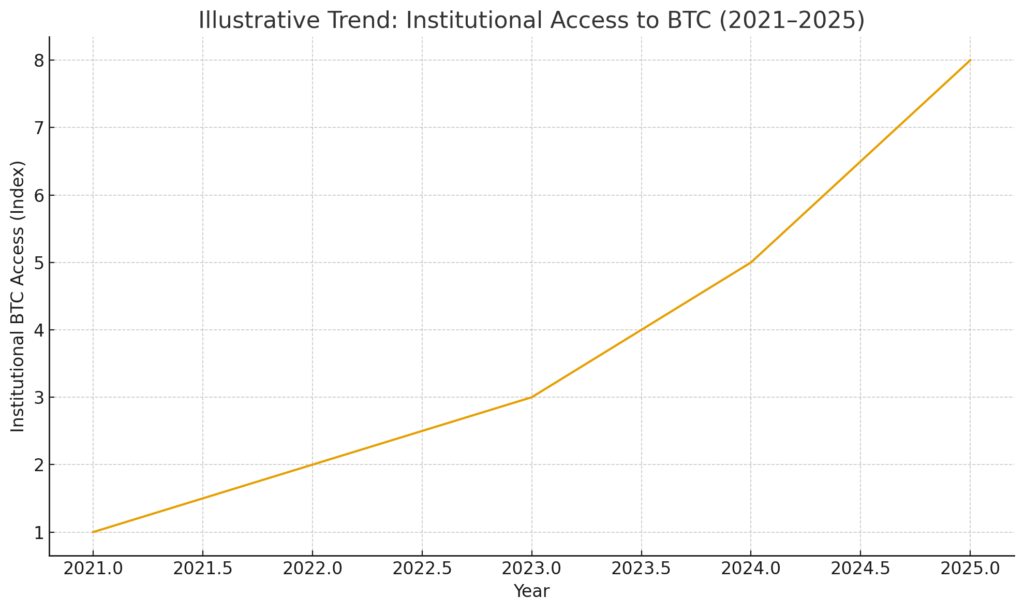
Throughout 2024–2025, institutional adoption accelerated:
- BlackRock’s Bitcoin ETF became one of the fastest-growing ETFs in U.S. history.
- Corporations increasingly added BTC to treasury strategies.
- Sovereign funds of Singapore, UAE, and Norway explored BTC exposure.
As institutions normalized Bitcoin, banks faced rising pressure not to lag behind.
3.2. Regulatory clarity improved
New U.S. digital asset regulations (2024–2025) clarified:
- Custody requirements for financial institutions
- Separation of client assets
- Licensing requirements for intermediaries
Banks were finally given a compliant pathway to integrate Bitcoin directly.
3.3. Customer demand reached a tipping point
American consumers increasingly view Bitcoin as:
- A hedge against inflation
- A long-term investment asset
- A legitimate part of wealth preservation strategy
PNC, like other major banks, realized that ignoring this trend would risk losing its wealth clients to fintech competitors.
4. The Coinbase Infrastructure Behind the Integration
Coinbase’s CaaS platform serves as the technological backbone for PNC Bank’s offering. This component is crucial because it solves the biggest barrier banks face: operational blockchain complexity.
CaaS provides three core modules:
4.1. Trade Execution Module
- Executes buy and sell orders instantly
- Accesses Coinbase’s deep liquidity pool
- Minimizes slippage compared to fragmented retail exchanges
4.2. Custody & Wallet Security
- Multi-layer cold storage
- SOC 1, SOC 2 regulatory audited
- Insurance coverage and institutional-grade key management
4.3. Regulatory Compliance
- KYC/AML integration
- Travel Rule implementation
- Reporting tools for auditors and banking supervisors
This architecture lets banks integrate digital assets without touching private keys, reducing operational risk dramatically.
5. Broader Market Trends Supporting PNC’s Move
To contextualize this announcement, several parallel developments highlight why 2025 is becoming the year institutional crypto finally matures.5.1. Surge in tokenized real-world assets (RWA)
2025 has seen explosive growth in tokenization:
- Money market funds
- Treasury bills
- Private credit instruments
- Real estate and commodities
Analysts estimate the tokenized RWA market surpassed $40B (approx. $40B USD) in 2025.
Banks cannot ignore this shift because tokenized assets represent a new financial infrastructure that competes directly with traditional banking rails.5.2. Uptick in corporate treasury Bitcoin strategies
Following MicroStrategy’s returns, multiple companies adopted similar approaches:
- U.S. tech firms increased BTC exposure
- Latin American fintech companies added BTC to reserves
- Asian conglomerates explored mixed treasury allocations
Corporate acceptance reduces perceived risk for banks.5.3. Retail adoption becomes mainstream
With ETFs, custodial banks, and regulated apps offering Bitcoin purchasing, U.S. retail adoption reached record highs.
The more normalized Bitcoin becomes in consumer apps, the more banks must compete.
6. Competitive Implications for Other U.S. Banks
PNC’s move places strategic pressure on peers:
6.1. Banks likely to follow
Industry analysts expect the next adopters may include:
- JPMorgan Private Wealth (already blockchain-active)
- Morgan Stanley Wealth Management
- Citi Global Wealth
- U.S. Bank (already offers custody services)
6.2. Banks likely to resist
Some institutions remain cautious due to:
- Risk-averse leadership
- Regulatory scrutiny
- Concerns around custody liability
Nevertheless, the precedent set by PNC Bank makes resistance less sustainable long-term.
7. Impact on Bitcoin (BTC) Market Structure
Direct bank integration may have these effects:
7.1. Increased spot demand
Unlike ETF exposure, direct bank trading requires actual spot BTC acquisition, tightening supply.
7.2. Lower barriers for wealthy clients
HNW clients who avoided crypto due to operational risks may now enter the market.
7.3. Legitimization and volatility reduction
As regulated banks enter the market, market manipulation concerns lessen, and institutional flows stabilize price dynamics.
8. Future Outlook: What Comes Next?
PNC stated explicitly that the service will expand beyond wealth segments to broader retail clients, potentially opening Bitcoin access to millions of Americans.
Possible additional features include:
- Ethereum (ETH) trading
- Staking services (depending on regulations)
- Tokenized treasury funds
- Unified digital asset portfolio management
We may also see:
- Payroll BTC allocation
- Mortgage collateralization using digital assets
- Blockchain-based settlement rails for interbank transfers
The real long-term effect is the blending of TradFi and decentralized finance (DeFi), where users can move seamlessly between traditional banking services and blockchain-based assets.
Conclusion
PNC Bank’s partnership with Coinbase to offer direct spot Bitcoin trading marks a pivotal turning point in the U.S. financial system. It provides a regulated pathway for high-net-worth clients to access Bitcoin inside environments they already trust, while reducing friction, improving security, and eliminating the operational barriers associated with external exchanges.
This move will likely accelerate institutional adoption, normalize Bitcoin within mainstream finance, and pressure competitors to adopt similar capabilities. As banking integrates digital assets directly, we move toward a future where crypto is not an alternative system—it becomes an integral layer of global finance.
