
Main Points :
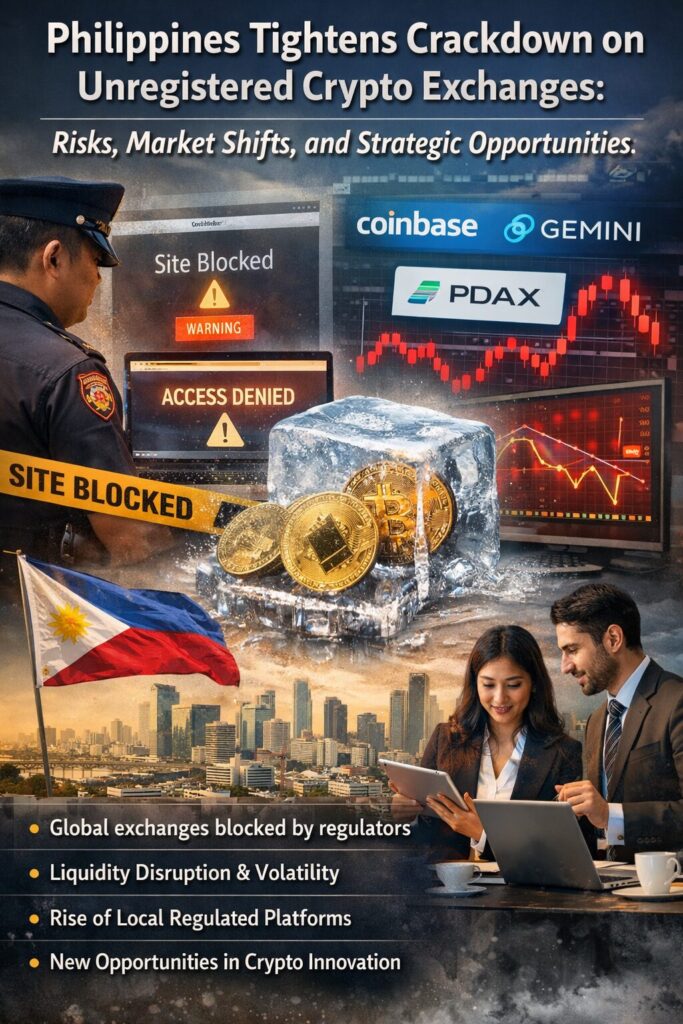
- Philippine regulators have intensified enforcement against unregistered cryptocurrency exchanges, ordering internet service providers to block access to dozens of platforms.
- Global exchanges such as Coinbase and Gemini were reportedly affected, signaling a strict territorial approach to licensing.
- Short-term impacts include liquidity disruption, frozen access, and heightened volatility for local traders.
- Medium- to long-term effects may accelerate the growth of regulated domestic platforms like PDAX.
- The Philippines remains a top global crypto adoption market, suggesting regulation is shifting the market—not suppressing it.
- For investors and builders, the environment is moving toward compliance-driven opportunities, including stablecoins, payments, payroll, and enterprise blockchain use cases.
1. Regulatory Shock: What Happened in the Philippines
In late December 2025, Philippine authorities escalated their regulatory stance against unlicensed cryptocurrency exchanges by blocking internet access to dozens of platforms operating without domestic authorization. Reports indicated that the National Telecommunications Commission (National Telecommunications Commission) instructed local internet service providers to immediately restrict access to approximately 50 online trading platforms.
This action followed a formal request from the Bangko Sentral ng Pilipinas (Bangko Sentral ng Pilipinas), reinforcing its supervisory authority over virtual asset service providers (VASPs). The move aligns with the BSP’s revised regulatory framework under Circular No. 1206, which strengthens rules on consumer protection, financial stability, and anti-money laundering compliance.
Crucially, this was not a warning or a future roadmap—it was direct enforcement. For many users, access to affected exchanges vanished overnight.
2. Why Coinbase and Gemini Were Blocked
Among the platforms impacted were major U.S.-based exchanges Coinbase and Gemini, both globally recognized for regulatory engagement in their home jurisdictions. Their inclusion underscores a critical point: global compliance does not substitute for local licensing.
Philippine regulators have made it clear that any platform offering services to residents—directly or indirectly—must register domestically. This territorial approach mirrors enforcement trends seen in other jurisdictions, including the EU, Japan, and parts of Southeast Asia.
From the regulator’s perspective, unlicensed platforms pose several risks:
- Lack of consumer recourse in disputes or insolvency
- Unverified custody and segregation of funds
- Insufficient AML/CTF oversight
- Exposure to cross-border financial crimes
3. Immediate Market Impact: Liquidity and User Risk
For Philippine traders, the short-term consequences have been severe.
Users of blocked platforms reported:
- Inability to cancel open orders
- Loss of access to withdraw funds
- Disrupted trading strategies during volatile periods
The sudden contraction of available exchanges has also reduced market depth, increasing the likelihood of price slippage and volatility in local markets.
[“Estimated Liquidity Drop in Philippine Crypto Markets After Exchange Blocking”]
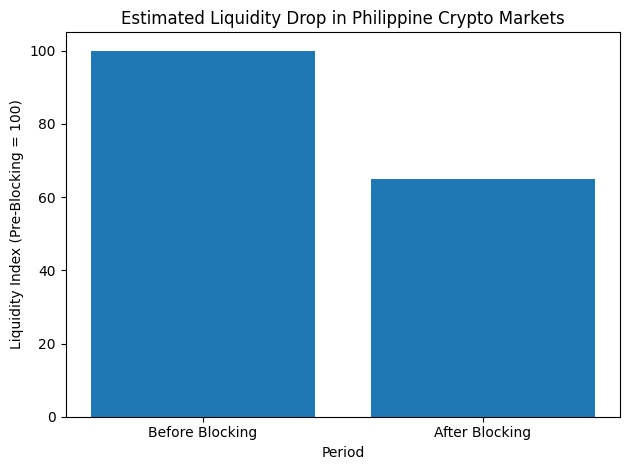
A simple bar or line chart showing pre- and post-block estimated liquidity levels, expressed in USD
4. VPNs: A Temporary and Risky Workaround
Some users have turned to Virtual Private Networks (VPNs) to bypass access restrictions. While technically feasible, this approach introduces legal, operational, and security risks.
VPN usage does not resolve:
- Potential account freezes
- Compliance violations under Philippine law
- Inability to obtain local legal protection
Moreover, regulators may escalate enforcement through payment rail restrictions, rendering VPN access ineffective. For users holding assets on blocked platforms, the safest long-term option remains migration to locally approved exchanges.
5. The Role of the Securities and Exchange Commission
Parallel to BSP enforcement, the Securities and Exchange Commission of the Philippines (Securities and Exchange Commission) has reinforced its stance that offering unregistered securities or acting as an unlicensed broker violates national law.
In 2024, the SEC ordered Google and Apple to remove Binance’s mobile applications from Philippine app stores, citing the sale of unregistered securities. This precedent set the stage for the current access-blocking measures.
Licensed platforms must comply with:
- Segregation of customer funds
- Regular disclosures
- Cybersecurity standards
- AML and sanctions screening
6. Regulation Is Not Killing Crypto in the Philippines
Despite the crackdown, crypto adoption in the Philippines continues to grow.
According to Chainalysis, the Philippines ranked 9th globally in its 2025 grassroots crypto adoption index. The country placed 6th worldwide in centralized-service crypto receipts among retail users, indicating strong everyday usage.
Decentralized finance (DeFi) adoption ranked lower at 13th, suggesting that centralized, regulated services remain the dominant entry point for most Filipinos.
[“Philippines Global Crypto Adoption Ranking (Centralized vs DeFi)”]
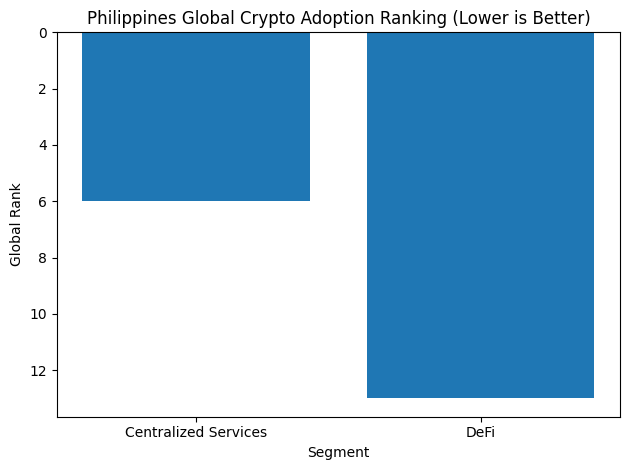
A comparative bar chart showing rankings and relative adoption levels
7. Rise of Regulated Domestic Platforms
One of the biggest beneficiaries of this regulatory shift may be PDAX, a BSP-licensed exchange that has expanded beyond spot trading.
PDAX recently launched a stablecoin-based payroll service tailored for remote workers, enabling employers to pay salaries in USD-denominated stablecoins while remaining compliant with Philippine regulations.
This highlights a broader trend: regulated crypto is evolving from speculation toward infrastructure—payments, remittances, payroll, and enterprise settlement.
8. Strategic Implications for Investors and Builders
For readers seeking new crypto assets, revenue streams, and practical blockchain applications, the Philippine case offers several lessons:
- Compliance is now a competitive advantage
Projects that integrate licensing, reporting, and AML from day one are better positioned to scale. - Local-first strategies matter
Partnerships with licensed VASPs, EMIs, and banks are increasingly essential. - Stablecoins and payments are growth vectors
USD-denominated stablecoins, remittances, and payroll services align with both user demand and regulatory priorities. - Market exits create openings
As global exchanges pull back or localize, opportunities emerge for compliant platforms, liquidity providers, and infrastructure builders.
9. Conclusion: A Market Reset, Not a Shutdown
The Philippine government’s decision to block unregistered crypto exchanges represents a decisive regulatory reset, not an anti-crypto stance. Short-term disruption is real and painful, but the long-term trajectory points toward a more structured, institution-friendly crypto ecosystem.
For investors, this environment favors regulated platforms, compliance-ready tokens, and real-world use cases over regulatory arbitrage. For builders, the Philippines remains one of Asia’s most promising crypto markets—provided they play by the rules.
