
Main Points :
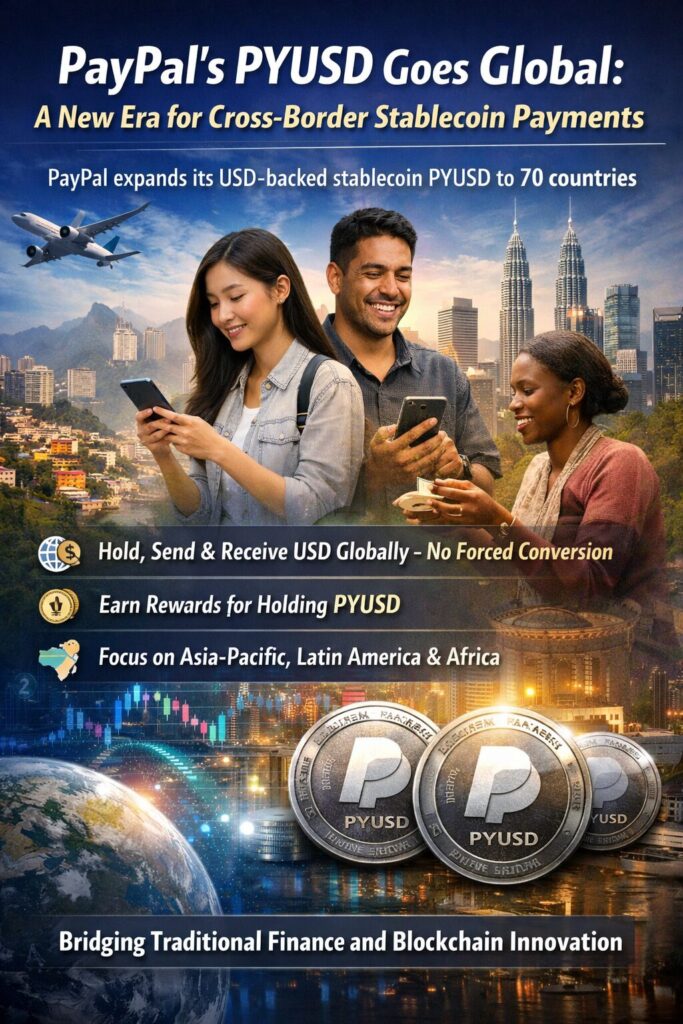
- PayPal expands its USD-backed stablecoin PYUSD to 70 countries
- Users can now hold, send, and receive USD globally without forced conversion
- Introduction of yield-like rewards for holding PYUSD
- Expansion targets remittance-heavy regions (Asia-Pacific, Latin America, Africa)
- Signals increasing convergence between traditional fintech and blockchain finance
1. Introduction: PayPal’s Strategic Expansion of PYUSD
PayPal has taken a decisive step toward redefining global payments by expanding its USD-backed stablecoin, PayPal USD (PYUSD), to 70 countries. Initially launched in August 2023 in partnership with Paxos Trust Company, PYUSD was first limited to users in the United States and the United Kingdom. However, as of March 2026, PayPal has significantly broadened access, allowing users across Asia-Pacific, Europe, Latin America, and Africa to hold, send, and receive PYUSD directly within their PayPal accounts.
This move is not merely a geographic expansion—it represents a structural shift in how digital dollars can be accessed and utilized globally. By enabling users to transact directly in USD without relying on local currency conversions, PayPal is positioning PYUSD as a practical financial tool rather than just a speculative crypto asset.
For readers seeking new crypto-based revenue opportunities and real-world blockchain applications, this development marks a critical inflection point: stablecoins are no longer confined to crypto-native platforms but are becoming embedded within mainstream financial ecosystems.
2. Removing Friction: The Real Problem PYUSD Solves
2.1 Cross-Border Payment Inefficiencies
Traditional remittance systems remain costly and inefficient. In many regions, users face:
- High FX conversion fees
- Delays in settlement
- Limited ability to hold foreign currency
For example, in countries like Peru, users have historically been forced to withdraw funds in local currency, incurring conversion losses. Similarly, in markets like Malawi, PayPal transfers are immediately routed to bank accounts, preventing users from maintaining a balance within their PayPal wallet.
PYUSD directly addresses these constraints.
With this expansion, users can:
- Hold balances in USD
- Transfer funds internationally without forced conversion
- Reduce remittance costs
This effectively transforms PayPal from a payment processor into a quasi-dollar banking layer for global users.
2.2 Wallet Retention and Financial Behavior Shift
One of the most important implications is behavioral: users can now retain value within PayPal wallets.
Previously:
- Funds were often automatically withdrawn or converted
- No concept of “yield-bearing balance” existed
Now:
- Users can store USD value digitally
- Maintain balances for future use
- Potentially earn rewards on holdings
This introduces a proto-banking model within PayPal’s ecosystem, especially impactful in regions with limited access to USD banking services.
3. Yield and Incentives: The Next Growth Engine
A notable addition is the introduction of rewards for holding PYUSD. While details vary by region, this effectively mirrors yield-generation mechanisms seen in decentralized finance (DeFi), but within a regulated fintech environment.
This is significant for three reasons:
- User Acquisition
Yield incentives encourage users to adopt and retain PYUSD - Liquidity Retention
Funds remain within the PayPal ecosystem rather than being withdrawn - Bridging DeFi and TradFi
PayPal introduces yield concepts without exposing users to DeFi complexity
This model aligns with broader industry trends where stablecoins are evolving from mere payment tools into financial instruments capable of generating passive income.
4. Market Position: PYUSD in the Stablecoin Landscape
As of early 2026, PYUSD has grown to approximately $4.1 billion in market capitalization, making it one of the top USD-backed stablecoins globally.
For context, leading competitors include:
- Tether (USDT)
- USD Coin (USDC)
Despite entering the market later, PYUSD has demonstrated rapid growth:
- Early 2025: ~$0.5 billion
- End of 2025: ~$3.6 billion
- 2026: ~$4.1 billion
This represents roughly a 600% increase within a year, highlighting strong adoption driven by PayPal’s existing user base and distribution power.
Unlike crypto-native stablecoins, PYUSD benefits from:
- Direct integration into PayPal’s global network
- Regulatory alignment via Paxos
- Immediate utility in payments and remittances
5. Strategic Implications for the Global Financial System
5.1 Dollarization Through Fintech
PYUSD effectively accelerates digital dollarization.
In many emerging markets:
- Local currencies are volatile
- Access to USD is restricted
PYUSD allows users to:
- Store value in USD digitally
- Avoid currency depreciation
- Participate in global commerce
This creates a parallel financial layer that operates independently of traditional banking systems.
5.2 Competition with Banks and Remittance Providers
PayPal’s expansion directly challenges:
- Traditional remittance providers (e.g., Western Union)
- Local banking systems
- FX-based revenue models
By reducing transaction costs and enabling instant transfers, PYUSD undermines legacy financial intermediaries.
5.3 Infrastructure Layer for Web3 Payments
PYUSD is also positioned as a bridge between Web2 and Web3.
With support for transfers to third-party digital wallets, it can integrate with:
- Decentralized applications (dApps)
- Crypto exchanges
- Blockchain-based financial services
This creates a hybrid ecosystem where users can seamlessly move between traditional fintech and blockchain networks.
6. Recent Trends: Stablecoins Becoming Core Financial Infrastructure
The expansion of PYUSD aligns with several macro trends:
6.1 Institutional Adoption
Major financial institutions are increasingly entering the stablecoin space, recognizing their utility in payments and settlement.
6.2 Regulatory Clarity
Jurisdictions are developing frameworks for stablecoins, encouraging compliant players like PayPal to scale globally.
6.3 Real-World Utility Focus
The market is shifting from speculative tokens to utility-driven assets, particularly in:
- Payments
- Remittances
- Treasury management
7. Opportunities for Investors and Builders
For readers seeking new revenue streams and blockchain applications, PYUSD opens several opportunities:
7.1 Arbitrage and FX Optimization
Users can exploit differences in local currency exchange rates versus stablecoin pricing.
7.2 Payment Integration
Businesses can integrate PYUSD for:
- Cross-border payroll
- Merchant settlements
- Digital services
7.3 Yield Strategies
Holding PYUSD within PayPal or connected ecosystems may provide passive income opportunities.
7.4 Wallet and Infrastructure Development
Developers can build:
- Wallet integrations
- Payment gateways
- Compliance-ready financial tools
8. Diagram Section (Insert Images Below)
[Global PYUSD Flow]
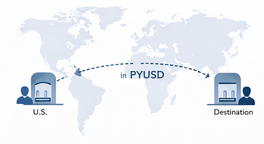
A visual showing user → PayPal wallet → PYUSD → cross-border transfer → recipient wallet
[Traditional vs PYUSD Remittance Cost Structure]
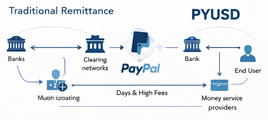
Comparison chart showing fee reduction and time efficiency
[PYUSD Ecosystem Architecture]
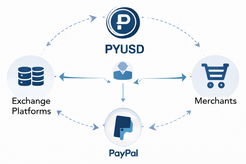
Diagram showing PayPal + Paxos + blockchain + user wallets
9. Conclusion: PYUSD as a Catalyst for Financial Convergence
PayPal’s expansion of PYUSD to 70 countries is more than a product update—it is a foundational shift in global finance.
By combining:
- The stability of the US dollar
- The efficiency of blockchain
- The distribution power of PayPal
PYUSD represents a new category of financial infrastructure.
For emerging markets, it offers access.
For investors, it offers opportunity.
For developers, it offers a platform.
Most importantly, it signals a future where stablecoins are not just crypto assets, but core components of everyday financial life.
