
Key Points :
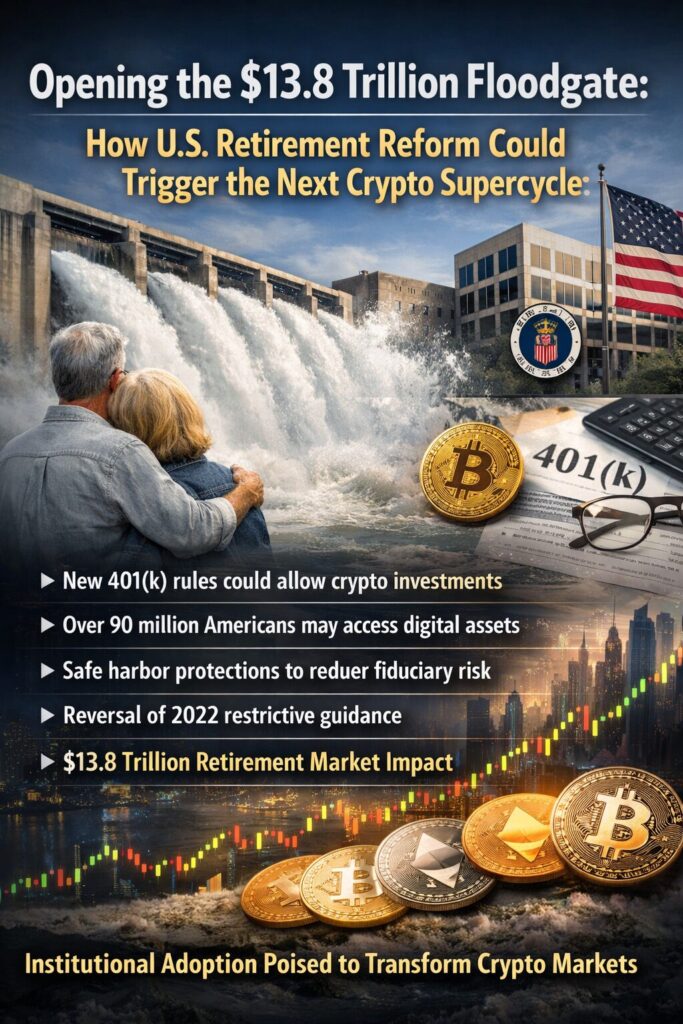
- The U.S. Department of Labor has proposed rules allowing 401(k) retirement plans to include crypto and alternative assets.
- Over 90 million Americans could gain exposure to digital assets through retirement savings.
- The proposal introduces safe harbor protections for fiduciaries, reducing legal risk.
- It reverses restrictive guidance issued in 2022, signaling a major policy shift.
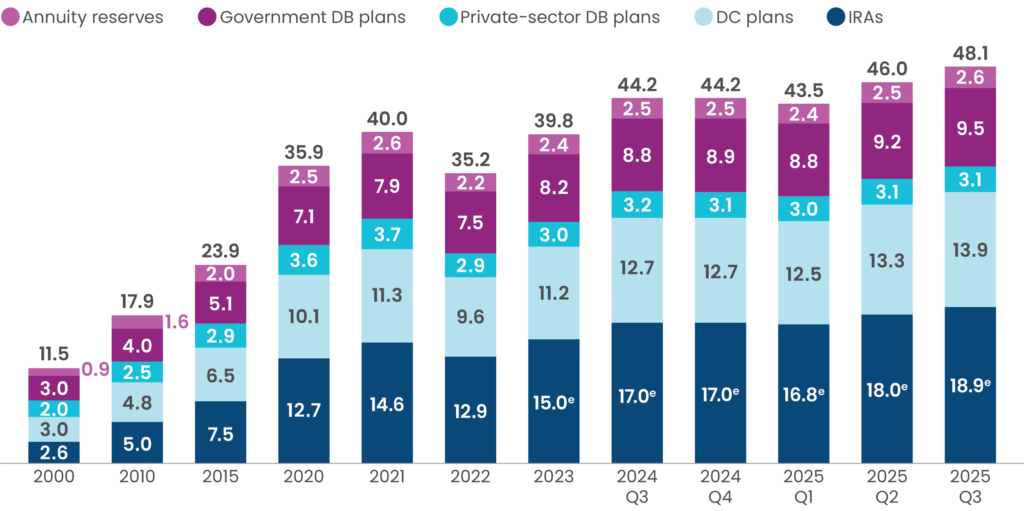
- The total retirement market affected exceeds $13.8 trillion, including $12.5 trillion in 401(k) plans.
- Institutional adoption could fundamentally reshape crypto liquidity, volatility, and long-term valuation.
1. A Historic Policy Shift: From Restriction to Expansion
The recent proposal by the U.S. Department of Labor represents one of the most consequential regulatory developments in the history of digital assets. For the first time, U.S. retirement plans—specifically 401(k) accounts—are being formally opened to cryptocurrencies and other alternative investments such as private equity.
This is not merely a regulatory tweak. It is a structural transformation of capital allocation. With over 90 million Americans participating in 401(k) plans, the inclusion of crypto as an investable asset class effectively embeds digital assets into the core of the U.S. financial system.
The rule proposal stems from a broader executive directive aimed at democratizing access to alternative investments. In contrast to earlier policies that discouraged crypto exposure, the current administration is signaling a clear pivot: rather than restricting access, regulators will focus on enabling responsible participation.
This shift marks the end of what many in the industry saw as “regulatory gatekeeping” based on asset class prejudice. Instead, the emphasis is now on process, risk evaluation, and fiduciary responsibility.
2. Safe Harbor and Fiduciary Clarity: Removing the Legal Barrier
A central component of the proposal is the introduction of a “safe harbor” framework for plan fiduciaries.
Historically, pension plan managers have avoided crypto not necessarily because of lack of interest, but due to legal uncertainty. Under ERISA (Employee Retirement Income Security Act), fiduciaries must act prudently and in the best interest of beneficiaries. The ambiguity around whether crypto met these standards created a chilling effect.
The new rule changes that dynamic.
Under the proposed framework, fiduciaries can include crypto and other alternative assets if they follow a clearly defined due diligence process, including:
- Evaluation of fees and cost structures
- Liquidity assessment
- Transparency and valuation methodologies
- Risk-return profile analysis
This procedural clarity significantly reduces litigation risk, effectively unlocking institutional participation.
In practical terms, this is the difference between theoretical accessibility and real capital flows.
3. Market Scale: Why $13.8 Trillion Changes Everything
To understand the magnitude of this development, consider the numbers:
- Total U.S. retirement assets impacted: $13.8 trillion
- 401(k) assets alone: $12.5 trillion
Even a small allocation shift—say 1%—would translate into $125 billion flowing into crypto markets.
Such inflows would dwarf many previous bull cycle catalysts, including ETF approvals and institutional treasury allocations.
Unlike speculative retail flows, retirement capital is:
- Long-term oriented
- Systematic (regular contributions)
- Less reactive to short-term volatility
This introduces a new type of liquidity—“sticky capital”—which could fundamentally stabilize crypto markets over time.
4. Reversal of 2022 Policy: A Political and Strategic Pivot
The proposal explicitly overturns guidance issued in 2022, which had effectively discouraged crypto investments in retirement accounts.
That earlier stance reflected concerns about volatility, fraud, and lack of regulatory clarity. However, the market has evolved significantly since then:
- Institutional custody solutions have matured
- Spot Bitcoin ETFs have gained regulatory approval
- Compliance frameworks (KYC/AML, Travel Rule) are more robust
- Market infrastructure is increasingly institutional-grade
By rescinding the previous guidance, regulators are acknowledging that crypto has transitioned from a fringe asset to a legitimate component of modern portfolios.
This is not just regulatory acceptance—it is institutional normalization.
5. Institutional Endorsement and Policy Alignment
The proposal has received support from key policymakers and regulators.
Leadership voices within the government have emphasized that the role of regulators is not to judge the merit of specific assets, but to ensure that decision-making processes are sound and transparent.
This aligns with broader trends across agencies:
- The U.S. Securities and Exchange Commission has gradually expanded its engagement with crypto markets
- The Treasury Department has balanced innovation with financial stability concerns
- The White House has prioritized economic growth through technological innovation
This convergence of policy signals suggests that crypto is no longer being treated as an outlier, but as part of the broader financial ecosystem.
6. Implications for Crypto Markets: Beyond Price
While much attention will focus on price impact, the deeper implications are structural.
6.1 Portfolio Integration
Crypto will transition from a speculative allocation to a standard portfolio component, alongside equities, bonds, and real estate.
6.2 Product Innovation
Financial institutions will develop new retirement-focused products, such as:
- Target-date funds with crypto exposure
- Hybrid portfolios combining digital assets and private equity
- Risk-managed crypto allocations
6.3 Liquidity Evolution
Markets will become:
- Less volatile (due to long-term capital)
- More liquid (due to institutional participation)
- More efficient (due to better price discovery mechanisms)
7. Risks and Constraints: Not a Free Pass
Despite its transformative potential, the proposal does not eliminate risk.
Fiduciaries remain responsible for:
- Assessing suitability
- Managing volatility exposure
- Ensuring diversification
Crypto’s inherent risks—price swings, regulatory uncertainty, technological vulnerabilities—still apply.
Moreover, allocations are likely to remain conservative in the early stages. Most plans may start with small exposure (e.g., 1–5%) rather than aggressive positioning.
8. Strategic Opportunities for Investors and Builders
For your audience—those seeking new assets, revenue opportunities, and practical blockchain applications—this development creates several strategic angles:
8.1 Early Positioning
Assets that are:
- Institutionally compliant
- Liquid and transparent
- Supported by strong infrastructure
are likely to benefit first.
8.2 Infrastructure Plays
Opportunities extend beyond tokens to:
- Custody solutions
- Compliance tools (Travel Rule, AML)
- Portfolio management platforms
8.3 Tokenization and Real-World Assets (RWA)
The inclusion of private equity signals broader acceptance of alternative assets. This strengthens the case for:
- Tokenized funds
- On-chain asset representation
- Hybrid TradFi-DeFi models
This aligns closely with your “Two-Extremes Model” concept—bridging traditional finance and decentralized systems.
9. Timeline and What Comes Next
The proposal now enters the public comment phase.
While timelines can vary, several factors suggest acceleration:
- Strong political backing
- Institutional demand
- Market readiness
If finalized, implementation could begin within a relatively short timeframe, potentially triggering phased adoption across major retirement platforms.
Conclusion: The Beginning of Crypto’s Retirement Era
The opening of U.S. retirement accounts to cryptocurrency is not just another milestone—it is a paradigm shift.
For over a decade, crypto has evolved from a niche experiment to a speculative asset class. With this policy change, it takes the next step: becoming a core component of long-term wealth management.
The implications extend far beyond price:
- Structural capital inflows
- Institutional validation
- Integration into everyday financial planning
If even a fraction of the $13.8 trillion retirement market flows into digital assets, the resulting transformation could define the next decade of finance.
In this sense, the proposal is not merely about access—it is about legitimacy, scale, and permanence.
