
Main Points :
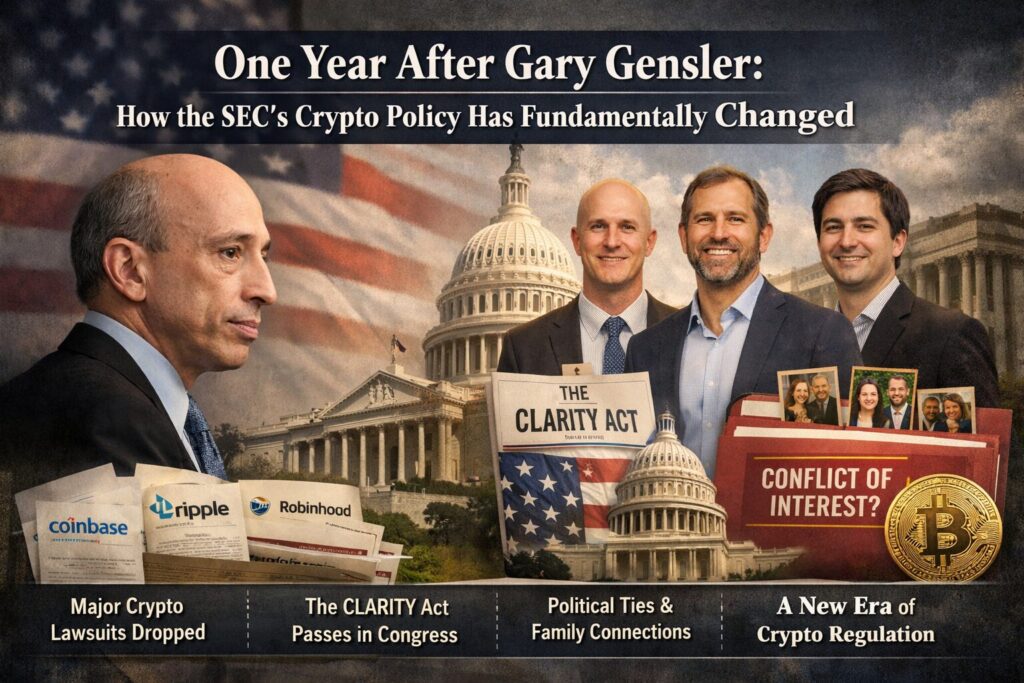
- The departure of Gary Gensler marked a decisive shift in the U.S. Securities and Exchange Commission’s stance toward crypto enforcement and regulation.
- Under the Trump administration, the SEC rapidly dropped or settled major crypto investigations and lawsuits involving Coinbase, Ripple Labs, Robinhood Crypto, and Uniswap Labs.
- The SEC pivoted from “regulation by enforcement” to dialogue-driven clarification, while Congress advanced a comprehensive market-structure bill known as the CLARITY Act.
- Political alignment between the administration and the crypto industry—combined with direct family involvement in crypto ventures—has raised serious governance and conflict-of-interest questions.
- For builders and investors, the U.S. is transitioning from legal uncertainty toward a more permissive but politically sensitive crypto environment.
1. The End of the Gensler Era: From Enforcement to Reversal
One year ago, on the day of President Donald Trump’s inauguration, Gary Gensler resigned as Chair of the SEC. His tenure had been defined by an aggressive approach to digital assets, centered on the belief that most tokens constituted unregistered securities and that existing securities law was sufficient to regulate them.
From 2021 to early 2025, the SEC under Gensler pursued what critics labeled “regulation by enforcement.” Rather than issuing clear rulebooks for token issuance, exchanges, or decentralized finance (DeFi), the agency relied heavily on investigations and lawsuits. This posture created a chilling effect: projects hesitated to launch in the U.S., venture capital flowed offshore, and compliance teams operated under constant uncertainty.
The backlash was not merely rhetorical. Major crypto firms, most notably Ripple, began funding political action committees (PACs) to support candidates more sympathetic to digital assets in the 2024 presidential election. By the time Gensler stepped down, crypto had become a first-order political issue rather than a niche regulatory debate.
2. Immediate Policy Whiplash Under Acting Chair Mark Uyeda
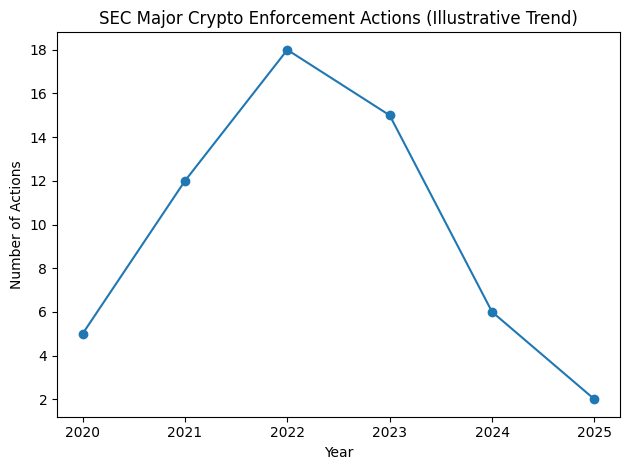
Following Gensler’s resignation, Trump appointed SEC Commissioner Mark Uyeda as Acting Chair. Within weeks, the agency’s posture changed dramatically.
2.1 The Coinbase Case: A Symbolic Turning Point
In February 2025, the SEC announced it would drop its civil enforcement action against Coinbase, originally filed in 2023. The lawsuit had accused the exchange of operating as an unregistered securities broker and exchange. Its dismissal sent a clear signal: the era of broad, precedent-setting crypto enforcement was over.
2.2 Domino Effect Across the Industry
Soon after:
- Investigations into Robinhood Crypto were formally closed.
- The SEC ended its probe into Uniswap Labs, a key DeFi infrastructure developer.
- In March, Ripple CEO Brad Garlinghouse confirmed that the SEC would withdraw its appeal related to the long-running XRP case first filed in 2020.
These reversals represented more than case-by-case decisions; they amounted to a strategic retreat from the SEC’s prior interpretation of securities law as applied to crypto markets.
3. Political Economy of Crypto: Power, Proximity, and Profit
The speed and scale of the SEC’s policy reversal inevitably drew scrutiny. Lawmakers questioned whether the administration’s close ties to the crypto industry influenced regulatory outcomes.
President Trump and his family openly supported World Liberty Financial, a crypto firm that launched its own U.S.-dollar stablecoin while Congress debated crypto legislation. Trump himself held a meme token known as “Official Trump (TRUMP),” while his sons were involved in launching American Bitcoin, a domestic mining venture.
Some estimates suggest that by June 2025, Trump-affiliated entities may have generated over $1.0 billion in crypto-related gains (USD-denominated). Even if legally permissible, this unprecedented overlap between political power and digital asset ownership has reshaped perceptions of regulatory neutrality.
4. The SEC’s New Strategy: Roundtables Instead of Raids
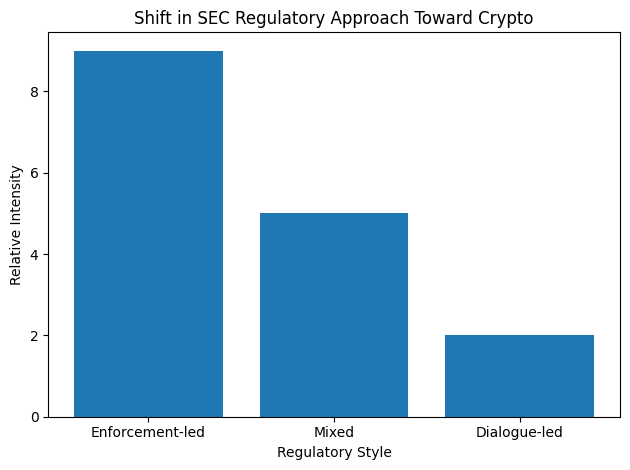
In 2025, the SEC began hosting a series of crypto roundtables involving:
- Industry executives
- Legal scholars
- Policy experts
- Custody providers and DeFi developers
Key discussion themes included financial privacy, digital asset custody, tokenization of real-world assets, and decentralized finance. For the first time in years, the SEC appeared to be listening rather than litigating.
However, the practical impact of these discussions may be limited. As comprehensive legislation advances in Congress, many interpret the roundtables as transitional—bridging the gap until lawmakers, not regulators, define the rules of the game.
5. The CLARITY Act: Redrawing the Regulatory Map
At the center of legislative reform is the Digital Asset Market Clarity (CLARITY) Act. The bill aims to:
- Clearly define which digital assets fall under SEC jurisdiction versus the CFTC
- Establish registration pathways for exchanges and intermediaries
- Reduce reliance on enforcement actions as de facto rulemaking
The House of Representatives passed the bill in July, but progress in the Senate has stalled. Amendments under review by the Banking and Agriculture Committees were postponed after Coinbase CEO Brian Armstrong temporarily withdrew his support, citing unresolved concerns.
Still, few doubt that some form of market-structure legislation will eventually pass. For crypto entrepreneurs, the message is clear: the regulatory center of gravity is shifting from agencies to Congress.
6. A One-Party SEC and the End of Internal Dissent
Institutional change at the SEC extended beyond policy. With Gensler’s departure in January 2025, Democratic Commissioner Jaime Lizárraga also exited. Commissioner Caroline Crenshaw remained as the sole Democrat, often voicing skepticism toward crypto.
After extending her service for 18 months beyond her term, Crenshaw left the SEC in January 2026. As of this writing, Trump has not announced plans to restore bipartisan balance to the Commission.
This effectively one-party leadership structure further accelerates deregulatory momentum—but also concentrates risk. Future administrations could again reverse course, reintroducing uncertainty for long-term projects.
7. Gary Gensler After the SEC: Consistent Views, Reduced Power
After leaving public office, Gensler returned to the MIT Sloan School of Management as a professor of finance and global economics. In interviews and lectures, he continues to describe Bitcoin and other cryptocurrencies as “speculative assets,” emphasizing investor protection and systemic risk.
While his influence on policy has waned, his intellectual framework still shapes global regulatory thinking—particularly outside the United States, where enforcement-heavy models remain common.
8. Implications for Investors and Builders
For readers seeking new crypto assets, revenue opportunities, or practical blockchain applications, this moment is pivotal:
- Short-term: Regulatory risk premiums in the U.S. are declining, encouraging listings, token launches, and capital inflows.
- Mid-term: Legislative outcomes will determine whether today’s permissive environment becomes stable infrastructure or another temporary cycle.
- Long-term: Political alignment has become as important as technical merit. Regulatory arbitrage is giving way to political arbitrage.
Conclusion: A Softer SEC, a Harder Question
One year after Gary Gensler’s resignation, the SEC is almost unrecognizable. Lawsuits have been dropped, dialogue has replaced confrontation, and the crypto industry enjoys unprecedented proximity to political power.
Yet clarity remains incomplete. The center of decision-making has shifted, not disappeared. For serious participants in blockchain—those building real systems, not just trading narratives—the opportunity lies in understanding this new equilibrium: less hostile, more political, and still evolving.
