
Main Points :
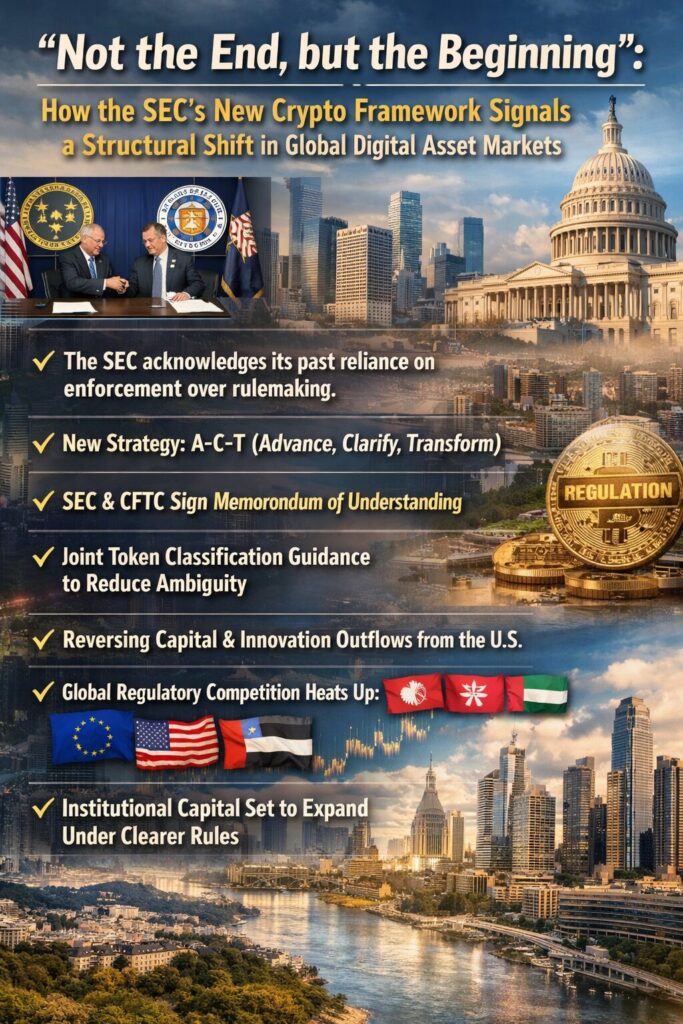
- The U.S. Securities and Exchange Commission (SEC) acknowledges its past reliance on enforcement over rulemaking
- A new regulatory strategy—A-C-T (Advance, Clarify, Transform)—aims to modernize crypto oversight
- The SEC and Commodity Futures Trading Commission (CFTC) signed a Memorandum of Understanding (MOU)
- Joint token classification guidance is expected to reduce long-standing ambiguity
- The shift could reverse capital and innovation outflows from the U.S.
- Global regulatory competition (EU, Hong Kong, UAE) is accelerating
- Institutional capital may expand significantly under clearer rules
1. A Turning Point in U.S. Crypto Regulation
The recent remarks by SEC Chair Paul Atkins at the annual SEC Speaks event mark a decisive turning point in how the United States approaches cryptocurrency regulation. His statement—“this is not the end, but the beginning”—is more than rhetorical framing; it signals a structural reset of regulatory philosophy that could reshape global crypto markets.
For years, the U.S. has been criticized for regulating digital assets primarily through enforcement actions rather than proactive rulemaking. This approach created an environment of uncertainty where startups, developers, and institutional investors struggled to determine whether their activities complied with securities laws.
Atkins openly acknowledged this failure. He stated that innovation in digital assets did not decline because of a lack of entrepreneurial ambition or investor demand, but rather due to regulatory hesitation. This admission is significant: it reflects a shift from defensive regulation to strategic enablement.
In practical terms, this means that the U.S. is attempting to reclaim its role as a global hub for financial innovation—particularly in blockchain and tokenized systems.
2. The A-C-T Strategy: Advance, Clarify, Transform
At the core of this new direction is the A-C-T strategy, a three-pillar framework designed to modernize crypto regulation:
Advance
The “Advance” component focuses on proactively developing regulatory frameworks that keep pace with innovation. Rather than reacting to violations, regulators aim to anticipate technological developments such as DeFi, tokenized assets, and stablecoins.
Clarify
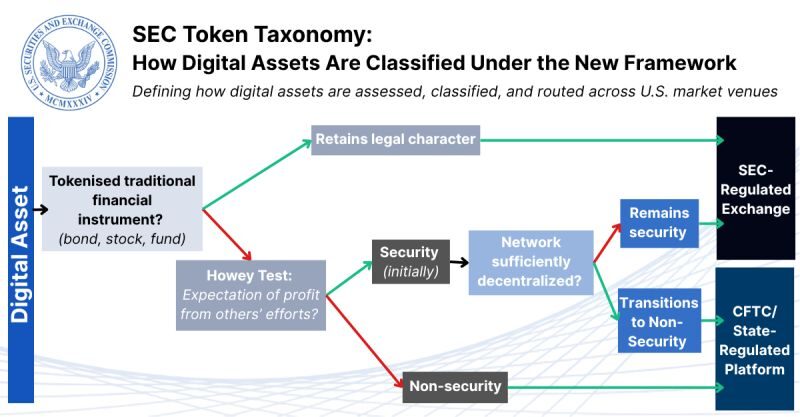
“Clarify” addresses one of the industry’s biggest pain points: ambiguity. Historically, the classification of tokens—whether as securities, commodities, or something else—has been inconsistent. This uncertainty has led to costly legal disputes and cautious market behavior.
Transform
The “Transform” pillar goes further by rethinking how regulation itself is structured. This includes inter-agency coordination, updated definitions, and potentially new regulatory categories tailored to digital assets.
Together, these pillars indicate a shift from fragmented oversight to a cohesive, forward-looking regulatory architecture.
3. SEC–CFTC Collaboration: A Long-Awaited Breakthrough
One of the most impactful developments is the formal collaboration between the SEC and the CFTC through a Memorandum of Understanding (MOU). Historically, jurisdictional overlap between these agencies created confusion—particularly regarding whether certain tokens fell under securities or commodities law.
The new agreement aims to:
- Harmonize definitions of digital assets
- Coordinate supervisory responsibilities
- Reduce regulatory arbitrage
- Provide unified guidance to market participants
This collaboration is already producing tangible outcomes. The two agencies have jointly issued interpretive guidance on token classification, a move widely seen as a breakthrough after years of fragmentation.
For developers and exchanges, this could dramatically reduce compliance costs and legal uncertainty—two major barriers to innovation.
4. From Enforcement to Rulemaking: Why This Matters
The SEC’s admission that it relied too heavily on enforcement is not merely symbolic—it has deep economic implications.
Under the previous regime:
- Startups avoided launching tokens in the U.S.
- Venture capital shifted toward jurisdictions with clearer rules
- Exchanges limited product offerings to reduce risk
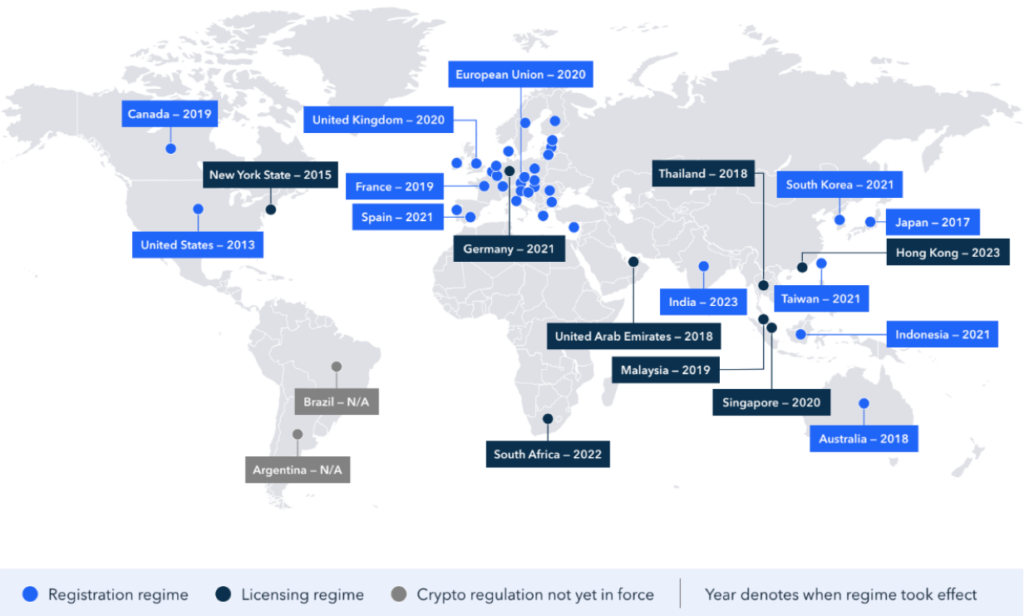
As a result, regions like the EU (through MiCA), Hong Kong, and the UAE gained competitive advantages.
The new framework aims to reverse this trend by offering:
- Predictable compliance pathways
- Reduced legal risk
- Increased investor confidence
If successful, this could trigger a repatriation of innovation capital back to the United States.
5. Global Context: Regulatory Competition Is Intensifying
The SEC’s shift cannot be understood in isolation. It is part of a broader global race to define the future of digital asset regulation.
Europe (MiCA)
The European Union’s Markets in Crypto-Assets (MiCA) framework provides comprehensive rules for token issuance, stablecoins, and service providers. Its clarity has already attracted major firms.
Hong Kong
Hong Kong has re-emerged as a crypto hub with licensing regimes designed to attract institutional players while maintaining strict compliance standards.
United Arab Emirates
Dubai and Abu Dhabi have established specialized regulators and free zones, offering tax incentives and clear guidelines for crypto businesses.
In this context, the U.S. risks falling behind unless it provides comparable clarity. The A-C-T strategy is therefore not just regulatory reform—it is a competitive response.
6. Implications for Investors and Builders
For readers interested in new crypto assets and revenue opportunities, the implications are substantial.
Institutional Expansion
Clearer rules could unlock large pools of institutional capital. Pension funds, asset managers, and banks have largely remained on the sidelines due to regulatory uncertainty.
Token Innovation
Developers may feel more confident launching new token models, including:
- Utility tokens with defined use cases
- Tokenized real-world assets (RWAs)
- Hybrid financial instruments
Market Structure Evolution
Exchanges and platforms may expand their offerings, including derivatives, staking services, and cross-chain products, under clearer compliance frameworks.
7. Practical Blockchain Applications: Beyond Speculation
The regulatory shift also has implications for real-world blockchain adoption.
Payments and Stablecoins
Clear guidelines could accelerate the integration of stablecoins into payment systems, particularly for cross-border transactions.
Tokenization of Assets
Real estate, bonds, and commodities could increasingly be tokenized, enabling fractional ownership and improved liquidity.
Enterprise Blockchain
Corporations may adopt blockchain solutions for supply chain management, identity verification, and data integrity once regulatory risks are reduced.
8. Market Outlook: A Medium- to Long-Term Bullish Signal
While regulatory clarity does not immediately drive price action, it lays the foundation for sustainable growth.
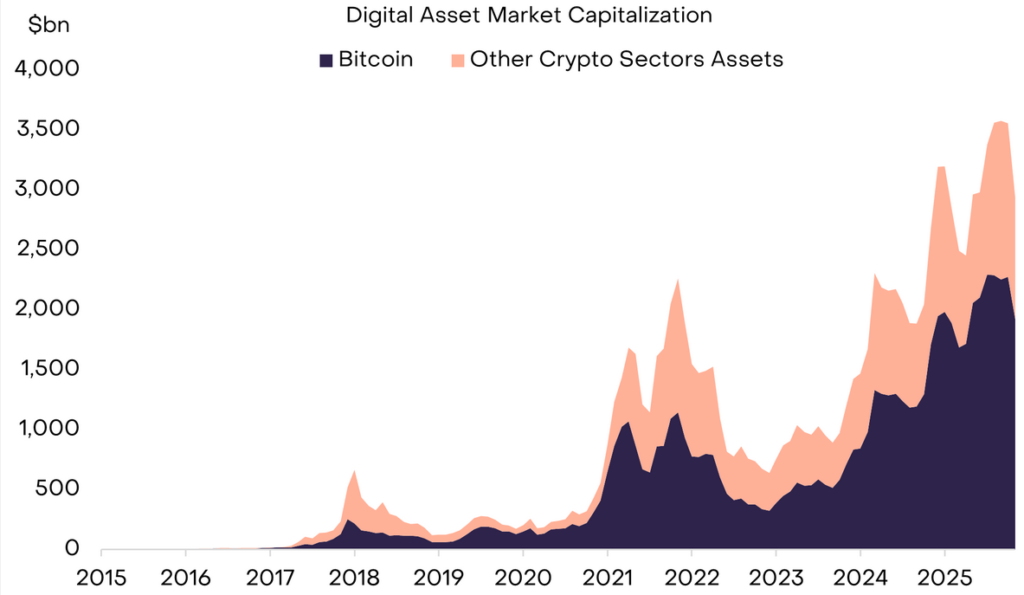
Historically, major bull cycles in crypto have been preceded by structural improvements:
- Infrastructure development (e.g., exchanges, custody)
- Institutional participation
- Regulatory clarity
The current shift aligns with all three factors, suggesting a medium- to long-term bullish outlook for the digital asset market.
Regulatory Evolution Timeline
Capital Flow Shift (Estimated)
Token Classification Framework
Conclusion
The SEC’s announcement of a new regulatory framework represents more than a policy update—it is a strategic repositioning of the United States in the global digital asset landscape.
By acknowledging past shortcomings and committing to a structured, collaborative, and forward-looking approach, regulators are laying the groundwork for a more stable and innovative market environment.
For investors, this signals the potential for increased institutional participation and new asset classes. For builders, it offers the clarity needed to innovate confidently within the world’s largest financial market.
Most importantly, the message is clear: this is not the culmination of regulatory efforts, but the beginning of a new phase—one where regulation and innovation are no longer in conflict, but in alignment.
