

Main Points :
- Michael Saylor hinted that his company Strategy (formerly MicroStrategy) may purchase more Bitcoin as the price hovers near $66,000.
- The firm already holds over 720,000 BTC, valued at roughly $48.1 billion.
- Bitcoin treasury companies are emerging as a new institutional category alongside ETFs and sovereign holdings.
- Some analysts expect industry consolidation in 2026, while Saylor remains skeptical of mergers and acquisitions.
- Corporate treasury strategies may evolve to include validation services, mining, lending, and blockchain infrastructure.
- These trends could reshape the supply dynamics and long-term investment narrative of Bitcoin.
The Beginning of “Bitcoin’s Second Century”
Michael Saylor, the co-founder of the corporate Bitcoin treasury firm Strategy, has once again signaled that another Bitcoin purchase may be imminent. In a recent post on the social media platform X, Saylor wrote a cryptic message: “The second century begins.” Alongside the message, he shared the well-known chart tracking his company’s continuous Bitcoin accumulation.
The timing of the message caught the market’s attention. Bitcoin has recently been trading around $66,000, significantly below Strategy’s average acquisition cost of approximately $75,985 per BTC. For many companies, buying more of an asset while it is below the average purchase price might appear risky. However, Saylor has repeatedly emphasized a long-term conviction: Bitcoin is not merely a speculative asset but a digital store of value that will appreciate over decades.
Strategy’s latest Bitcoin acquisition occurred in the final week of February. The company invested more than $204 million, purchasing 3,015 BTC. This brought its total holdings to 720,737 BTC, making it the largest corporate holder of Bitcoin in the world.
At current market prices, this stash is worth approximately $48.1 billion, representing one of the most aggressive treasury strategies ever implemented by a public company.
From Saylor’s perspective, the logic remains simple: if Bitcoin is the best long-term store of value, then the optimal strategy is to accumulate it consistently regardless of short-term market volatility.
Strategy’s Bitcoin Treasury Model
The Strategy model has reshaped how corporations think about balance sheets.
Traditionally, companies hold treasury reserves in cash, short-term government bonds, or other low-risk assets. These assets preserve liquidity but often lose purchasing power due to inflation.
Saylor argues that Bitcoin represents a superior treasury reserve asset, especially in an era of persistent monetary expansion and sovereign debt growth.
Instead of passively holding cash, Strategy raises capital through:
- Equity issuance
- Convertible bonds
- Debt financing
The proceeds are then used to purchase Bitcoin.
This strategy effectively transforms the company into a Bitcoin holding vehicle combined with a public equity structure. Investors who want exposure to Bitcoin through traditional stock markets can gain indirect exposure by purchasing shares of Strategy.
Interestingly, despite its massive holdings, the company’s net asset value (NAV) is currently trading slightly below 1. This means the market is valuing the company at less than the value of the Bitcoin it holds.
Such situations sometimes occur during market downturns, when investors question the sustainability of the strategy or anticipate further volatility in Bitcoin prices.
However, long-term believers see this discount as an opportunity.
Corporate Bitcoin Treasuries: A New Institutional Category
Over the past several years, Bitcoin ownership has diversified across several major categories:
- Exchange-traded funds (ETFs)
- Nation-state reserves
- Corporate treasury companies
- DeFi wrapped Bitcoin products
Among these categories, corporate treasury companies are becoming an increasingly important force.
Unlike ETFs, which simply hold Bitcoin on behalf of investors, treasury companies actively use capital markets to increase their Bitcoin exposure over time.
This creates a powerful feedback loop:
- Investors buy the company’s stock for Bitcoin exposure.
- The company raises capital through equity or debt.
- The capital is used to buy more Bitcoin.
- The company’s Bitcoin holdings increase, attracting more investors.
This model effectively converts traditional capital markets into a Bitcoin acquisition engine.
As more firms adopt similar strategies, the supply dynamics of Bitcoin could change significantly.
With only 21 million BTC ever to exist, large-scale corporate accumulation could reduce available supply on exchanges and intensify long-term scarcity.
The Possibility of Industry Consolidation in 2026
Some analysts believe that the rapid rise of Bitcoin treasury companies could lead to consolidation across the sector.
According to Wojciech Kaszycki, Chief Strategy Officer of the digital asset treasury firm BTCS, companies that generate real cash flow may begin acquiring firms that merely accumulate Bitcoin.
He explained that mergers can sometimes create a situation where “two plus two equals six.”
Companies that trade below their net asset value are particularly vulnerable. If their market valuation falls too far below the value of their Bitcoin reserves, they could become acquisition targets.
This dynamic is not unusual in traditional financial markets.
Investment holding companies, closed-end funds, and asset managers often experience similar consolidation cycles when their shares trade at persistent discounts to their underlying assets.
If the same pattern emerges in crypto treasury firms, the industry could undergo a significant restructuring phase by 2026.
Saylor Rejects the M&A Strategy
Despite these predictions, Michael Saylor has publicly dismissed the idea of acquiring competing Bitcoin treasury companies.
His reasoning is straightforward.
Mergers and acquisitions introduce long timelines and financial uncertainty. Negotiations can take anywhere from six months to a year, and market conditions may change dramatically during that period.
Saylor argues that an acquisition that looks attractive at the beginning of negotiations may no longer make sense months later.
Instead of pursuing complex corporate deals, Strategy prefers to focus on what it does best: raising capital and buying Bitcoin.
This philosophy reflects Saylor’s broader belief that Bitcoin itself is the ultimate strategic asset. Corporate complexity, in his view, only distracts from the core mission of accumulation.
Expanding Revenue Streams Beyond Bitcoin Holdings
While many treasury companies focus purely on accumulating Bitcoin, industry experts believe the model will evolve.
Kaszycki suggests that treasury companies could expand their operations into several blockchain-related sectors, including:
- Blockchain validation services
- Cryptocurrency mining
- Private and public credit products
- Digital asset infrastructure services
These activities would generate cash flow that could be reinvested into additional Bitcoin purchases.
For example, a treasury company could operate validator nodes for proof-of-stake networks or provide institutional staking services. The fees earned from these services could be used to increase Bitcoin reserves.
Similarly, mining operations could convert energy resources directly into digital assets.
Such hybrid models may become increasingly attractive, as they combine operational revenue with long-term asset accumulation.
Institutional Demand and the Changing Bitcoin Landscape
The rise of Bitcoin treasury companies is occurring alongside another major institutional trend: the growth of Bitcoin ETFs.
Since the approval of spot Bitcoin ETFs in the United States, billions of dollars have flowed into these investment vehicles.
Institutional investors who previously lacked a compliant pathway to Bitcoin exposure can now access the asset through regulated financial products.
The combination of ETF demand, corporate treasury accumulation, and sovereign adoption has created a powerful narrative: Bitcoin is gradually becoming a global reserve asset.
This shift could dramatically change how investors perceive risk and value within the cryptocurrency market.
Why This Matters for Investors and Blockchain Builders
For readers searching for new crypto investment opportunities or practical blockchain applications, the emergence of Bitcoin treasury companies offers several key insights.
First, it signals that institutional conviction in Bitcoin is strengthening, even during periods of market uncertainty.
Second, it highlights a potential business model for blockchain companies: combining digital asset accumulation with revenue-generating infrastructure services.
Third, it reinforces the idea that Bitcoin’s long-term value may increasingly depend on institutional adoption rather than retail speculation.
As more corporations adopt Bitcoin treasury strategies, the asset may become less volatile over time, behaving more like digital gold.
Chart: Corporate Bitcoin Accumulation Trend
Insert the chart below after the section “Corporate Bitcoin Treasuries: A New Institutional Category.”
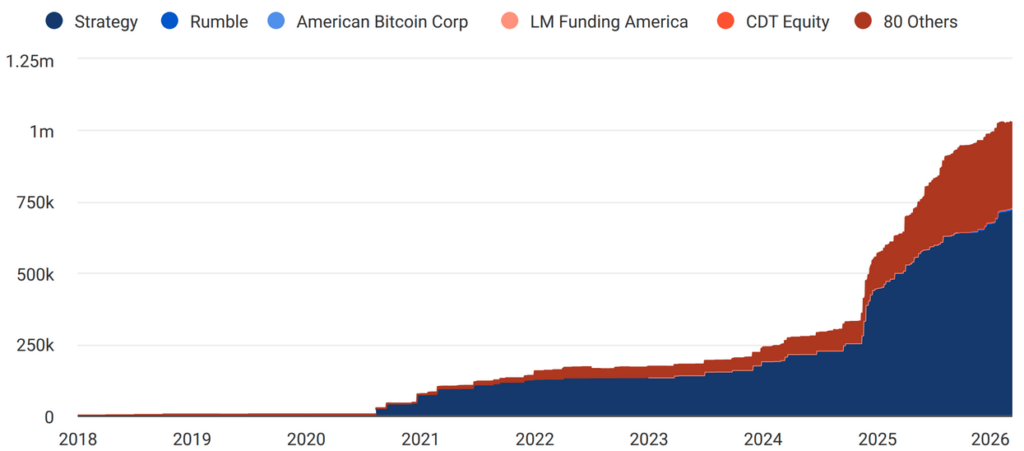
This chart illustrates how corporate Bitcoin holdings have grown alongside ETFs and sovereign adoption, highlighting the increasing role of institutional players in the Bitcoin ecosystem.