
Main Points :
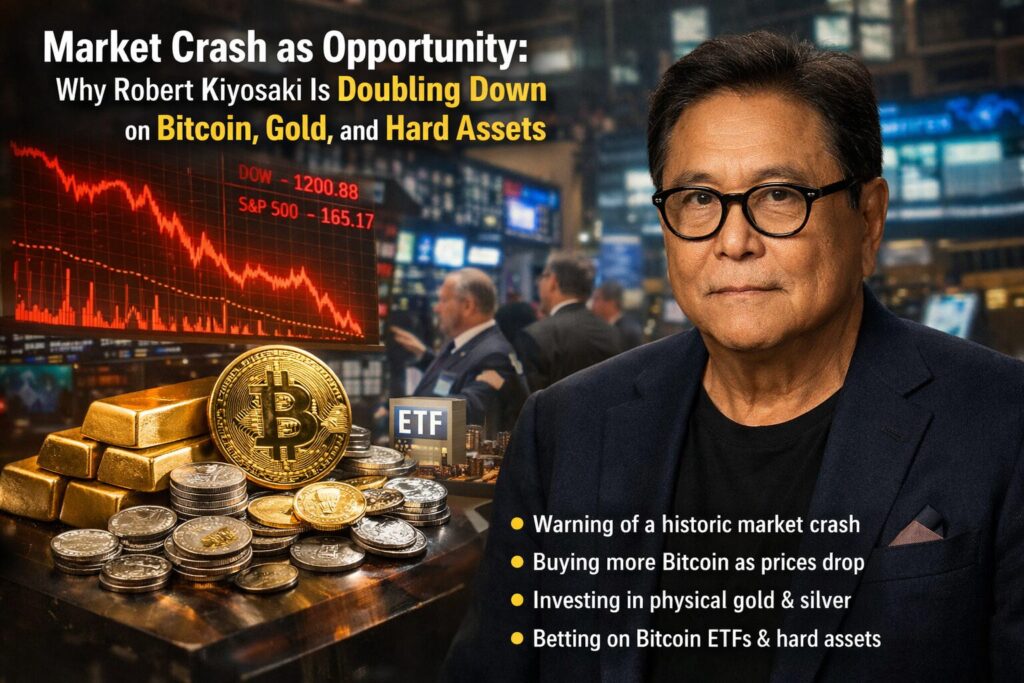
- Robert Kiyosaki warns of a historic stock market crash and frames it as a generational buying opportunity.
- He plans to accumulate more Bitcoin as prices fall, citing its fixed supply of 21 million coins.
- Physical gold and silver remain core components of his defensive strategy.
- Institutional adoption of Bitcoin via ETFs has structurally changed market dynamics.
- Long-term investors may benefit from volatility if positioned with liquidity and discipline.
1. Robert Kiyosaki’s Warning: A Historic Crash Approaches
On February 17, 2026, Robert Kiyosaki, investor and author of Rich Dad Poor Dad, took to X to issue a stark warning: the largest stock market crash in history may be imminent.
Kiyosaki reminded followers that he had predicted such an event in his earlier works and reiterated that the coming downturn is not merely a risk but an approaching inevitability. However, unlike many commentators who emphasize fear, Kiyosaki frames the crash as a rare window for asset acquisition.
He openly stated that he already holds physical gold, silver, Bitcoin, and Ethereum, and that he intends to buy more Bitcoin as prices decline. His message is consistent with his long-standing philosophy: crises transfer wealth from the unprepared to the prepared.
2. “Crash = Sale”: The Philosophy of Strategic Accumulation
Kiyosaki characterizes a market crash as a “giant sale.” When panic dominates sentiment, liquidity evaporates, and leveraged positions unwind, high-quality assets frequently trade below intrinsic value. Historically, major downturns — from 2008 to 2020 — have rewarded investors who accumulated during peak pessimism.
For crypto-focused readers seeking new digital asset opportunities, this mindset aligns with a structural view of volatility: volatility is not risk; lack of preparation is risk.
[Market Decline Scenario Here]
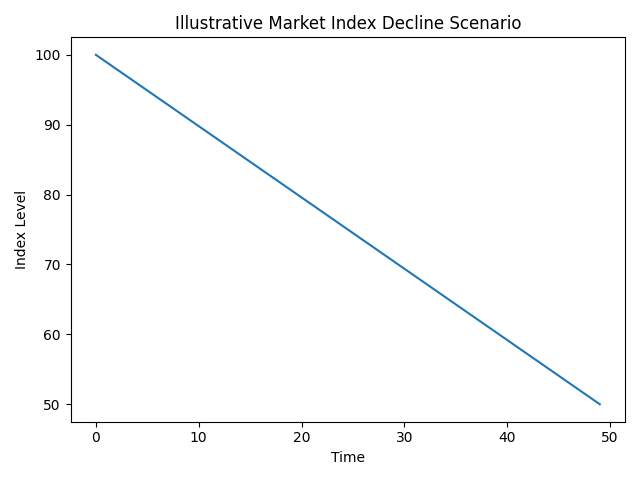
This illustrative chart demonstrates how broad market indices may decline sharply during crisis periods. Such phases historically create entry points for long-term investors with available capital.
3. Bitcoin’s 21 Million Cap: Scarcity as Monetary Design
Central to Kiyosaki’s conviction is Bitcoin’s fixed supply. Unlike fiat currencies, which central banks can expand through monetary policy, Bitcoin’s issuance is algorithmically capped at 21 million coins.
[Bitcoin Supply Curve Here]
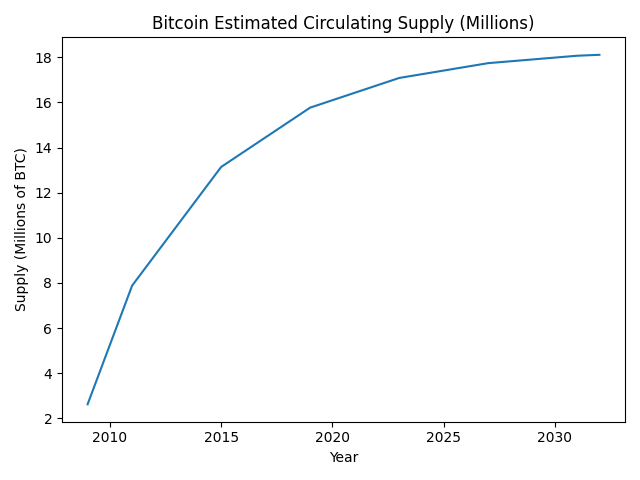
This simplified supply projection illustrates how issuance declines over time through halving cycles. As block rewards decrease, newly minted supply approaches zero. From a macroeconomic perspective, this creates a predictable scarcity model.
Institutional investors increasingly recognize this design feature. Since U.S. spot Bitcoin ETFs were approved, institutional capital has entered the asset class more systematically, reducing the perception that Bitcoin is purely speculative.
For readers exploring revenue opportunities, scarcity-based digital assets introduce a fundamentally different monetary architecture compared to inflationary fiat regimes.
4. Gold, Silver, and Bitcoin: Complementary Hard Assets
Kiyosaki does not advocate a Bitcoin-only approach. He repeatedly emphasizes physical gold and silver ownership. His reasoning is diversification across asset classes that resist monetary debasement.
[Gold Trend Illustration Here]
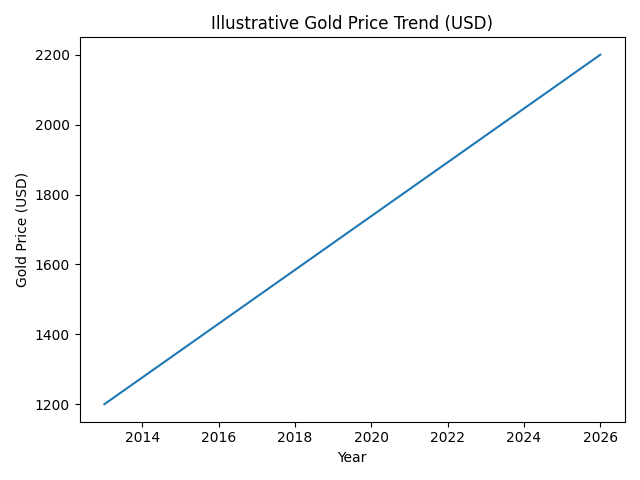
Gold has historically functioned as a hedge during systemic uncertainty. Bitcoin, by contrast, is often described as “digital gold.” While Bitcoin exhibits higher volatility, its long-term growth trajectory has significantly outpaced traditional commodities.
For sophisticated allocators, the key question is not “gold or Bitcoin?” but “what allocation mix balances volatility and asymmetric upside?”
5. Macro Backdrop: Why a Crash Is Plausible
Recent macro conditions support heightened caution:
- Elevated sovereign debt levels globally
- Tight monetary policy cycles
- Slowing global growth
- Liquidity contraction in risk assets
Crypto markets remain sensitive to macro liquidity. However, structural adoption trends continue to advance:
- Institutional custody improvements
- Regulatory clarity expansion
- Stablecoin growth in cross-border payments
- Layer-2 scaling solutions enhancing blockchain efficiency
These developments mean that while short-term price declines may occur, infrastructure maturation continues.
6. Psychological Dynamics: Buying When Others Panic
Kiyosaki’s most provocative statement is psychological rather than technical: “When people panic sell, I buy.”
Behavioral finance research consistently demonstrates that retail investors sell near bottoms and buy near tops. Panic is contagious; discipline is rare.
For crypto-native investors, this has practical implications:
- Maintain dry powder (liquidity)
- Predefine accumulation levels
- Avoid leverage during systemic stress
- Focus on assets with strong tokenomics
This approach is particularly relevant for emerging digital assets with real utility — payment rails, decentralized identity systems, tokenized real-world assets, and cross-border settlement protocols.
7. Long-Term Thesis: Wealth Transfer Cycles
Major crashes historically produce wealth redistribution cycles:
- 2000: Tech bubble collapse → survivors became giants
- 2008: Financial crisis → early Bitcoin adoption
- 2020: Pandemic shock → DeFi expansion
If a large-scale equity correction occurs, it could accelerate blockchain adoption as investors seek alternatives to traditional finance structures.
Kiyosaki’s framework implies that crises compress opportunity windows. Those positioned with capital and conviction can capture asymmetric upside.
8. Strategic Considerations for Crypto-Oriented Readers
For readers searching for new crypto assets or revenue streams, consider:
- Scarcity-driven assets (Bitcoin-like tokenomics)
- Infrastructure plays (Layer-2, modular blockchains)
- Real-world asset tokenization platforms
- Stablecoin-based payment ecosystems
- Custody and compliance technologies
Volatility often separates speculative tokens from structurally sound protocols.
Conclusion: Is the Crash a Threat or a Catalyst?
Robert Kiyosaki’s message is simple but powerful: crashes are not merely destructive events — they are selection mechanisms.
Bitcoin’s capped supply, gold’s historical resilience, and silver’s industrial utility form a diversified hard-asset thesis. Institutional participation has fundamentally changed Bitcoin’s market profile, yet volatility remains inherent.
If a historic crash unfolds, it may test conviction. But for disciplined investors with liquidity and strategic clarity, such periods can become generational entry points.
Whether one agrees with Kiyosaki’s timing or not, the structural logic of scarcity, decentralization, and financial self-sovereignty continues to gain relevance.
The true question is not whether volatility will come — it always does.
The question is whether you will be positioned to act when it does.
