
Main Points :
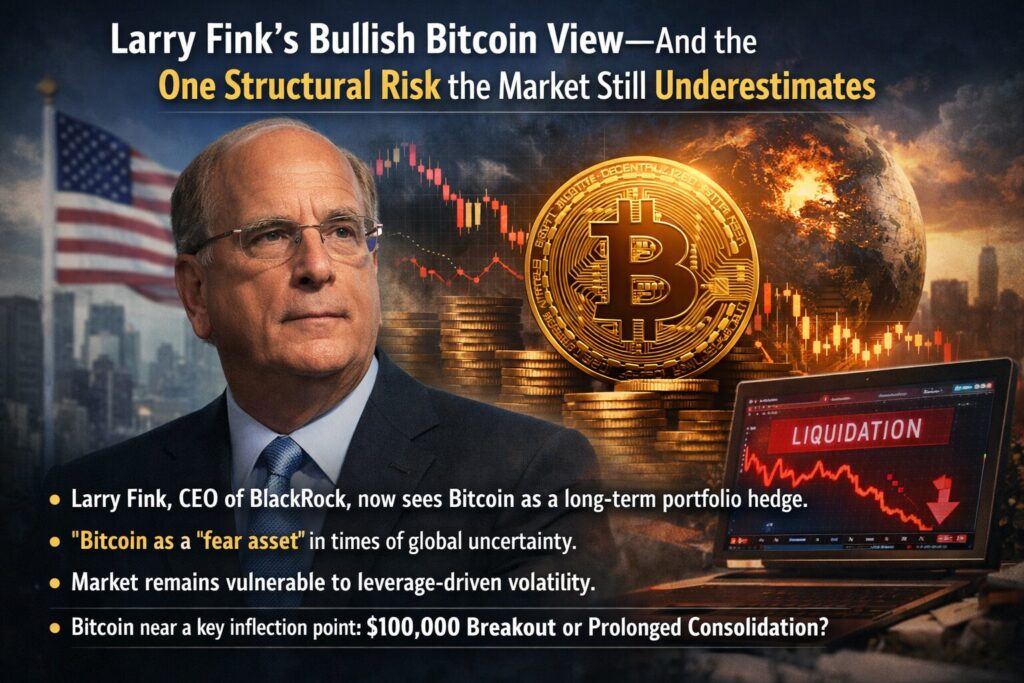
- Larry Fink, CEO of BlackRock, now openly recognizes Bitcoin as a long-term portfolio hedge, particularly in times of geopolitical and fiscal anxiety.
- Bitcoin increasingly functions as a “fear asset,” reacting to global uncertainty rather than traditional risk-on narratives.
- Despite strong institutional adoption via spot Bitcoin ETFs, the market remains structurally vulnerable to leverage-driven volatility.
- Analysts argue that recent price weakness is not about fundamentals or the halving cycle, but about forced deleveraging.
- Bitcoin is approaching a technical inflection point that could lead either to a breakout toward $100,000 or a prolonged consolidation phase.
Introduction: From Skepticism to Strategic Acceptance
The global financial narrative around Bitcoin has shifted dramatically over the past few years, and few figures symbolize this transformation more clearly than Larry Fink, the CEO of BlackRock. Once a vocal skeptic of cryptocurrencies, Fink now speaks publicly about Bitcoin’s role as a hedge against systemic and geopolitical risk.
Yet his recent comments reveal a nuanced position: while Bitcoin’s long-term value proposition is becoming clearer, the asset still suffers from a deep structural flaw—its susceptibility to leverage-driven market distortions. This tension between institutional legitimacy and speculative fragility defines Bitcoin’s current phase.
Bitcoin as a “Fear Asset” in a Fragmented World
Speaking at the New York Times DealBook Summit, Fink described Bitcoin not as a conventional risk asset, but as something fundamentally different.
“Bitcoin is a fear asset.”
According to Fink, investors often turn to Bitcoin during periods of heightened anxiety: geopolitical conflict, concerns about personal safety, ballooning fiscal deficits, and the long-term erosion of fiat currency purchasing power. In this sense, Bitcoin behaves less like a technology stock and more like a decentralized insurance instrument.
Notably, Fink observed that even tentative discussions about geopolitical de-escalation—such as potential diplomatic progress in Ukraine—have coincided with modest pullbacks in Bitcoin’s price. When fear subsides, demand softens.
This behavior reinforces Bitcoin’s emerging identity as a macro-sensitive hedge rather than a pure growth asset.
Short-Term Trading vs. Long-Term Portfolio Protection
While increasingly bullish on Bitcoin’s long-term role, Fink offered a stark warning to short-term traders.
Bitcoin’s price recently declined by roughly 20–25%, marking the third drawdown of similar magnitude since the launch of BlackRock’s spot Bitcoin ETF, IBIT. For Fink, this volatility underscores a critical distinction:
- As a trading vehicle, Bitcoin is brutally unforgiving. Timing errors are costly, and liquidity cascades can unfold rapidly.
- As a hedge, Bitcoin can meaningfully alter portfolio resilience over the long term, particularly when traditional financial systems face stress.
Most investors, Fink argued, lack the tools and discipline required to trade such a volatile instrument successfully.
The “Big Problem”: Leverage Still Rules the Market
Despite institutional inflows reaching tens of billions of dollars, Fink identified what he sees as Bitcoin’s single largest unresolved issue:
Excessive influence from leveraged players.
This concern is echoed by Tom Lee, who argues that Bitcoin’s recent weakness has little to do with cyclical events like the halving. Instead, the dominant force has been forced deleveraging.
Lee compares the current environment to the post-FTX-collapse period: rapid price appreciation followed by abrupt, liquidity-driven sell-offs. From October into early November, Bitcoin surged approximately 36%, only to reverse sharply as leverage unwound.
In other words, the market’s plumbing—not its fundamentals—remains the weakest link.
Institutional Adoption: Progress Without Immunity
The approval and success of U.S. spot Bitcoin ETFs represent a historic milestone. Products like IBIT have absorbed massive inflows, signaling that Bitcoin has crossed a psychological and regulatory threshold.
However, ETF adoption has not eliminated structural fragility:
- Derivatives markets still exert outsized influence on spot prices.
- Liquidation cascades can overwhelm organic demand.
- Institutional capital often arrives through vehicles that are still indirectly exposed to broader crypto market dynamics.
Bitcoin is becoming part of the global financial system—but not yet on its own terms.
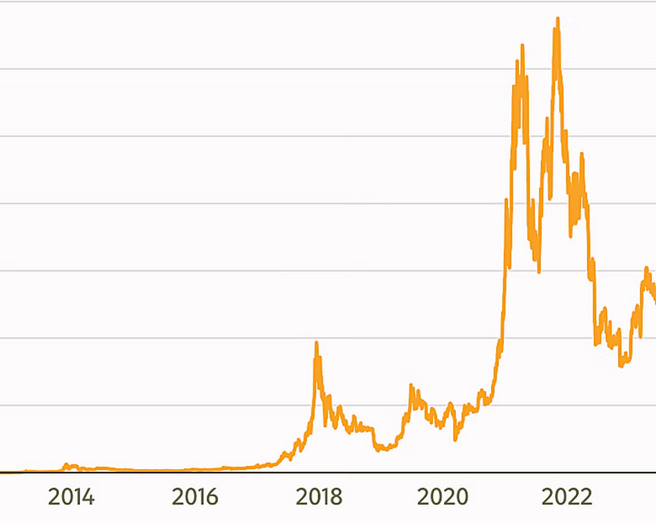
Bitcoin Price and Major Drawdowns (2023–2025)
Figure 1 illustrates repeated 20–25% corrections despite rising institutional participation.
Technical Inflection Point: Breakout or Consolidation
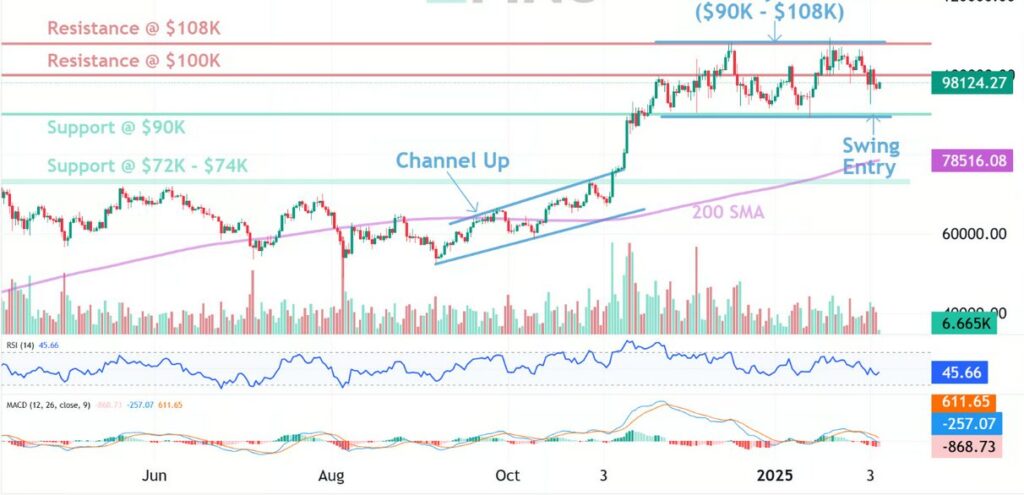
Market analyst Valdrin Tahiri notes that Bitcoin is approaching a decisive technical moment. Price action is compressing beneath a key diagonal resistance line, setting the stage for a binary outcome.
- Successful breakout: A move toward $100,000 becomes plausible, potentially triggering a wave of short liquidations.
- Failed breakout: Continued consolidation or a deeper retracement, especially if buyers fail to reclaim momentum.
This moment will likely determine whether Bitcoin enters a new macro uptrend or remains range-bound for months.
Key Resistance and Liquidation Zones
Figure 2 highlights how leverage positioning amplifies directional moves.
Beyond Price: What This Means for Blockchain Practitioners
For readers interested not only in price speculation but also in practical blockchain applications, this phase offers important lessons:
- Risk management and capital efficiency matter more than narratives.
- Infrastructure resilience—custody, settlement, transparency—will define the next wave of winners.
- Assets that reduce reliance on leverage-heavy speculation may gain relative appeal.
Bitcoin’s maturation does not eliminate volatility; it reframes it.
Conclusion: A Strong Asset with an Unfinished Structure
Larry Fink’s evolving stance reflects a broader truth: Bitcoin has earned a seat at the global financial table, but it has not yet outgrown its structural weaknesses.
As a hedge against fear, fiscal excess, and geopolitical instability, Bitcoin’s case is stronger than ever. As a market instrument, however, it remains vulnerable to leverage-induced distortions that can overwhelm fundamentals.
The next breakout—or breakdown—will not merely be a price event. It will be a referendum on whether Bitcoin can continue its transition from a speculative frontier to a durable financial primitive.
