

Main Points :
- Japan is accelerating a policy shift to integrate cryptocurrencies into its traditional capital market framework, rather than treating them as a parallel system.
- Finance Minister Satsuki Katayama publicly endorsed securities exchanges as the primary gateway for crypto and blockchain-based assets.
- Regulatory supervision is moving from the Payment Services Act to the Financial Instruments and Exchange Act (FIEA), reclassifying crypto as a financial product.
- Tax reform proposes a flat 20% capital gains tax, aligning crypto with equities and investment funds.
- Enforcement actions against unregistered offshore exchanges signal a clear preference for regulated, domestic access routes.
- This model creates new opportunities for institutional crypto products, tokenized securities, and compliant blockchain infrastructure.
1. A Clear Policy Signal from Tokyo
At the opening ceremony of the year at the Tokyo Stock Exchange, Japan’s Finance Minister and Minister for Financial Services, Satsuki Katayama, delivered a message that marks a decisive turning point for the country’s crypto policy.
Speaking to market participants and institutional stakeholders, Katayama framed 2026 as “Japan’s first true year of full digitalization.” Within that vision, cryptocurrencies and blockchain-based digital assets are not positioned as fringe innovations or alternative financial systems. Instead, they are to be absorbed into the existing market infrastructure, with securities exchanges playing the central role.
Her remarks were unambiguous:
“If citizens are to benefit from digital assets and blockchain-based assets, we must leverage the strength of commodity and securities exchanges.”
This statement reflects a broader regulatory philosophy: innovation should scale through trusted, regulated institutions, not through loosely supervised platforms operating outside Japan’s legal perimeter.
2. From Parallel Systems to Full Integration
For much of the past decade, crypto markets globally evolved in parallel with traditional finance. Exchanges, custody, settlement, and even derivatives grew largely outside existing regulatory frameworks.
Japan’s approach now rejects that separation.
Rather than building a standalone crypto regime, regulators are folding digital assets into the same rules that govern stocks, bonds, and funds. This approach prioritizes:
- Market integrity
- Investor protection
- Transparency and disclosure
- Systemic risk management
For investors seeking sustainable returns and for institutions evaluating long-term crypto exposure, this signals lower regulatory uncertainty, even if it comes with stricter compliance.
3. Regulatory Shift: From Payments to Securities Law
3.1 Reclassification Under FIEA
The Financial Services Agency (FSA) has indicated plans to move crypto supervision from the Payment Services Act to the Financial Instruments and Exchange Act (FIEA).
This is not a technical change—it is a conceptual redefinition.
Under the Payment Services Act, cryptocurrencies were treated primarily as:
- Means of settlement
- Instruments for transfer of value
Under FIEA, they become:
- Investment products
- Subject to rules similar to securities
3.2 Practical Implications
This shift introduces:
- Stricter disclosure requirements
- Clear prohibitions on insider trading and market manipulation
- Enhanced supervision of issuers, intermediaries, and exchanges
- Stronger enforcement against unregistered foreign platforms
For market participants, this means higher compliance costs—but also a more predictable, institution-friendly environment.
4. Tax Reform: Aligning Crypto with Equities
One of the most consequential changes under discussion is crypto taxation.
4.1 From Progressive to Flat Tax
Historically, crypto gains in Japan could be taxed at progressive rates up to 55%, depending on total income.
The new proposal supports:
- A flat 20% capital gains tax
- The same rate applied to stocks and investment funds
4.2 Why This Matters
For professional investors and entrepreneurs, this dramatically improves:
- After-tax returns
- Portfolio planning
- Long-term investment viability
It also reduces the incentive to move trading activity offshore purely for tax reasons, reinforcing Japan’s domestic market ecosystem.
5. Enforcement: Regulated Access Only
Policy direction is not theoretical—it is already being enforced.
5.1 App Store Removals
On February 7, 2025, Japanese regulators requested Apple and Google to remove apps linked to unregistered crypto exchanges, including:
- Bybit
- MEXC
- KuCoin
This effectively restricted Japanese users to licensed, compliant platforms.
5.2 Market Exit by Offshore Exchanges
On December 23, 2025, Bybit announced it would phase out services for Japanese residents in 2026, citing regulatory and registration constraints.
These actions make one point clear: access to crypto in Japan will be exchange-led, licensed, and supervised.
6. Securities Exchanges as Crypto Gateways
6.1 Why Exchanges?
Traditional exchanges offer:
- Proven market surveillance
- Robust clearing and settlement
- Investor protection mechanisms
- Institutional-grade custody integration
By positioning exchanges as the main crypto gateway, Japan minimizes systemic risk while maximizing trust.
6.2 Emerging Opportunities
This model opens doors to:
- Crypto ETFs and ETNs
- Tokenized equities and bonds
- Blockchain-based settlement rails
- Hybrid products combining traditional securities and digital assets
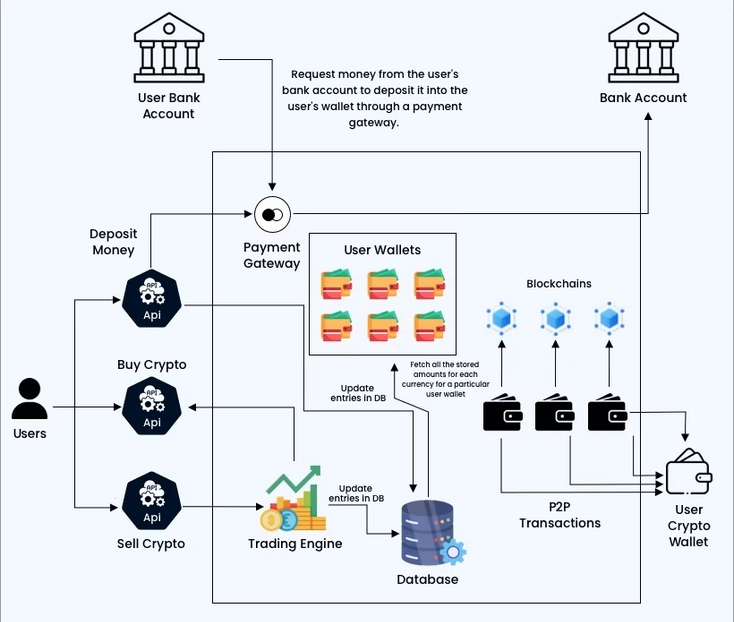
“Crypto Integration into Capital Market Infrastructure”
7. Banks, Stablecoins, and Institutional Infrastructure
Beyond exchanges, regulators are also encouraging bank-led stablecoin initiatives.
Under this framework:
- Stablecoins are issued by regulated financial institutions
- Reserves are fully transparent
- Compliance aligns with AML, KYC, and capital requirements
This approach contrasts with offshore, algorithmic, or opaque stablecoin models and reinforces Japan’s preference for institutional-grade crypto infrastructure.
8. Global Context: Japan vs. the World
Japan’s strategy sits between two global extremes:
- U.S. model: Fragmented regulation, enforcement-driven clarity
- EU model (MiCA): Unified crypto-specific framework
Japan’s choice is different: absorption into existing securities law.
This makes Japan particularly attractive for:
- Asset managers seeking regulated crypto exposure
- Blockchain projects targeting institutional adoption
- Long-term capital allocators prioritizing stability over speculation
9. What This Means for Investors and Builders
For readers searching for:
- New crypto assets
- Next revenue opportunities
- Practical blockchain use cases
Japan’s direction offers clarity.
Investors
- Benefit from predictable taxation and oversight
- Gain access to institutional-grade products
- Face fewer counterparty and platform risks
Builders
- Must design with compliance in mind
- Can integrate with existing financial infrastructure
- Gain credibility through exchange-led distribution
10. Conclusion: A Mature Crypto Market by Design
Japan is not rejecting crypto—it is institutionalizing it.
By anchoring digital assets to securities exchanges, applying financial product regulations, and aligning taxation with equities, Japan is building a crypto market designed for:
- Longevity
- Institutional trust
- Real economic integration
For global investors and blockchain entrepreneurs alike, Japan’s model represents a blueprint for crypto’s next phase—less speculative, more structural, and deeply embedded in the financial system.
