

Main Points :
- Japan’s Financial Services Agency (FSA) plans to establish a new Crypto Asset & Stablecoin Department as part of a major supervisory reorganization.
- The move reflects Japan’s strategy to become a “leading asset management nation” and to respond to rapid financial digitalization.
- Stablecoin legalization, crypto tax reform, and institutional participation are converging into a single policy direction.
- For investors, builders, and financial institutions, this signals regulatory clarity, lower uncertainty, and new business opportunities.
- Japan is positioning itself not just as a regulator, but as a practical blockchain adoption hub.
1. A Structural Shift in Japan’s Financial Supervision
In January 2026, Japan’s Financial Services Agency (FSA) announced that it will establish a dedicated Crypto Asset & Stablecoin Department within its reorganized policy framework. This announcement, published in the agency’s official bulletin on January 26, marks one of the most explicit acknowledgments to date that digital assets are no longer a peripheral issue in Japan’s financial system, but a core policy domain.
The new department will be created as part of a broader restructuring of the FSA’s internal organization. The existing Policy Bureau will be reorganized into the Asset Management and Insurance Supervision Bureau, while the current Supervisory Bureau will be renamed the Banking and Securities Supervision Bureau. Within this new structure, crypto assets and stablecoins will be overseen by a specialized unit with a clear mandate.
This is not merely a change of labels. Organizational structure within a regulator signals priorities, budget allocation, and long-term policy intent. By elevating crypto and stablecoins into a standalone department, the FSA is signaling that digital assets are now viewed on par with banking, securities, and insurance.
2. Why Now? The Policy Background Behind the New Department
Stablecoin Legalization as a Catalyst
The most immediate catalyst for this reorganization was the June 2023 amendment to Japan’s Payment Services Act, which officially legalized certain types of stablecoins. Under the revised framework, fiat-backed stablecoins are legally defined as electronic payment instruments, allowing licensed banks, trust companies, and registered fund transfer service providers to issue and distribute them.
This change fundamentally altered Japan’s financial landscape. Stablecoins are no longer theoretical instruments or offshore products; they are now regulated domestic payment tools. Once stablecoins entered the legal system, the need for a specialized supervisory framework became unavoidable.
Tax Reform and Investor Protection
Another major driver is Japan’s ongoing crypto tax reform. In December 2025, the government and ruling coalition approved a tax reform outline for fiscal year 2026 that includes the introduction of separate self-assessment taxation for crypto transactions.
Under this plan, crypto gains will be taxed at a flat rate of 20%, aligning them with equities and other financial instruments, instead of being treated as miscellaneous income subject to progressive rates that could exceed 55%. This reform dramatically improves the investment environment for both retail and institutional participants.
[Japan Tax Treatment Comparison]
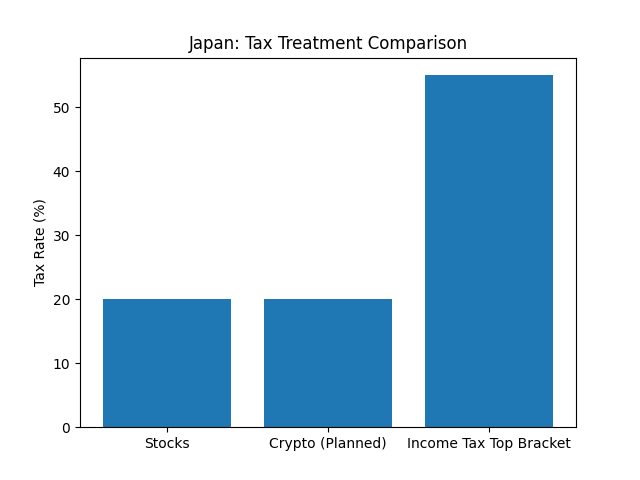
Tax reform without supervisory reform would be incomplete. The new department allows the FSA to align taxation, disclosure, market surveillance, and investor protection under a coherent policy umbrella.
3. From Fragmentation to Centralization: What Changes Internally
Previously, crypto-related matters were handled across multiple divisions, often under advisory or coordinator-level units. The new structure consolidates these responsibilities into formal “departments” (ka), including:
- International Affairs Department
- Credit Systems Department
- Postal Financial Services Department
- Crypto Asset & Stablecoin Department
This shift from advisory offices to full departments matters. Departments have clearer authority, staffing, and accountability. It also improves Japan’s ability to engage in international regulatory coordination, particularly with frameworks emerging from the EU (MiCA), the US, and Singapore.
4. Implications for Crypto Investors Seeking the Next Opportunity
For readers searching for new digital assets, yield opportunities, or long-term investment themes, Japan’s move sends several important signals.
First, regulatory risk in Japan is declining, not increasing. Clear rules tend to reduce volatility premiums and attract long-term capital. Second, the alignment of crypto taxation with stock taxation removes one of the largest structural disadvantages previously facing Japanese crypto investors.
Third, Japan’s approach is conservative but predictable. Unlike jurisdictions that oscillate between permissive and hostile stances, Japan is building a slow, institution-friendly framework. This creates fertile ground for:
- Regulated exchanges
- Yen- and dollar-backed stablecoins
- Tokenized financial products
- On-chain settlement infrastructure
5. Stablecoins as Financial Infrastructure, Not Speculative Assets
One of the most important conceptual shifts embedded in the new department is the treatment of stablecoins as financial infrastructure rather than speculative crypto assets.
In Japan, stablecoins are increasingly discussed in the context of:
- Cross-border remittances
- Corporate treasury management
- Settlement between financial institutions
- Tokenized deposits and securities
This mirrors global trends. In the United States, major banks are experimenting with deposit tokens. In Europe, MiCA explicitly separates asset-referenced tokens from speculative crypto assets. Japan’s new department positions the country to integrate stablecoins into its existing payment rails rather than treating them as disruptive outsiders.
6. Institutional Participation and the “Asset Management Nation” Vision
Japan’s government has repeatedly emphasized its ambition to become an asset management-oriented nation, attracting global capital and encouraging households to shift from cash savings to productive investments.
Crypto assets and blockchain-based instruments fit neatly into this vision when properly regulated. By establishing a dedicated department, the FSA can:
- Encourage institutional participation without compromising consumer protection
- Support banks and securities firms entering the digital asset space
- Develop disclosure and custody standards suitable for pensions and funds
This is especially relevant as Japanese households still hold a large proportion of their wealth in cash compared to Western economies.
7. Practical Blockchain Use Cases Likely to Accelerate
For builders and operators focused on practical blockchain use, the new department suggests where policy support may concentrate:
- Stablecoin-based B2B payments
- On-chain settlement for securities and funds
- Compliance-friendly DeFi integrations
- Regulated access to decentralized exchanges (DEXs)
The FSA has already indicated interest in addressing insider trading rules, bank participation, and DEX oversight. A specialized department makes it easier to develop nuanced rules rather than blunt restrictions.
8. Japan in the Global Regulatory Landscape
Japan’s move aligns it with other major jurisdictions that are institutionalizing crypto oversight rather than marginalizing it.
[Key Milestones in Japan’s Crypto Regulation]
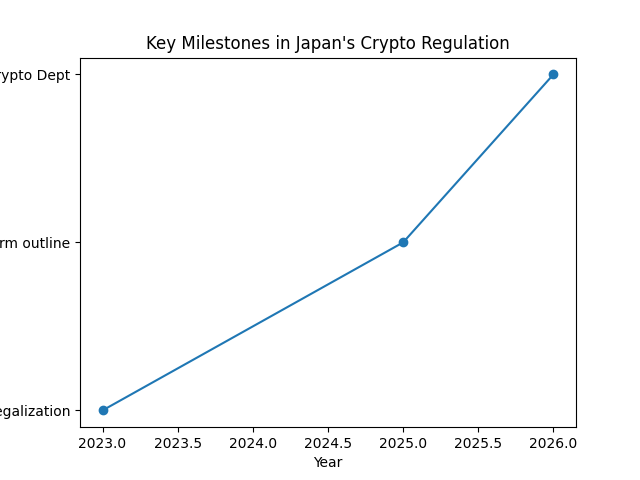
While the US continues to struggle with fragmented oversight, and Europe focuses on harmonization under MiCA, Japan is choosing administrative clarity and incremental integration. This may not generate headlines, but it creates a stable environment for long-term builders.
Conclusion: A Quiet but Decisive Turning Point
The establishment of the Crypto Asset & Stablecoin Department may appear bureaucratic, but it represents a decisive turning point in Japan’s digital asset policy.
It signals that crypto and stablecoins are no longer experimental, no longer temporary, and no longer peripheral. They are now a permanent part of Japan’s financial system, subject to dedicated oversight, integrated taxation, and long-term policy planning.
For investors seeking the next generation of digital assets, for companies exploring new revenue models, and for practitioners building real-world blockchain applications, Japan is quietly positioning itself as one of the most predictable and institution-ready markets in the world.
