
Main Points :
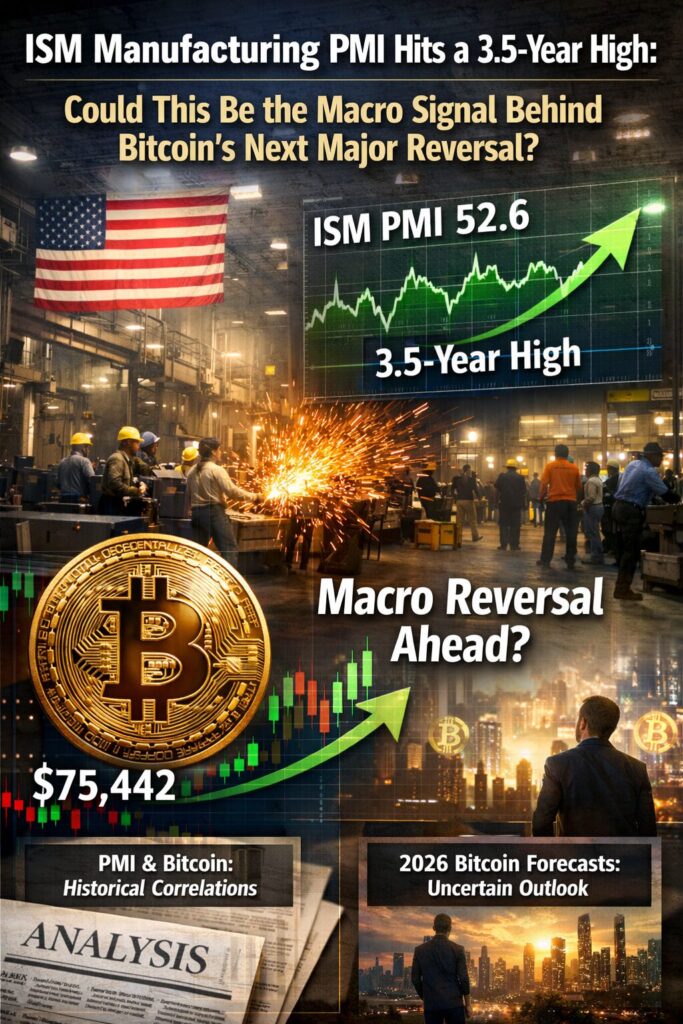
- The U.S. ISM Manufacturing PMI surged to 52.6, its highest level in approximately 3.5 years, signaling a return to economic expansion.
- Historically, reversals in PMI trends have often coincided with risk-on transitions, benefiting assets such as Bitcoin.
- Bitcoin recently rebounded from around $75,442 after heavy deleveraging, raising questions about a potential macro-driven trend reversal.
- While correlations between PMI and Bitcoin have been strong in past cycles, analysts caution against over-reliance on a single macro indicator.
- Institutional forecasts for Bitcoin in 2026 vary widely, reflecting heightened uncertainty—and opportunity.
1. ISM Manufacturing PMI: A Macro Indicator Investors Cannot Ignore
The Institute for Supply Management (ISM) released its January Manufacturing Purchasing Managers’ Index (PMI), which surprised markets by coming in at 52.6, far exceeding the consensus forecast of around 48.5. This reading marks the first clear expansionary signal after 26 consecutive months of contraction and represents the highest level since August 2022.
The ISM Manufacturing PMI is one of the most closely watched indicators of U.S. economic health. A reading above 50 signals expansion, while a reading below 50 indicates contraction. Because it captures forward-looking sentiment from purchasing managers, it often acts as an early signal for shifts in economic momentum, inflation pressures, and monetary policy expectations at the Federal Reserve.
For risk assets, including equities, commodities, and increasingly digital assets such as Bitcoin, this shift back into expansion territory is not merely academic—it has direct implications for capital flows and investor psychology.
2. Historical Relationship Between PMI Cycles and Bitcoin
Data from Trading Economics shows that from mid-2020 through 2023, movements in the ISM Manufacturing PMI exhibited a notable correlation with Bitcoin price trends. Periods of PMI recovery often coincided with renewed risk appetite and capital rotation into alternative assets.
ISM Manufacturing PMI vs. Bitcoin Price (2016–2026)
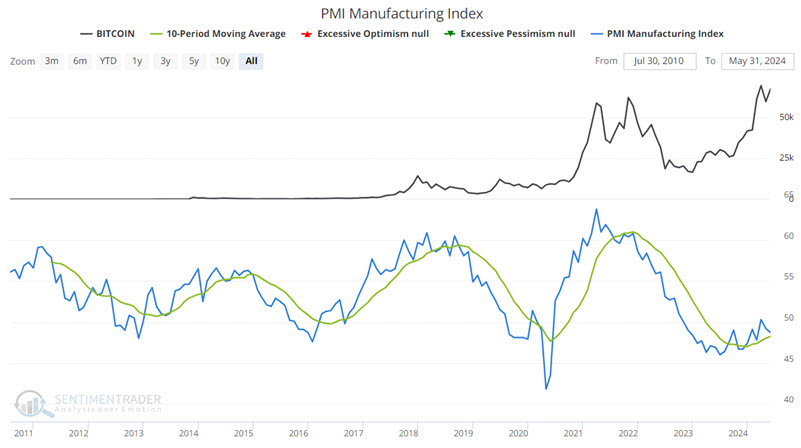
A dual-axis line chart comparing ISM PMI readings with Bitcoin price in USD, highlighting major PMI reversals.
Joe Burnett, Vice President of Bitcoin Strategy at Strive, has noted that historically, PMI reversals have marked transitions into risk-on regimes. He points to 2013, 2016, and 2020, periods when rising manufacturing activity preceded substantial Bitcoin appreciation.
From this perspective, the latest PMI surge may represent more than just a data surprise—it could be the early macro signal of a broader shift in market regime.
3. Moving Beyond the “Halving-Only” Narrative
An anonymous Bitcoin analyst known as “Plan C” argues that investors must update their mental models. According to him, relying solely on Bitcoin’s four-year halving cycle is no longer sufficient:
“If investors fail to move beyond the almost mythical halving narrative and ignore macroeconomic cycles, they risk missing the second wave of this bull market entirely.”
This view reflects a broader trend among institutional and professional investors who increasingly analyze Bitcoin alongside traditional macro indicators such as PMI, real yields, liquidity conditions, and dollar strength. Bitcoin, in this framing, is evolving from a purely idiosyncratic asset into a macro-sensitive risk instrument.
4. Skepticism and Limits of the PMI–Bitcoin Correlation
Not all analysts agree that PMI is a reliable leading indicator for Bitcoin. Benjamin Cowen, founder and CEO of Into The Cryptoverse, cautions against drawing overly deterministic conclusions:
“Bitcoin is not the economy itself.”
Indeed, there have been periods where Bitcoin rallied despite weak or flat PMI readings. In 2025, for example, Bitcoin surged toward $126,080 even as the manufacturing index stagnated for several months. This divergence underscores that while macro data matters, Bitcoin’s price dynamics are also driven by liquidity events, ETF flows, regulatory developments, and leverage conditions.
5. Recent Market Structure: Deleveraging and Volatility
Bitcoin’s recent price action cannot be understood without examining market structure. Following a massive liquidation event on October 10—where approximately $19 billion in leveraged positions were wiped out—Bitcoin entered a period of heightened volatility.
At current levels, Bitcoin remains roughly 38% below its October high. This contrasts sharply with traditional assets such as equities and gold, which have largely maintained upward trends. The result has been a pronounced cooling of market sentiment toward Bitcoin, even as long-term fundamentals remain intact.
Bitcoin Drawdowns vs. Major Liquidation Events
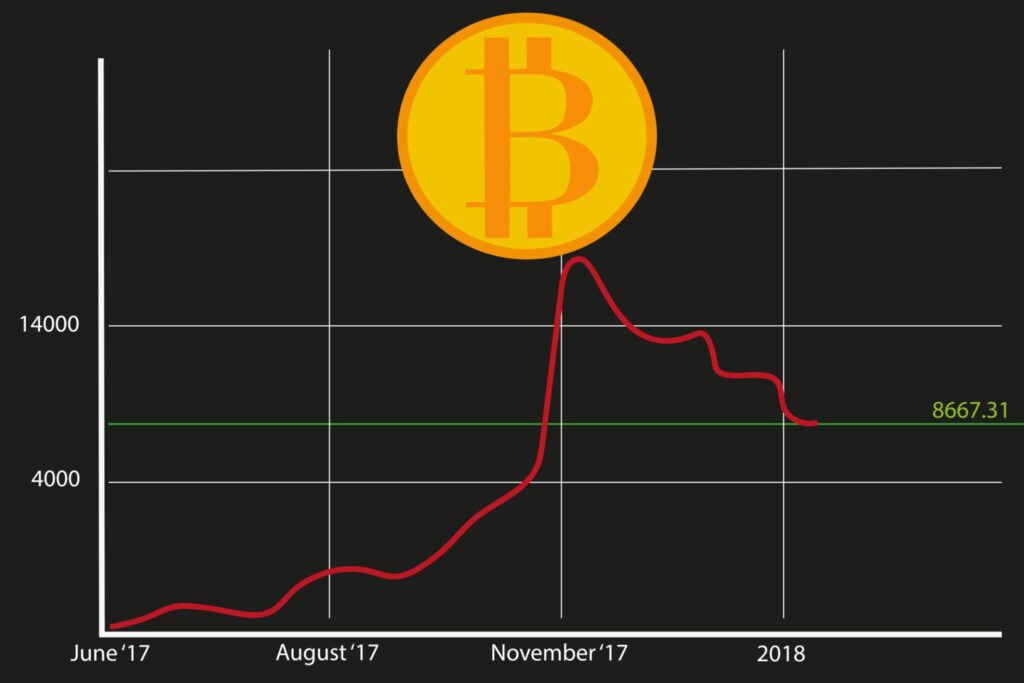
Highlighting the October liquidation and subsequent price recovery attempts.
From a contrarian standpoint, such sentiment divergence has historically preceded major inflection points.
6. Institutional Outlook for Bitcoin in 2026
Looking ahead, institutional forecasts for Bitcoin in 2026 span an unusually wide range:
- Dragonfly Capital projects Bitcoin trading above $150,000 by the end of 2026, citing increasing institutional adoption and macro tailwinds.
- Tom Lee of Fundstrat suggests further near-term consolidation, followed by a strong rebound in the latter half of the year, potentially leading to new all-time highs.
- Galaxy Digital declines to provide a point estimate, arguing that macro uncertainty is too high. Its analysts suggest Bitcoin could plausibly settle anywhere between $50,000 and $250,000.
This dispersion of forecasts reflects not confusion, but rather optionality. For investors seeking asymmetric returns, such environments often present the most compelling opportunities.
7. Strategic Implications for Crypto-Focused Investors
For readers searching for new crypto assets, revenue opportunities, and practical blockchain applications, the key takeaway is not to treat PMI as a trading signal in isolation. Instead, it should be integrated into a broader framework that includes:
- Liquidity conditions and leverage metrics
- Institutional capital flows (ETFs, custody, derivatives)
- Regulatory clarity and jurisdictional shifts
- On-chain activity and real-world blockchain adoption
Bitcoin’s potential reversal, if confirmed, may act as a liquidity catalyst for the broader crypto ecosystem, including Layer-2 solutions, tokenized real-world assets, and payment-focused blockchains.
Conclusion: A Macro Door Is Opening—But Timing Still Matters
The ISM Manufacturing PMI reaching a 3.5-year high is more than a statistical footnote. It signals a potential shift in the macroeconomic environment, one that has historically favored risk assets, including Bitcoin.
However, history also teaches caution. Bitcoin does not move in lockstep with any single indicator. The most robust strategies will be those that combine macro awareness with disciplined risk management and a clear understanding of blockchain’s evolving role in the global financial system.
For investors and builders alike, this moment may not yet be the final confirmation of a new bull phase—but it could very well be the macro knock on the door.
