

Key Points :
- Strategy (formerly MicroStrategy) is acquiring Bitcoin at a pace far exceeding new mining supply.
- This creates a new form of supply shock, potentially stronger than the halving cycle.
- The traditional 4-year Bitcoin cycle may be weakening or evolving.
- Institutional demand—especially structured capital like STRC—could redefine price dynamics.
- Long-term projections now include scenarios where Bitcoin exceeds $400,000.
Introduction: A Structural Shift in Bitcoin’s Supply Dynamics
For over a decade, Bitcoin’s market behavior has been largely explained through one dominant mechanism: the halving cycle. Every four years, Bitcoin’s block rewards are cut in half, reducing new supply and historically triggering bull markets.
However, recent developments suggest that this long-standing model may be undergoing a fundamental transformation.
At the center of this shift is Strategy, led by Michael Saylor, which has accelerated Bitcoin acquisition using financial instruments such as preferred shares (STRC). This aggressive accumulation is not only absorbing newly mined Bitcoin but significantly exceeding it.
The critical question now is: Has institutional accumulation replaced halving as the primary driver of Bitcoin’s supply shock?
Strategy’s Buying Spree: Absorbing More Than the Market Produces
Strategy’s recent purchasing activity has been nothing short of unprecedented.
In a single week ending March 15, the company acquired 22,337 BTC, funded in part by approximately $1.18 billion raised through STRC issuance. To understand the scale:
- Global Bitcoin mining produces roughly 450 BTC per day
- Strategy’s weekly purchases equate to ~7 weeks of global supply
In the prior week, the company purchased nearly 18,000 BTC for $1.28 billion, again absorbing several weeks’ worth of mined supply.
Even more striking, peak days saw purchases of over 4,000 BTC, equivalent to 9 days of total global production—driven by STRC-related funding alone.
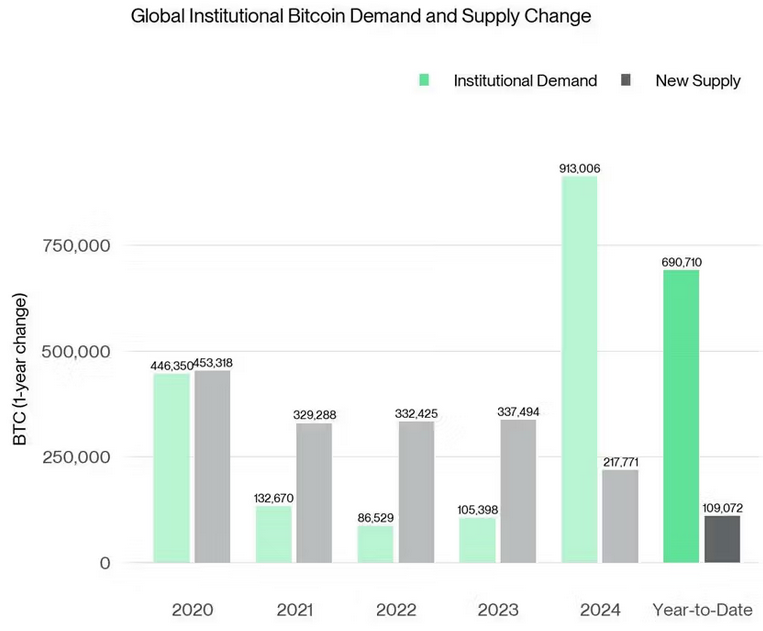
Across broader post-halving data, corporations—led by Strategy—are collectively acquiring Bitcoin at approximately 2.8x the mining supply rate.
Implication
This is not just accumulation. It is systematic supply absorption, effectively removing Bitcoin from circulation faster than it can be produced.
The Weakening of the Four-Year Cycle
Historically, Bitcoin’s market has followed a predictable rhythm:
- Halving reduces supply
- Bull market emerges
- Peak forms
- Bear market follows
Analysts such as Benjamin Cowen have argued that, if this pattern holds, 2026 should be a bearish year.
However, this assumption depends on one key premise:
That halving remains the dominant supply shock.
This premise is now being challenged.
If a single entity—or a group of institutions—can consistently purchase more Bitcoin than miners produce, the halving becomes less relevant. The market is no longer constrained by issuance alone, but by capital inflows and treasury strategies.
Trader “Grain of Salt” highlights this shift:
If institutional buyers continuously outpace miners, the halving ceases to be the primary catalyst.
New Paradigm
- Old Model: Supply ↓ (Halving) → Price ↑
- New Model: Demand ↑↑ (Institutional Buying) → Supply Scarcity → Price ↑↑
Institutional Capital as the New Supply Shock
The introduction of STRC-like instruments represents a structural evolution in crypto markets.
Instead of relying on organic demand, Strategy is effectively engineering demand through capital markets:
- Raising funds via preferred shares
- Converting capital directly into Bitcoin
- Locking supply into long-term holdings
This transforms Bitcoin from a speculative asset into a treasury reserve asset with financial engineering support.
Why This Matters
- Predictability of Demand
Unlike retail cycles, institutional accumulation can be continuous and strategic. - Reduced Circulating Supply
Coins acquired are often not resold, tightening liquidity. - Market Floor Formation
Persistent buying creates structural support levels.
Technical Perspective: Long-Term Trendline Retest
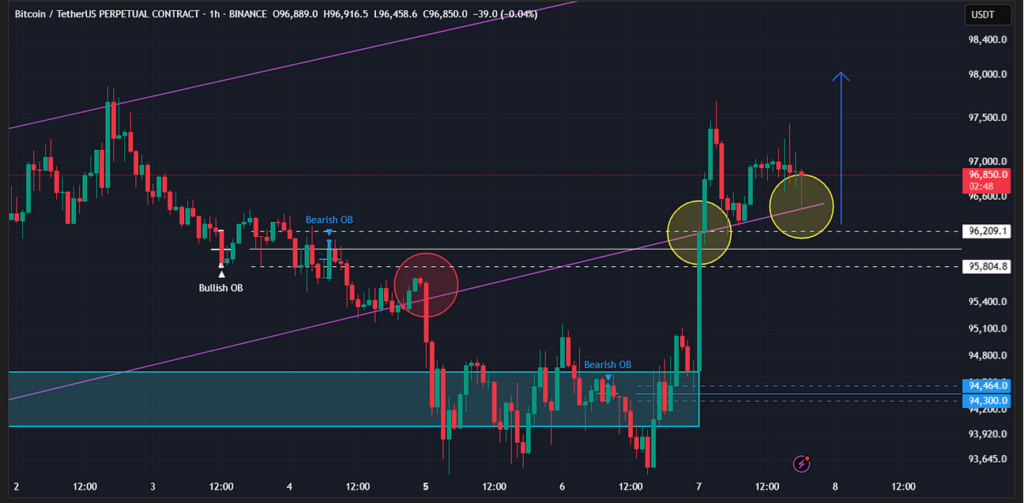
Bitcoin is currently retesting a six-year ascending trendline, which previously marked cycle bottoms in:
- 2018
- 2020
- 2022
Analysts such as Vivek Sen suggest that holding this level could signal the beginning of a new bullish phase.
Historically, rebounds from this trendline have been explosive. The last major bounce resulted in a ~450% increase in price.
Scenario Analysis
If a similar move occurs from current levels:
- Bitcoin could exceed $400,000
This aligns with multiple bullish projections under high-demand scenarios.
Demand Shock vs. Geopolitical Risk
Interestingly, Strategy’s accumulation continues even amid macro uncertainty, including rising geopolitical tensions such as U.S.–Iran conflicts.
This suggests a deeper shift:
- Bitcoin is increasingly viewed as a strategic asset, not just a risk asset
- Institutional players are less reactive to short-term volatility
Emerging Narrative
Bitcoin is transitioning toward:
- Digital gold → Strategic reserve asset
- Speculative cycle → Balance sheet allocation model
Beyond Halving: A New Market Driver
If Strategy and similar entities continue accumulating at current rates, the implications are profound:
1. Shrinking Retail Influence
Retail-driven cycles may become secondary to institutional flows.
2. Supply Illiquidity
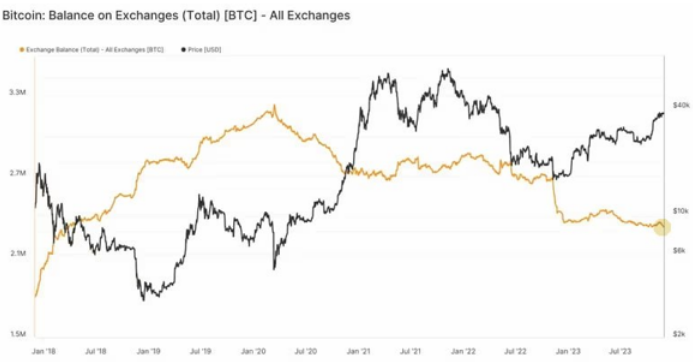
A growing portion of Bitcoin becomes effectively “locked,” reducing tradable supply.
3. Cycle Compression or Elimination
Instead of clear bull/bear cycles, markets may exhibit persistent upward pressure with periodic corrections.
4. New Metrics for Analysis
Traditional indicators (halving timing, miner behavior) may be replaced by:
- Treasury accumulation rates
- ETF inflows
- Corporate balance sheet allocations
Opportunities for Investors and Builders
For readers seeking new crypto assets, revenue opportunities, and practical blockchain use cases, this shift opens several avenues:
1. Treasury Strategy Tokens
Projects that integrate Bitcoin or similar scarcity models into treasury frameworks.
2. Structured Crypto Finance
Instruments like STRC signal growth in:
- Tokenized equity
- Yield-bearing crypto securities
- Hybrid TradFi–DeFi structures
3. Liquidity Layer Innovations
As supply tightens, demand for:
- Lending platforms
- Synthetic assets
- Liquidity provisioning tools
will increase.
Conclusion: A Paradigm Shift in Bitcoin’s Market Structure
Bitcoin may be entering a new era—one where halving is no longer the primary driver of price dynamics.
Instead, institutional accumulation and engineered demand are emerging as dominant forces.
Strategy’s aggressive buying is not just influencing price—it is redefining the very mechanics of the market:
- Supply is no longer just reduced—it is actively absorbed
- Demand is no longer organic—it is strategically created
- Cycles are no longer predictable—they are evolving
If this trend continues, Bitcoin’s next major move may not depend on the 2028 halving, but on how aggressively institutions continue to remove supply from the market.
In such a scenario, price targets like $400,000 are no longer speculative extremes—they become logical outcomes of structural scarcity.
