
Key Points :
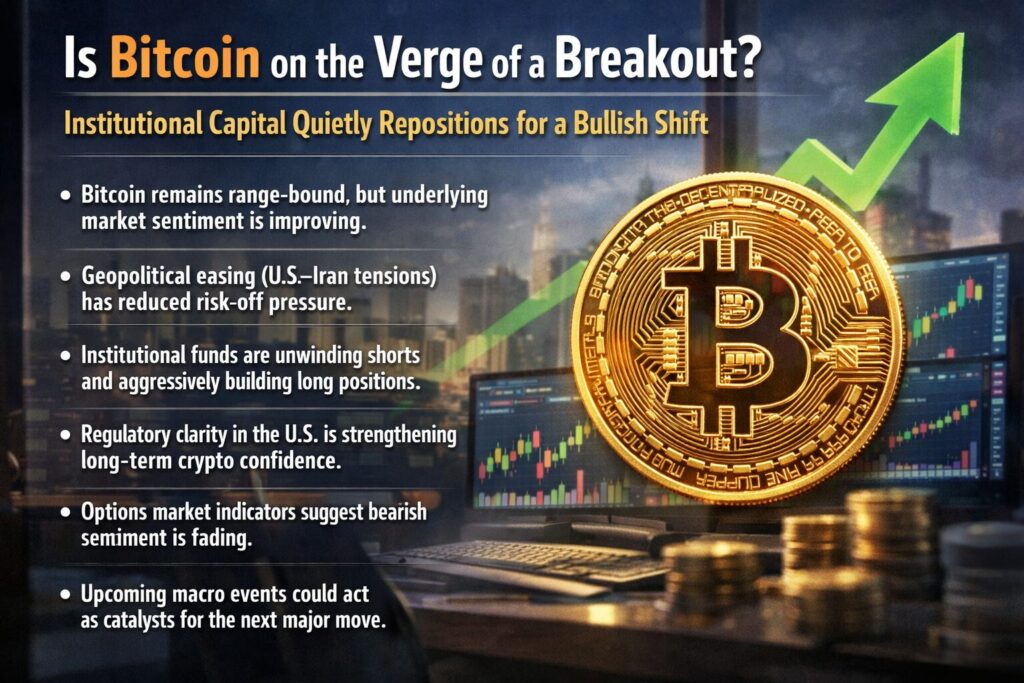
- Bitcoin remains range-bound, but underlying market sentiment is improving.
- Geopolitical easing (U.S.–Iran tensions) has reduced risk-off pressure.
- Institutional funds are unwinding shorts and aggressively building long positions.
- Regulatory clarity in the U.S. is strengthening long-term crypto confidence.
- Options market indicators suggest bearish sentiment is fading.
- Upcoming macro events could act as catalysts for the next major move.
Introduction: Calm Before the Storm?
Bitcoin has entered a period of deceptive calm. Price action remains largely sideways, yet beneath the surface, a series of structural changes are unfolding that could signal the early stages of a major directional move. According to analysis contributed by Japanese crypto analyst 仮想NISHI, combined with broader global data sources, the current environment resembles a classic “pre-breakout consolidation phase.”
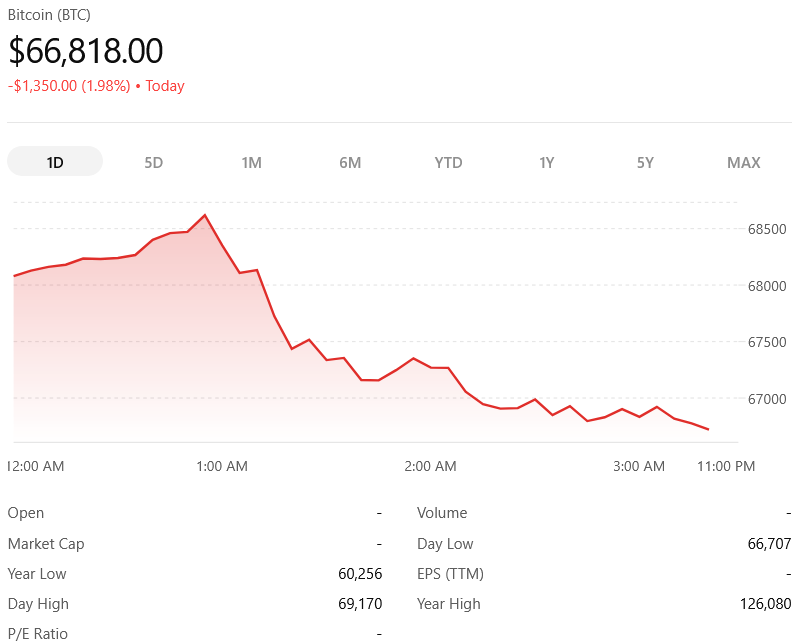
At the time of writing, Bitcoin’s price has not exhibited significant volatility. However, this stability is not necessarily indicative of market indecision—it may instead reflect a transition phase where capital is quietly repositioning.
What makes this moment particularly important is the convergence of three forces: geopolitical easing, regulatory progress, and institutional positioning. When these align, markets often move rapidly.
Geopolitical Easing and Its Impact on Risk Assets
One of the primary drivers behind Bitcoin’s recent stability is the easing of geopolitical tensions between the United States and Iran. Statements from Donald Trump suggesting a near-term withdrawal from military operations have reduced fears of prolonged conflict.
This shift has had a measurable impact on global markets. Oil prices, particularly WTI Crude Oil futures, briefly fell toward the mid-$90 range before stabilizing.
Bitcoin historically exhibits sensitivity to energy markets. Rising oil prices tend to correlate with macro uncertainty and inflation concerns—both of which can create short-term headwinds for risk assets like cryptocurrencies. Conversely, declining oil prices often alleviate these pressures.
However, the current situation is nuanced. While oil has pulled back, it has not collapsed, leaving Bitcoin in a transitional state rather than triggering an immediate rally.
BTC vs Oil Price Correlation (Last 90 Days)
(Chart showing inverse relationship between Bitcoin price and WTI crude fluctuations)
Regulatory Progress: The GENIUS Act and Market Confidence
Another critical development is the advancement of U.S. crypto regulation, particularly the implementation framework of the GENIUS Act (stablecoin regulation law).
The U.S. Treasury’s release of a Notice of Proposed Rulemaking (NPRM) marks a significant milestone. For the first time, the division of authority between federal and state regulators is becoming clearer.
This matters more than it appears.
Regulatory ambiguity has long been one of the biggest barriers to institutional adoption of crypto. By defining supervisory boundaries, the U.S. government is effectively lowering operational risk for businesses and funds entering the space.
Historically, periods of regulatory clarity have preceded major inflows of capital. The current development may follow the same pattern, particularly as stablecoins form the backbone of crypto liquidity.
Options Market Signals: Bearish Sentiment is Fading
Looking at derivatives markets, the Put-Call Ratio (PCR)—a key indicator of investor sentiment—has started to decline after remaining elevated for an extended period.
A high PCR typically indicates bearish positioning (more puts than calls). The recent decline suggests that excessive pessimism is unwinding.
Importantly, this does not mean the market has turned fully bullish. Instead, it reflects a shift toward neutrality with a slight upward bias.
This type of sentiment reset is often observed before trend reversals. Markets rarely move from extreme bearishness directly into strong bullishness; they pass through a normalization phase first.
BTC Options Put-Call Ratio Trend
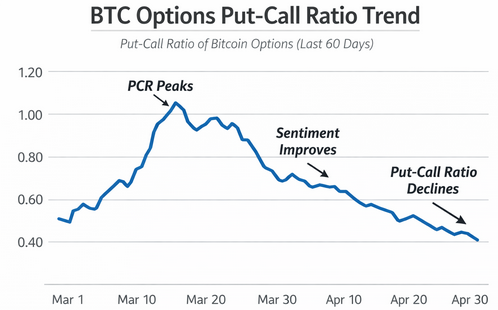
(Chart showing PCR peaking and then declining, indicating sentiment improvement)
Institutional Positioning: The Most Important Signal
Perhaps the most compelling data point comes from on-chain analytics platform Nansen.
Using AI-driven wallet analysis, Nansen identified a significant shift among high-performing institutional funds. At the start of the new fiscal period (April 1), these funds increased their long exposure dramatically—from 45% to 77%.
This is not a minor adjustment.
Breaking down the numbers:
- Approximately $8.5 million in short positions were closed.
- Around $3.9 million in new long positions were opened.
This indicates more than just short covering. It represents a deliberate reallocation toward bullish exposure.
Institutional investors typically move early, not late. Their positioning often precedes major market trends rather than reacting to them.
Institutional Position Shift (Long vs Short)
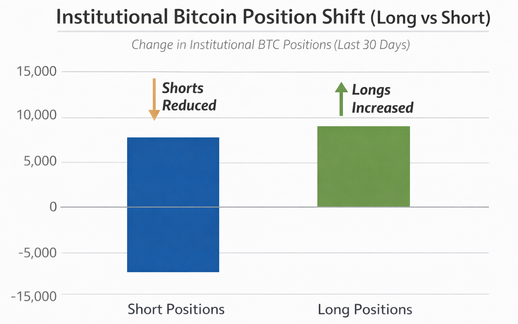
(Bar chart showing reduction in short positions and increase in long positions)
Macro Context: Why This Shift Matters Now
The timing of this repositioning is critical.
We are entering a period filled with macroeconomic catalysts:
- U.S. Employment Report
- ISM Non-Manufacturing Index
- FOMC Minutes
These events have historically triggered volatility across all asset classes, including crypto.
When institutional positioning aligns with upcoming macro catalysts, the probability of a significant move increases.
Beyond Bitcoin: Broader Market Implications
While this analysis focuses on Bitcoin, the implications extend across the crypto ecosystem.
If Bitcoin breaks upward, capital typically rotates into:
- Ethereum and Layer 1 ecosystems
- AI-integrated blockchain projects
- Real-world asset (RWA) tokenization platforms
- Payment-focused tokens and stablecoin infrastructure
This aligns with current trends where institutional interest is expanding beyond BTC into infrastructure plays.
Strategic Insight: What Investors Should Watch
For readers seeking new opportunities in crypto, the current market offers a unique setup.
Key indicators to monitor:
- Sustained increase in institutional long positioning
- Continued decline in PCR
- Breakout above key resistance levels
- Stability or decline in oil prices
- Regulatory follow-through in the U.S.
If these conditions align, the probability of a strong upward trend increases significantly.
Conclusion: A Quiet Accumulation Phase Before Expansion
Bitcoin’s current sideways movement may be misleading. Beneath the surface, the market is undergoing a structural shift driven by institutional capital, improving sentiment, and regulatory clarity.
This combination has historically preceded major bull phases.
While no single indicator guarantees a breakout, the alignment of multiple signals increases confidence in a bullish scenario.
For investors, this is not a moment of excitement—it is a moment of preparation.
Markets often reward those who act before the move becomes obvious.
