

Main Points :
- The U.S. Internal Revenue Service (IRS) has proposed regulatory changes to cryptocurrency tax reporting rules.
- Crypto exchanges may be allowed to send Form 1099-DA electronically by default, even without explicit customer consent.
- The proposal aims to reduce operational and administrative costs associated with paper tax reporting.
- Exchanges could potentially terminate relationships with customers who refuse electronic document delivery.
- The reform reflects the rapid growth of digital asset trading and the impracticality of paper-based reporting systems.
- The proposal forms part of a broader global shift toward digitized tax compliance in crypto markets.
The Digitization of Crypto Tax Reporting: IRS Reform and Its Implications for the Industry
Introduction: Why Crypto Tax Reporting Is Becoming a Major Global Issue
Cryptocurrency adoption has reached a scale where governments can no longer treat digital asset transactions as marginal financial activity. The explosive growth of exchanges, decentralized finance platforms, and blockchain-based financial products has forced tax authorities worldwide to rethink how digital asset reporting should function.
In the United States, the Internal Revenue Service (IRS) has taken another step toward modernizing its crypto regulatory framework. In March 2026, the agency published a proposal to modify tax reporting rules affecting cryptocurrency exchanges, particularly those related to Form 1099-DA, the reporting form used to disclose digital asset transactions to both taxpayers and the IRS.
The proposed rule change aims to reduce the administrative burden on exchanges by allowing electronic tax document delivery as the default method, rather than requiring paper copies for users who have not explicitly agreed to digital delivery.
At first glance, this change might appear procedural. However, its implications reach much deeper. The proposal reflects the structural transformation of financial markets in the digital era and highlights the growing role of automated compliance systems in the cryptocurrency economy.
For investors, exchanges, and blockchain entrepreneurs, the reform signals a broader shift: crypto tax compliance is entering an era of full digital integration.
Background: The Emergence of Form 1099-DA
The IRS Expands Crypto Reporting Requirements
The IRS has been tightening its oversight of digital asset transactions for several years. Historically, cryptocurrency reporting obligations were limited and inconsistent, which allowed many investors to operate in a gray area.
However, regulatory momentum accelerated after the U.S. Infrastructure Investment and Jobs Act introduced expanded reporting requirements for digital asset brokers.
As a result, the IRS developed Form 1099-DA, a dedicated reporting form designed specifically for digital asset transactions.
The purpose of the form is to ensure that cryptocurrency trading activity is transparently reported both to taxpayers and to the IRS itself. Exchanges must document key information, including:
- Transaction proceeds
- Digital asset sales
- Transfers and swaps
- Customer identification data
This reporting structure resembles the traditional Form 1099-B used in securities trading.
The difference, however, lies in the complexity of cryptocurrency markets, where users may conduct thousands or even millions of transactions across multiple wallets and platforms.
Why the IRS Wants to Eliminate Paper-Based Reporting
Operational Burden on Crypto Exchanges
Under the current system, crypto exchanges must send paper copies of tax documents to users who have not explicitly opted in to electronic delivery.
This requirement may sound trivial, but for large exchanges it creates enormous operational overhead.
Consider that major exchanges such as Coinbase, Kraken, or Binance US serve millions of customers. Even if only a small percentage require paper reporting, the number of mailed documents can quickly reach hundreds of thousands.
Printing, packaging, and mailing tax forms creates significant costs.
Example Cost Estimate
| Expense Category | Approximate Cost per User |
|---|---|
| Printing | $0.70 |
| Paper handling | $0.30 |
| Mailing | $1.20 |
| Processing | $0.80 |
Total estimated cost per user: $3.00
If an exchange must send 500,000 paper forms, the cost exceeds:
$1.5 million per year
This cost ultimately affects the competitiveness of U.S. crypto platforms.
Cost Comparison: Paper Tax Reporting vs Digital Reporting for Crypto Exchanges

A Market That Already Operates Fully Online
The IRS also emphasized a key reality: digital asset trading is almost entirely conducted online.
Users open accounts online, deposit funds digitally, trade through web interfaces or APIs, and withdraw assets electronically.
Against this backdrop, physical tax forms appear increasingly outdated.
The agency noted that some crypto traders generate extremely high transaction volumes, making paper reporting impractical.
In algorithmic trading environments, a single user might execute tens of thousands of transactions annually.
This creates a reporting scale far beyond what traditional financial paperwork systems were designed to handle.
What the Proposed Rule Actually Changes
Electronic Delivery as the Default
The proposed rule fundamentally reverses the current assumption.
Today:
- Electronic delivery requires customer consent.
Under the proposed system:
- Exchanges may send electronic tax forms by default.
Even if a user does not explicitly agree, the exchange would no longer be required to send paper copies.
Terminating Relationships with Non-Compliant Users
Another controversial aspect of the proposal is that exchanges could be allowed to terminate relationships with customers who refuse electronic document delivery.
This provision reflects the growing regulatory expectation that crypto users must operate within digital compliance systems.
In practical terms, it means:
If a customer insists on paper tax forms, an exchange may simply close the account.
This approach mirrors policies already adopted by some digital banks and fintech platforms.
Public Comment and Regulatory Process
The proposal has not yet been finalized.
The IRS published the draft rule in the Federal Register, initiating a public comment period.
During this phase:
- Exchanges
- Industry groups
- Technology firms
- Individual investors
may submit feedback.
The final rule may be modified based on industry responses.
Global Context: Crypto Tax Reporting Is Becoming Standardized
International Regulatory Convergence
The IRS proposal does not exist in isolation.
Globally, governments are moving toward standardized digital asset reporting frameworks.
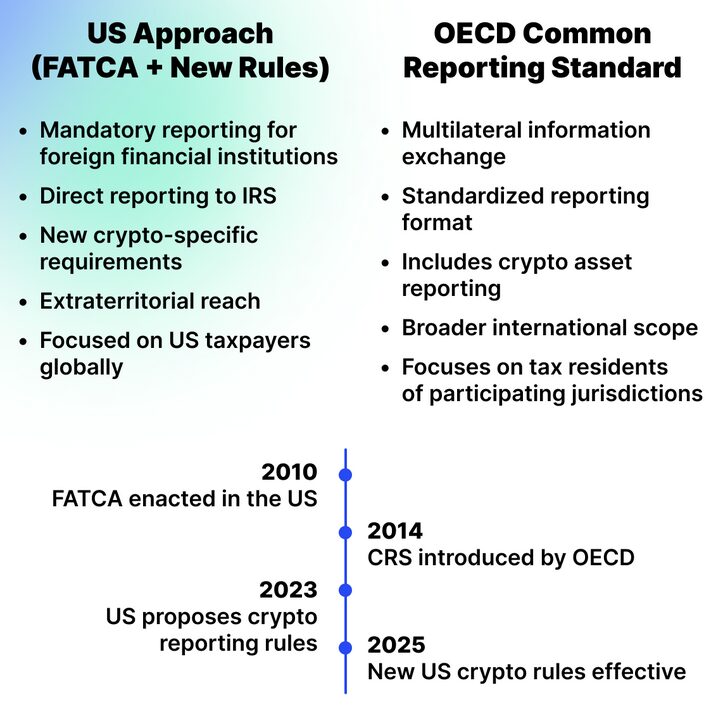
One major development is the Crypto-Asset Reporting Framework (CARF) introduced by the OECD.
CARF aims to establish a system for:
- Cross-border crypto transaction reporting
- Exchange information sharing between tax authorities
- Enhanced transparency in digital asset ownership
The European Union is also implementing DAC8, a directive designed to incorporate crypto asset reporting into existing financial transparency systems.
Together, these initiatives indicate a clear direction:
Cryptocurrency is being integrated into the global tax reporting infrastructure.
Global Crypto Tax Reporting Framework Timeline
Impact on Crypto Exchanges
Operational Benefits
For exchanges, the reform offers several advantages:
- Lower compliance costs
- Faster document distribution
- Reduced logistical complexity
- Easier integration with automated tax reporting software
Many exchanges already generate digital tax reports automatically.
This rule would simply align regulatory requirements with existing industry practices.
Technology Integration Opportunities
The shift toward digital tax reporting may also accelerate innovation in:
- blockchain analytics
- automated tax calculation engines
- real-time compliance monitoring
Companies developing crypto accounting platforms may see new growth opportunities.
Examples include tools for:
- portfolio tracking
- tax loss harvesting
- automated capital gains reporting
Implications for Crypto Investors
Increased Transparency
For individual investors, the proposal signals that tax reporting will become increasingly automated and unavoidable.
Historically, many crypto users relied on fragmented records across wallets and exchanges.
However, standardized reporting will make tax authorities better equipped to track digital asset activity.
Simplified Tax Filing
At the same time, digital reporting may make tax filing easier.
Electronic tax documents can integrate directly with accounting software.
Investors may eventually see automated tax reporting systems similar to those used for stock brokerage accounts.
Strategic Implications for the Blockchain Industry
A Step Toward Institutional Adoption
Regulatory clarity often accelerates institutional adoption.
Large financial institutions require standardized reporting frameworks before entering new markets.
The digitization of crypto tax reporting could therefore encourage:
- banks
- hedge funds
- asset managers
to expand their participation in digital asset markets.
Compliance as Infrastructure
Another emerging theme is that compliance itself is becoming an infrastructure layer of the crypto economy.
Blockchain companies increasingly design products with built-in regulatory reporting features.
Examples include:
- on-chain identity systems
- transaction monitoring APIs
- automated compliance dashboards
These tools may become as essential as wallets or exchanges.
Conclusion: A Small Regulatory Change with Major Structural Implications
The IRS proposal to digitize crypto tax reporting may appear minor at first glance, but it represents an important milestone in the maturation of the cryptocurrency industry.
By shifting toward electronic delivery of Form 1099-DA, the agency acknowledges a fundamental reality: digital asset markets operate entirely online and require modern compliance infrastructure.
For crypto exchanges, the reform promises reduced administrative costs and greater operational efficiency.
For investors, it signals a future where tax reporting becomes increasingly automated and integrated with trading platforms.
More broadly, the proposal reflects a global trend toward full integration of cryptocurrency into the traditional financial regulatory system.
As governments worldwide implement similar frameworks, digital assets will increasingly function within a standardized reporting environment.
For entrepreneurs, developers, and investors seeking new opportunities in blockchain technology, this shift opens a new frontier:
Not just building decentralized systems, but building compliant digital financial infrastructure for the next generation of global markets.
