
Main Points :
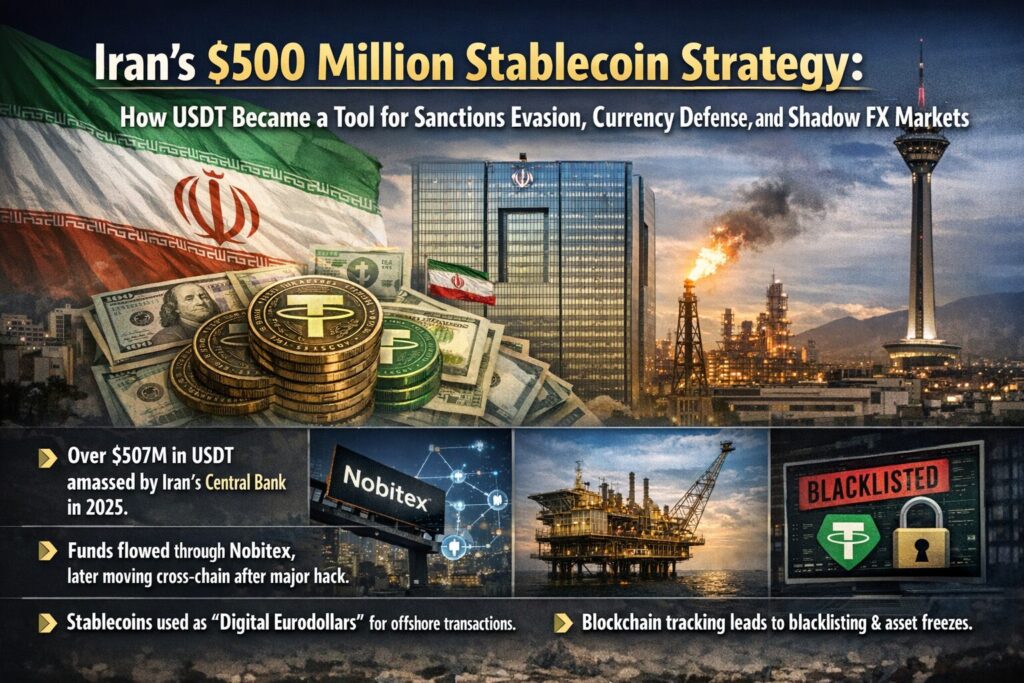
- Iran’s central bank accumulated over $507 million in USDT in 2025, primarily to stabilize its collapsing currency and bypass U.S. sanctions.
- Blockchain analytics reveal a state-level use of stablecoins as offshore dollar substitutes, effectively functioning as “digital Eurodollars.”
- Funds initially flowed through Iran’s largest exchange, Nobitex, before shifting cross-chain following a major hack incident.
- Stablecoins are now deeply embedded in sovereign monetary operations, not just retail crypto markets.
- Despite sanctions evasion attempts, blockchain transparency enables tracking, blacklisting, and asset freezes by issuers like Tether.
1. A Central Bank on the Blockchain
In January 2026, blockchain intelligence firm Elliptic published findings that fundamentally challenge traditional assumptions about central banking and digital assets. According to its analysis, the Central Bank of Iran accumulated at least $507 million worth of USDT, the U.S. dollar–pegged stablecoin issued by Tether, during 2025.
Unlike speculative crypto adoption, this was a strategic, state-driven operation. Purchases were executed in April and May 2025 using UAE dirhams, revealing a deliberate attempt to operate outside the U.S.-controlled financial system while maintaining exposure to dollar-denominated value.
For the first time, a sanctioned central bank was observed using stablecoins not as a payment rail—but as a core monetary policy instrument.
2. Why Iran Turned to USDT
Currency Collapse and FX Market Pressure
By mid-2025, Iran’s national currency, the Iranian rial, had lost over 50% of its value in less than eight months, reaching record lows against the U.S. dollar. Conventional foreign-exchange interventions—selling dollar reserves—were impossible due to U.S. and allied sanctions.
USDT offered an alternative:
- Dollar-linked value
- Global liquidity
- No reliance on correspondent banks
- Instant settlement across borders
In effect, USDT became Iran’s synthetic FX reserve.
Elliptic concluded that Iran likely used USDT to support the rial in domestic FX markets, acting as a buyer of last resort to slow capital flight and inflationary pressure.
3. Transaction Flows: From Nobitex to Cross-Chain Bridges

Early Phase: Domestic Liquidity Channels
Until early June 2025, most of the acquired USDT flowed into Nobitex, Iran’s largest cryptocurrency exchange. This strongly suggests:
- Domestic liquidity provision
- Rial–USDT conversion
- FX market intervention via crypto rails
Structural Shift After the Hack
On June 18, 2025, Nobitex suffered a $90 million hack attributed to a pro-Israel hacking group. Immediately afterward, on-chain behavior changed:
- USDT stopped flowing primarily into Nobitex
- Funds were routed into cross-chain bridge services
- Assets moved from Tron (TRC-20) to Ethereum (ERC-20)
This transition reflects a risk management pivot—away from domestic choke points and toward globally liquid, interoperable networks.
4. Stablecoins as “Digital Eurodollars”
Elliptic describes Iran’s system as a “sanctions-evasion banking mechanism”—a closed-loop trade and settlement environment officially approved in August 2022.
In this structure:
- USDT functions as a digital offshore dollar
- Holdings exist outside U.S. jurisdiction
- Transactions settle without SWIFT or correspondent banks
This mirrors the historical Eurodollar market, where offshore USD deposits fueled global trade beyond U.S. regulatory reach.
For investors and builders, this marks a pivotal shift: stablecoins are no longer just fintech products—they are sovereign financial infrastructure.
5. The Broader Crypto–Sanctions Economy
According to Chainalysis, stablecoins have become the primary medium for illicit and sanctions-linked crypto transactions globally.
Related reports estimate Iran’s broader crypto economy—spanning mining, trading, and settlement—has grown to the equivalent of over $8 billion annually, with participation by state-linked entities including the Islamic Revolutionary Guard Corps (IRGC).
This blurs the line between:
- Monetary policy
- National security
- Blockchain infrastructure
6. Enforcement Strikes Back: Freezing the Digital Dollars

Despite attempts to evade oversight, stablecoins are not immune to enforcement.
Key actions:
- June 2025: Tether blacklisted multiple Iran-linked wallets, freezing $37 million in USDT
- July 2024: Tether froze $1.14 billion USDT across 2,380 wallets, assisting the FBI and U.S. Secret Service
This highlights a central paradox:
Stablecoins enable sanctions evasion—but their issuers retain ultimate control.
For states relying on USDT, this introduces issuer risk into sovereign finance.
7. Implications for Investors and Builders
For Investors
- Stablecoin adoption is expanding at the state level, not just retail
- Political risk and issuer compliance now affect “cash-equivalent” assets
- Cross-chain liquidity is becoming strategically critical
For Builders
- Demand will grow for:
- Non-custodial settlement rails
- Decentralized liquidity bridges
- FX-grade stablecoin infrastructure
Projects enabling transparent, compliant, and censorship-resistant settlement may define the next cycle.
8. Conclusion: The New Monetary Frontier
Iran’s $500 million USDT strategy is not an anomaly—it is a preview of a fractured global monetary future.
As sanctions expand, currencies weaken, and digital infrastructure matures, stablecoins are evolving into:
- Shadow FX reserves
- Crisis-response tools
- Geopolitical instruments
For those seeking new crypto assets, revenue opportunities, and practical blockchain applications, the lesson is clear:
The real battleground is no longer speculation—it is money itself.
