
Main Points :
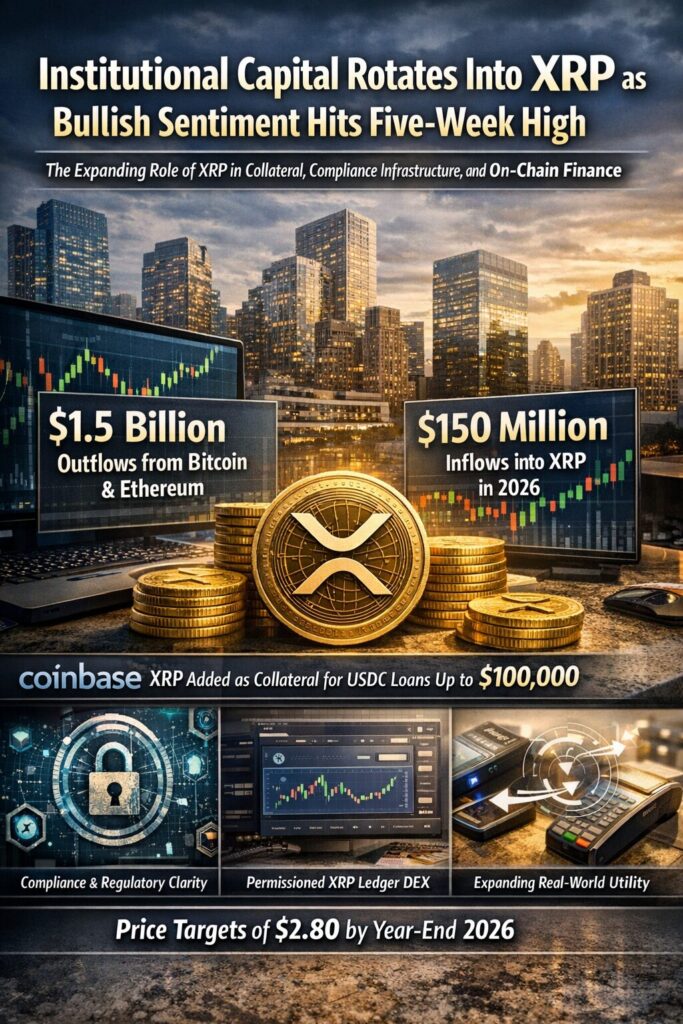
- Approximately $1.5 billion has flowed out of Bitcoin and Ethereum products year-to-date, while XRP has attracted roughly $150 million in new inflows, making it one of 2026’s strongest-performing digital assets.
- Bullish sentiment toward XRP has reached a five-week high, according to blockchain analytics.
- Coinbase has added XRP as eligible collateral for USDC loans up to $100,000, increasing liquidity utility without requiring asset liquidation.
- The XRP Ledger (XRPL) has implemented compliance-friendly features such as permissioned domains and restricted DEX environments.
- Regulatory clarity, including Ripple’s strengthened compliance positioning, is reshaping institutional confidence.
- Despite cautious price targets (e.g., $2.80 by year-end 2026 from certain institutions), XRP’s real-world utility is expanding across payments and collateral markets.
Institutional Rotation: Capital Leaves BTC and ETH, Enters XRP
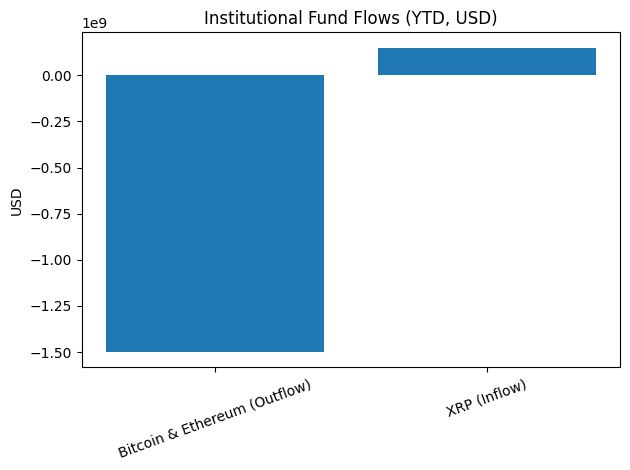
As broader crypto markets lean toward risk aversion, institutional capital appears to be rotating selectively rather than exiting entirely. According to recent digital asset fund flow reports, Bitcoin (BTC) and Ethereum (ETH) products have experienced combined outflows of approximately $1.5 billion, while XRP has attracted about $150 million in net inflows year-to-date.
This divergence suggests a structural shift rather than a simple speculative rotation. Institutional allocators appear increasingly focused on utility-driven digital assets that align with compliance standards and financial infrastructure use cases.
XRP’s capital inflow profile stands out because it is occurring during a period of macro uncertainty, rising U.S. yields, and tighter global liquidity conditions. Historically, altcoins suffer disproportionately in such environments. However, XRP’s positioning appears to be increasingly differentiated.
[Institutional Flow Comparison]
Sentiment Shift: Five-Week High in Bullish Positioning
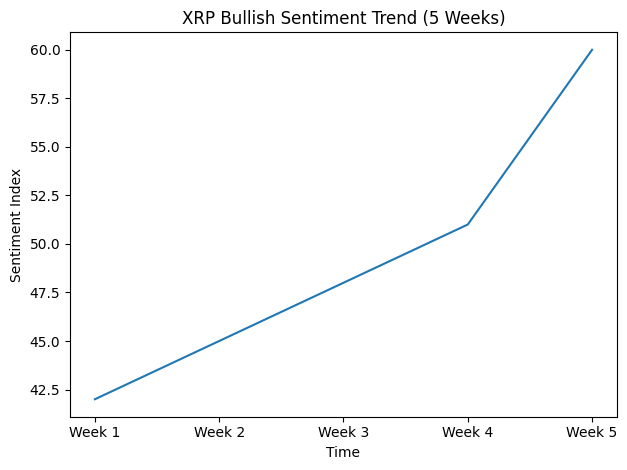
Blockchain analytics platforms report that bullish sentiment toward XRP has reached its highest level in five weeks. While sentiment alone does not guarantee price appreciation, it often signals positioning shifts among sophisticated traders.
In recent cycles, XRP sentiment spikes have coincided not merely with speculative momentum, but with structural announcements — legal clarity developments, exchange listings, or ecosystem upgrades.
The current sentiment improvement aligns with three catalysts:
- Expansion into collateral markets
- Regulatory normalization
- Infrastructure upgrades within XRPL
[Sentiment Trend]
Coinbase Adds XRP as Eligible Collateral
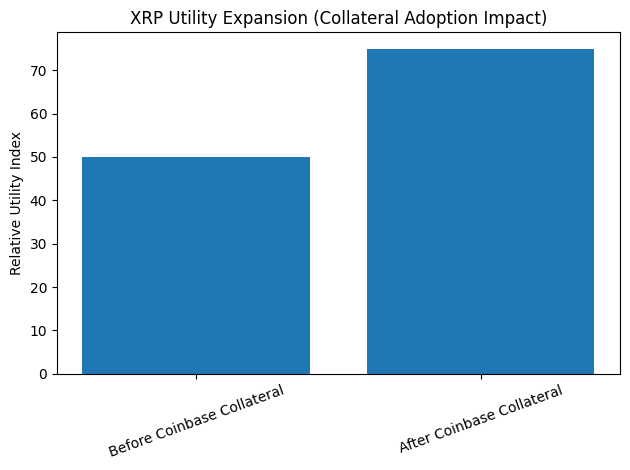
One of the most consequential developments came when Coinbase announced that XRP would be accepted as eligible collateral for USDC loans up to $100,000.
This is significant for several reasons:
- Holders can unlock liquidity without selling XRP.
- Reduced sell pressure may stabilize circulating supply dynamics.
- XRP gains functional parity with major assets in lending markets.
Collateral eligibility is often overlooked by retail investors, yet it represents one of the most important steps in transforming a token from a tradable instrument into a financial primitive.
When digital assets become collateralized instruments, they enter credit systems — and credit systems are foundational to institutional finance.
For investors seeking yield opportunities, collateral functionality introduces:
- Basis trades
- Leveraged carry strategies
- Stablecoin farming loops
- Hedged liquidity provision
This shift expands XRP’s total addressable market beyond payments.
XRPL Infrastructure: Compliance by Design
Institutional adoption requires more than liquidity. It requires compliance architecture.
XRPL has introduced:
- Permissioned domains for regulated transaction environments
- DEX features with identity restrictions
- On-chain rule enforcement mechanisms
These features directly address long-standing concerns from banks and financial institutions that public blockchains lack sufficient regulatory guardrails.
Rather than forcing institutions to adapt to crypto-native norms, XRPL is attempting to bridge the gap between traditional compliance standards and decentralized infrastructure.
This aligns closely with the emerging “regulated DeFi” narrative — a hybrid model where:
- Identity verification coexists with smart contracts
- Access controls are programmable
- Compliance rules are enforced algorithmically
For readers interested in practical blockchain implementation, this represents a blueprint for future institutional on-chain finance.
Regulatory Stabilization and Institutional Confidence
Ripple’s strengthening regulatory positioning — including resolution of key legal disputes and enhanced regulatory alignment — has significantly altered the narrative around XRP.
Regulatory clarity reduces existential risk discounts embedded in token valuations.
Institutions typically apply three layers of discount to digital assets:
- Regulatory risk discount
- Liquidity risk discount
- Utility uncertainty discount
As regulatory overhang declines, the first discount compresses.
When collateral utility expands, the second and third discounts also narrow.
This triple compression can structurally reprice assets over time, independent of short-term speculation.
Payments + Collateral: Dual Utility Expansion
XRP’s traditional narrative centered on cross-border payments. However, the current phase marks an expansion into:
- Institutional liquidity rails
- Stablecoin-backed credit markets
- Regulated on-chain trading environments
This dual role — payments and collateral — strengthens network resilience.
Historically, crypto assets dependent on a single use case are more vulnerable during downturns. Diversified utility creates more persistent demand.
[Utility Expansion Impact]
Price Targets and Conservative Outlooks
Some institutions have revised price expectations downward, with certain projections suggesting a potential target near $2.80 by end-2026, compared with previous higher expectations.
However, long-term valuation is less about headline targets and more about functional integration into financial systems.
A conservative price outlook does not negate structural utility growth.
Broader Market Context: Why XRP Now?
Macro conditions in 2026 include:
- Elevated interest rates
- Institutional ETF accumulation in BTC
- Retail participation remaining muted
- Increased regulatory scrutiny globally
In this environment, capital may prefer:
- Assets with defined regulatory frameworks
- Assets integrated into centralized exchange lending systems
- Tokens tied to real financial infrastructure
XRP appears to fit this category more clearly than in prior cycles.
Implications for Investors Seeking New Revenue Streams
For investors searching for:
- New digital assets
- Yield opportunities
- Practical blockchain use cases
XRP’s evolving role suggests several strategic angles:
- Collateralized lending strategies
- Liquidity provision in regulated environments
- Institutional flow tracking models
- Utility-driven valuation frameworks
Rather than viewing XRP solely as a speculative vehicle, it may now be evaluated as an infrastructure asset.
Conclusion: A Structural Phase Shift
The recent concentration of institutional capital into XRP is not occurring in isolation. It reflects:
- Regulatory stabilization
- Infrastructure maturation
- Collateral market integration
- Expanding compliance architecture
Even amid broader crypto risk aversion, XRP’s differentiated positioning suggests that capital is becoming more selective — not retreating entirely.
For readers focused on practical blockchain implementation and next-generation revenue streams, XRP’s trajectory represents a case study in how digital assets evolve from speculative tokens into financial infrastructure components.
The key question moving forward is not merely whether XRP reaches a specific price target, but whether it solidifies its position as:
- A regulated liquidity bridge
- A collateral-grade digital asset
- A compliance-ready blockchain infrastructure
If these pillars hold, institutional capital rotation may prove to be a structural trend rather than a temporary anomaly.
