

Main Points :
- Indiana’s legislature passed HB1042 allowing public pension exposure to Bitcoin and crypto ETFs.
- If signed, retirees will gain at least one crypto investment option by July 1, 2027.
- The bill reflects broader U.S. state-level digital asset adoption trends.
- Regulatory oversight and risk management frameworks are embedded into the system.
- Simultaneously, Indiana moved to ban crypto ATMs to combat rising fraud.
- The policy balances institutional crypto integration with consumer protection.
- Public pension crypto allocation may reshape long-term capital flows into Bitcoin markets.
1. Indiana Legislature Approves Bitcoin and Crypto ETF Investment for Public Pensions
On February 26, 2026, the Indiana State Legislature passed House Bill 1042 (HB1042), marking a significant milestone in the institutionalization of cryptocurrency within U.S. public finance systems. The bill authorizes public retirement and deferred compensation systems in Indiana to include Bitcoin and cryptocurrency exchange-traded funds (ETFs) as eligible investment options.
The legislation now awaits the signature of Governor Mike Braun. Under state law, the governor has ten days to sign or veto the bill. If enacted, Indiana will become one of the first U.S. states to formally integrate Bitcoin into public pension investment frameworks.
According to legislative documents, by July 1, 2027, the Indiana Public Retirement System and related deferred compensation boards must provide participants with at least one self-directed brokerage account option that includes cryptocurrency investment exposure.
Participants will be able to select crypto assets under guidelines established by oversight committees, pay management fees, and receive asset valuation reporting similar to traditional securities such as equities and bonds. In practical terms, this means state employees and retirees may allocate part of their long-term retirement portfolios to Bitcoin or crypto ETFs.
This is not merely symbolic. Pension capital represents long-duration capital. Its entry into Bitcoin markets suggests structural, not speculative, participation.
2. Institutional Design: Regulation and Oversight Framework
HB1042 defines cryptocurrency as a digital asset not issued by a central authority, functioning as a medium of exchange, and secured through cryptographic verification. This definition aligns with federal interpretations of decentralized digital assets such as Bitcoin.
The bill assigns supervisory responsibility to:
- The Public Retirement Committee
- The Deferred Compensation Committee
These bodies are responsible for:
- Setting fee structures
- Ensuring accurate valuation
- Establishing risk parameters
- Monitoring compliance
Importantly, crypto investments will not replace traditional assets but be offered within a self-directed account structure. This design mitigates systemic pension risk while allowing voluntary exposure.
This framework signals regulatory maturity. Rather than treating crypto as fringe or experimental, Indiana is embedding it into an institutional governance structure consistent with fiduciary standards.
3. Strategic Context: Federal Bitcoin Reserve Discussions and State-Level Action
The timing of Indiana’s legislation coincides with broader U.S. political discussions about digital asset reserves. Following federal-level conversations around a potential strategic Bitcoin reserve, multiple states have begun evaluating digital asset allocation frameworks.
Arizona’s Senate committee recently passed legislation exploring Bitcoin and XRP as state reserve assets. Oklahoma introduced a bill allowing state employees and vendors to receive compensation in Bitcoin.
Missouri is reportedly evaluating the feasibility of establishing a Bitcoin reserve fund.
Indiana’s move reflects a trend: states are acting independently, treating Bitcoin as a potential hedge, reserve, or growth asset within long-term financial strategies.
4. Public Pension Crypto Allocation: Risk and Portfolio Implications
From a portfolio theory perspective, Bitcoin offers characteristics that differ from traditional asset classes:
- High volatility
- Low long-term correlation to bonds
- Increasing correlation to equities during macro stress
- Asymmetric upside potential
For pension systems seeking return enhancement in low-yield environments, small allocations (1–5%) to Bitcoin may increase portfolio efficiency.
If even 1% of Indiana’s public pension assets were allocated to Bitcoin ETFs, the capital inflow would be meaningful. Public pension assets across the U.S. exceed $5 trillion. A gradual 1–2% allocation nationwide would represent tens of billions of dollars in structural demand.
This shifts Bitcoin from speculative asset to portfolio construction component.
5. Fraud Mitigation: Indiana Bans Crypto ATMs
While expanding institutional crypto investment, Indiana simultaneously passed separate legislation banning cryptocurrency ATMs statewide.
The move responds to growing fraud cases linked to crypto ATM scams. In Evansville, Indiana, approximately $400,000 in losses were reported in 2025 due to ATM-related fraud schemes.
According to FBI data, crypto ATM-related complaints reached approximately 11,000 in 2024, representing a 99% year-over-year increase. Estimated losses in the first half of 2025 alone reached approximately $240 million.
[Growth in Crypto ATM-Related Complaints]
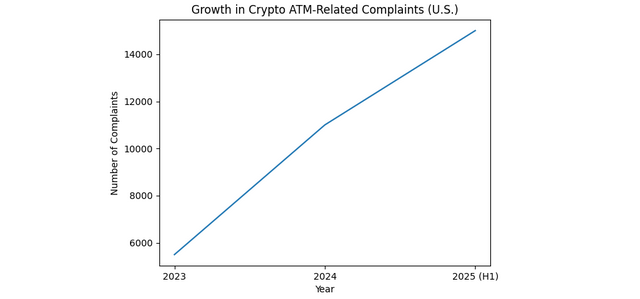
The simultaneous expansion of institutional crypto adoption and restriction of high-risk retail access illustrates a dual-track policy: enable controlled capital allocation while suppressing consumer exploitation channels.
6. National Trend: States Exploring Public Crypto Investment
Indiana’s decision is not isolated. State-level experimentation with digital assets is accelerating.
- Arizona: Reserve asset proposals including Bitcoin and XRP
- Oklahoma: Bitcoin payroll option bill
- Missouri: Strategic reserve exploration
- Other states: Evaluating ETF exposure within treasury management
The number of states exploring public crypto investment policies has increased rapidly over the past three years.
[U.S. States Exploring Public Crypto Investment Policies]
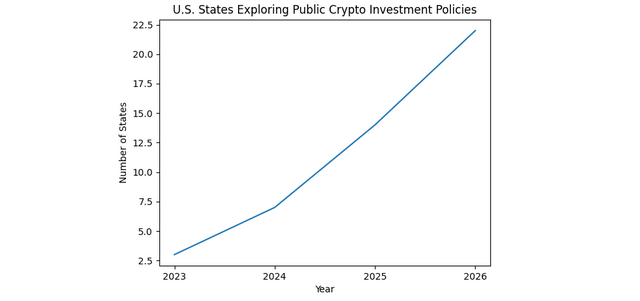
This trajectory suggests Bitcoin is transitioning from ideological debate to administrative policy implementation.
7. Implications for Investors and Builders
For readers seeking new crypto assets and income opportunities, the Indiana development signals several structural shifts:
- Bitcoin ETF demand may expand via pension flows.
- Regulatory clarity at state level reduces institutional hesitation.
- Public-sector endorsement increases perceived legitimacy.
- Infrastructure providers (custody, ETF issuers, compliance firms) may see growth.
Builders should consider:
- Pension-compliant custody solutions
- Risk analytics platforms tailored for public funds
- Tokenized ETF structures
- Transparent reporting frameworks
Institutionalization changes opportunity profiles. Retail volatility may persist, but structural capital flows stabilize long-term price floors.
8. Long-Term Capital and the Maturation of Bitcoin
The integration of Bitcoin into public pension frameworks represents a maturation milestone.
Bitcoin’s first decade was retail-driven. The second decade saw hedge fund and corporate treasury adoption. The emerging phase includes:
- ETF approval
- State-level pension integration
- Potential sovereign reserve discussions
This progression mirrors historical asset class evolution.
Gold transitioned from commodity to monetary reserve to ETF-accessible portfolio component. Bitcoin appears to be following a digital analogue.
Conclusion: A Structural Shift, Not a Symbolic Gesture
Indiana’s HB1042 is more than a regional policy change. It represents a structural pivot in how U.S. states approach digital assets.
By embedding cryptocurrency into pension governance frameworks while simultaneously strengthening fraud prevention measures, Indiana demonstrates a balanced approach: expansion with oversight.
For long-term investors, this signals that Bitcoin is entering the institutional core of American public finance.
If similar legislation spreads across multiple states, pension-driven demand could become one of the most stable and enduring sources of capital inflow into Bitcoin markets.
The question is no longer whether crypto will integrate into public systems. The question is how quickly.
