

Key Points :
- H100 plans to triple Bitcoin holdings to ~3,500 BTC via two acquisitions
- The company is set to become the second-largest listed Bitcoin holder in Europe
- Veteran Bitcoin figures, including Adam Back, strengthen strategic credibility
- Corporate Bitcoin accumulation continues despite price forecast downgrades
- Digital Asset Treasury (DAT) firms are emerging as institutional bridges into crypto
1. A Transformational Move: H100’s Acquisition Strategy
Sweden-based Bitcoin treasury firm H100 has announced a bold strategic expansion that signals a deeper institutional commitment to Bitcoin as a treasury asset. By signing letters of intent to acquire Moonshot AS and Never Say Die AS through share swaps, the company is positioning itself for a dramatic increase in its Bitcoin holdings.
Currently holding approximately 1,051 BTC, H100 expects its reserves to reach around 3,500 BTC after the deal is completed. At current market valuations, this translates to roughly $260 million in Bitcoin assets (converted to USD for consistency). This move represents not merely incremental growth, but a structural leap that places H100 among the top publicly listed Bitcoin holders globally.
This acquisition is particularly notable because it highlights a shift from organic accumulation to strategic consolidation. Instead of relying solely on open market purchases, H100 is effectively acquiring Bitcoin indirectly through corporate mergers—an approach increasingly seen in capital-efficient crypto treasury strategies.
2. Chart Insertion – Bitcoin Holdings Comparison
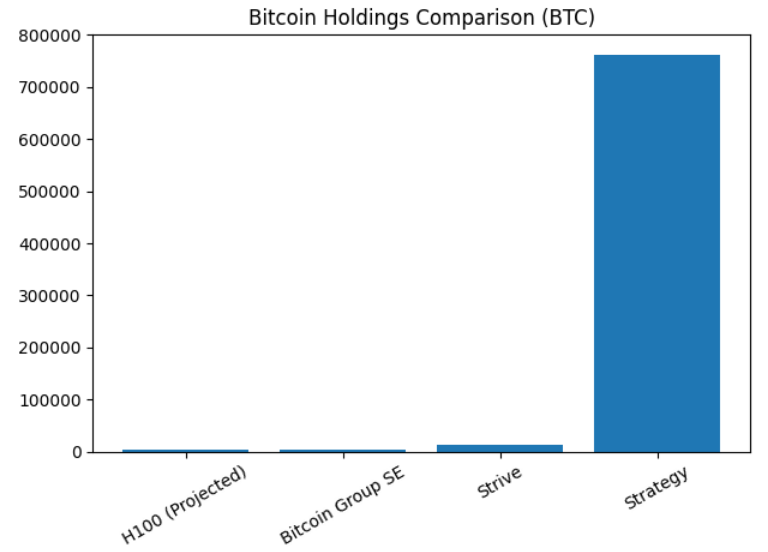
This chart illustrates how H100 compares to other major corporate Bitcoin holders. While still significantly smaller than giants like Strategy, H100’s growth trajectory positions it competitively within Europe.
3. Rising to Europe’s #2 Position
Following the completion of the acquisition, H100 is expected to rank just behind Germany’s Bitcoin Group SE, which holds approximately 3,605 BTC. This would make H100 the second-largest Bitcoin-holding listed company in Europe.
Globally, the company would rank around 27th among publicly traded firms in terms of Bitcoin reserves. While this may seem modest compared to U.S. heavyweights, it represents a significant milestone within the European context, where corporate Bitcoin adoption has historically lagged behind North America.
This positioning is not just symbolic—it has tangible implications for capital markets. As institutional investors increasingly seek exposure to Bitcoin through regulated vehicles, companies like H100 serve as indirect gateways. This could enhance liquidity, attract new investor segments, and potentially increase valuation multiples.
4. Understanding the DAT Model (Digital Asset Treasury)
H100 operates as a Digital Asset Treasury (DAT) company—a relatively new but rapidly evolving business model. DAT firms treat Bitcoin and other cryptocurrencies as core treasury assets, integrating them into their balance sheets alongside traditional financial instruments.
For investors, DAT companies offer an alternative to direct crypto ownership. Instead of managing wallets, private keys, and custody risks, investors can gain exposure through equity markets. This is particularly attractive for institutional participants constrained by regulatory or operational limitations.
The DAT model also introduces new layers of financial engineering. Companies can leverage their Bitcoin holdings for collateralized financing, structured products, and even yield-generating strategies. This transforms Bitcoin from a passive store of value into an active financial instrument within corporate treasury management.
5. Strategic Leadership and Bitcoin OG Influence
One of the most compelling aspects of H100’s expansion is the involvement of prominent Bitcoin pioneers. Adam Back, CEO of Blockstream and a legendary cryptographer, is a key shareholder holding more than 20% of the company’s voting rights.
Back’s presence brings not only credibility but also deep technical and philosophical alignment with Bitcoin’s long-term vision. His early contributions to cryptography and Bitcoin’s development make him one of the most respected figures in the ecosystem.
Additionally, Geir Harald Hansen, owner of the acquired companies, brings extensive experience from the early days of Bitcoin adoption. The integration of these individuals into H100’s network strengthens its strategic capabilities across investment, technology, and capital markets.
This combination of institutional structure and OG expertise is particularly powerful. It bridges the gap between traditional finance and decentralized innovation—a recurring theme in the evolution of the crypto industry.
6. Chart Insertion – H100 Growth Trajectory
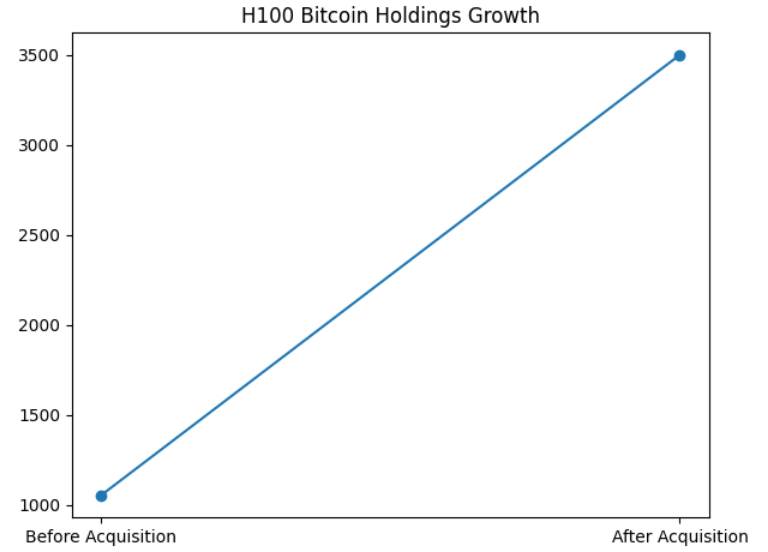
This chart shows the projected jump in H100’s Bitcoin holdings, illustrating the magnitude of the transformation.
7. Market Context: Accumulation Amid Uncertainty
H100’s announcement comes at a time when macro sentiment around Bitcoin is mixed. Citigroup recently revised its 12-month Bitcoin price forecast downward from $143,000 to $112,000, citing delays in regulatory clarity such as the U.S. “Clarity Act.”
Despite this, corporate accumulation continues unabated.
For example:
- Strategy recently purchased approximately $76.6 million worth of Bitcoin, bringing its total holdings to over 762,000 BTC (~$56.7 billion)
- Asset manager Strive added 317 BTC in a single week, reaching over 13,600 BTC (~$1.1 billion)
This divergence between price expectations and accumulation behavior is significant. It suggests that institutional players are focusing on long-term positioning rather than short-term price movements.
8. The Structural Shift: From Speculation to Treasury Strategy
The rise of DAT companies reflects a broader transformation in how Bitcoin is perceived. What was once considered a speculative asset is increasingly being treated as a strategic reserve.
Several factors are driving this shift:
- Inflation Hedging: Bitcoin’s fixed supply makes it attractive as a hedge against fiat currency debasement
- Balance Sheet Optimization: Companies can enhance returns by allocating a portion of reserves to Bitcoin
- Capital Market Signaling: Holding Bitcoin can signal innovation and forward-thinking strategy to investors
In this context, H100’s move is not an outlier—it is part of a larger trend toward institutionalization.
9. Implications for Investors and Emerging Opportunities
For readers interested in new crypto assets and revenue opportunities, the rise of DAT companies presents several actionable insights:
- Indirect Exposure Opportunities
Investing in DAT firms allows participation in Bitcoin upside without direct custody risks - Arbitrage Between Equity and Crypto Markets
Discrepancies between a company’s market valuation and its Bitcoin holdings can create arbitrage opportunities - Early Identification of Emerging Players
Smaller DAT firms like H100 may offer higher growth potential compared to established giants - Integration with Real-World Businesses
H100’s continuation of healthcare technology operations shows that Bitcoin treasury strategies can coexist with traditional industries
10. Conclusion: A New Phase of Institutional Bitcoin Adoption
H100’s planned expansion marks a pivotal moment in the evolution of corporate Bitcoin strategies in Europe. By tripling its holdings through strategic acquisitions, the company is not only increasing its exposure to Bitcoin but also redefining how corporations can integrate digital assets into their financial architecture.
The involvement of industry pioneers, combined with a robust acquisition strategy, positions H100 as a key player in the emerging DAT ecosystem. More importantly, it highlights a broader shift in market dynamics—one where Bitcoin is no longer just an investment, but a foundational component of corporate finance.
As institutional adoption accelerates, the lines between traditional finance and digital assets will continue to blur. For investors, developers, and entrepreneurs, this convergence represents both a challenge and an opportunity—one that will shape the next decade of financial innovation.
