

Key Takeaways :
- Google searches for “Bitcoin” have surged to their highest level in the past 12 months as BTC approached the $60,000 price range.
- Sharp price declines continue to act as a catalyst for renewed retail investor attention.
- On-chain and exchange-based indicators suggest selective accumulation by U.S. investors despite overall fear-driven sentiment.
- Extreme fear readings may historically indicate asymmetric opportunity rather than pure downside risk.
- For investors seeking new crypto assets, yield opportunities, and practical blockchain applications, retail re-engagement is a critical macro signal.
A Sudden Spike in Google Searches: Why Retail Attention Matters
In early February, global Google searches for the term “Bitcoin” surged dramatically, reaching a Google Trends score of 100 — the highest level recorded over the past twelve months. This spike coincided with Bitcoin’s sharp price decline toward the $60,000 level, marking the first time since October 2024 that BTC revisited this psychologically significant range.
Historically, Google search trends have served as a proxy for retail investor attention. Unlike institutional positioning, which often unfolds quietly through OTC desks, ETFs, or derivatives, retail interest tends to manifest loudly — through search engines, social media, and mobile trading apps. When Google search volume rises abruptly, it often reflects a reawakening of curiosity among individual investors who may have been sidelined during periods of price stability or gradual declines.
This latest surge mirrors a familiar pattern: retail attention does not necessarily peak during price highs, but rather during moments of fear, confusion, or perceived opportunity. The $60,000 level, once seen as expensive during earlier cycles, is now being reassessed by a broader audience as a potential entry zone rather than a speculative excess.
Bitcoin’s Price Decline and Rapid Rebound: A Volatility-Driven Awakening
[“Bitcoin Price Movement Over the Past 7 Days (USD)”]
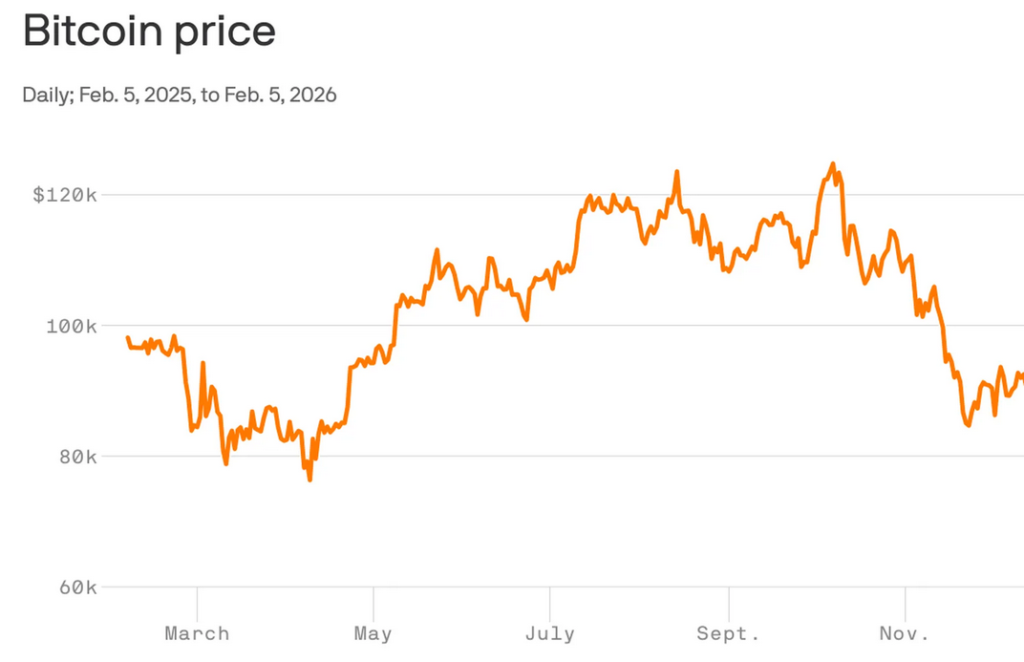
Bitcoin’s price action over the past week has been anything but calm. Beginning around $81,500, BTC experienced a rapid decline over five days, touching the $60,000 level before staging a rebound to approximately $70,740 at the time of writing.
Such abrupt volatility tends to act as a wake-up call for retail participants. While long-term holders often focus on multi-year adoption narratives, retail investors are more sensitive to short-term price dislocations. Sudden drops create urgency — fear for some, opportunity for others — and this emotional response is precisely what drives spikes in search behavior.
Importantly, this price movement occurred without a corresponding systemic failure, regulatory shock, or macroeconomic collapse. Instead, it appears to reflect a broader market repricing amid tightening liquidity expectations and shifting risk appetite across global financial markets. For many retail observers, this distinction matters: a price drop without existential threat can be interpreted as a “reset” rather than a breakdown.
Retail Investors Are Returning — But Selectively
Market participants have taken note of the renewed retail attention. André Dragosch, Head of European Research at Bitwise, publicly stated that “retail investors are coming back.” This observation aligns with both search data and exchange-level metrics that suggest increased activity from smaller wallet cohorts.
At the same time, Julio Moreno, Head of Research at CryptoQuant, highlighted a more nuanced trend: U.S.-based investors appear to be accumulating Bitcoin after it reached the $60,000 level. One key indicator supporting this claim is the Coinbase Premium Index, which turned positive for the first time since mid-January. A positive premium suggests stronger buying pressure on Coinbase — an exchange heavily used by U.S. retail and institutional investors — compared to offshore platforms.
This divergence implies that retail participation is not uniform. Rather than a broad speculative frenzy, the current phase appears characterized by selective accumulation driven by price sensitivity. Investors who previously viewed Bitcoin as overpriced at higher levels are now re-entering with more disciplined expectations.
Fear Dominates Sentiment — And That May Be the Point
Despite signs of renewed buying interest, broader sentiment indicators remain deeply pessimistic. The Crypto Fear & Greed Index recently dropped to a score of 6, signaling “Extreme Fear” — a level not seen since mid-2022.
[“Crypto Fear & Greed Index Historical Comparison”]
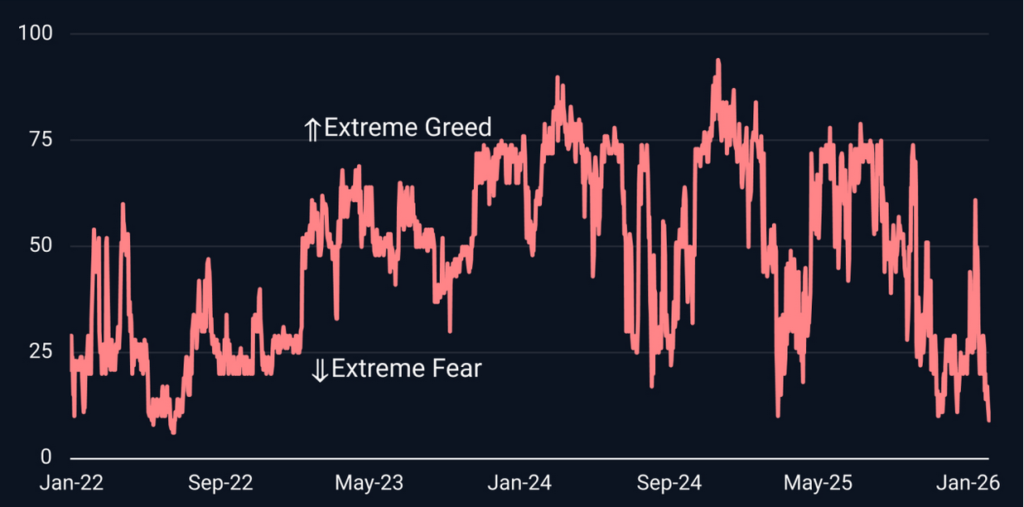
At first glance, such readings suggest widespread anxiety and risk aversion. However, experienced market participants often interpret extreme fear differently. Historically, periods of maximum pessimism have coincided with zones of asymmetric opportunity, where downside risk becomes increasingly priced in while upside potential remains underappreciated.
Crypto analyst Ran Neuner encapsulated this perspective by stating that “every indicator suggests Bitcoin is relatively the cheapest it has ever been.” While such claims should be treated cautiously, they underscore a recurring dynamic in crypto markets: sentiment extremes tend to precede inflection points rather than trend continuation.
For investors seeking new yield opportunities or exposure to emerging blockchain use cases, this environment may favor careful positioning rather than aggressive speculation.
Why the $60,000 Level Resonates With Retail Investors
The psychological importance of the $60,000 price range cannot be overstated. During earlier cycles, this level represented exuberance and late-stage speculation. Today, however, it is increasingly viewed through a different lens: as a structural support zone shaped by ETF inflows, institutional adoption, and growing integration with traditional finance.
Retail investors tend to anchor their decisions around round numbers and historically significant levels. As Bitcoin matures, these anchors evolve. The fact that $60,000 now triggers renewed interest rather than widespread panic suggests a gradual shift in collective perception.
This shift is critical for understanding Bitcoin’s role as both an asset and an infrastructure layer. As more individuals view BTC not merely as a speculative token but as a long-term store of value or settlement asset, price declines become opportunities for re-entry rather than exit signals.
Broader Implications for Crypto Markets and Blockchain Adoption
The resurgence of retail attention to Bitcoin has implications beyond price alone. Historically, retail inflows into BTC have acted as a gateway to broader crypto market participation. Once engaged, retail investors often explore alternative assets, decentralized finance (DeFi) platforms, and blockchain-based payment solutions.
For builders and operators in the blockchain industry, this cycle of renewed attention represents an opportunity to demonstrate real-world utility. Payments, remittances, asset tokenization, and yield-bearing on-chain instruments all stand to benefit if retail users move beyond passive holding toward active usage.
At the same time, the current environment demands greater transparency and education. Retail investors returning after periods of volatility are more cautious, more informed, and less tolerant of opaque risk. Platforms that prioritize usability, compliance, and clear value propositions are likely to capture disproportionate attention in the next phase.
Conclusion: Retail Curiosity as a Leading Indicator
The surge in Google searches for “Bitcoin” as BTC approached the $60,000 level is more than a curiosity-driven statistic. It reflects a deeper behavioral shift: retail investors are re-engaging with crypto markets not out of blind optimism, but out of strategic reassessment.
While fear remains elevated and volatility persists, the combination of selective accumulation, psychological repricing, and renewed curiosity suggests that Bitcoin is entering another transitional phase. For those seeking new crypto assets, future revenue streams, or practical blockchain applications, understanding retail behavior is essential.
Retail attention does not guarantee immediate price appreciation. However, it often marks the early stages of narrative rebuilding — a process that historically precedes the next wave of innovation, adoption, and capital formation in the crypto ecosystem.
