
Main Points :
- Gold has officially broken above $5,000 per ounce, reinforcing long-term hard asset narratives.
- Robert Kiyosaki projects a long-term gold target of $27,000, tied to a hypothetical return to a gold-backed monetary framework.
- His broader thesis includes $200 silver and $250,000 Bitcoin.
- Rising sovereign debt, persistent inflation, and currency debasement underpin his view.
- Institutional flows into Bitcoin ETFs and global de-dollarization trends are reshaping capital allocation.
- Investors seeking new revenue opportunities should examine gold, Bitcoin, and blockchain infrastructure plays together rather than in isolation.
Robert Kiyosaki Reaffirms a $27,000 Gold Target

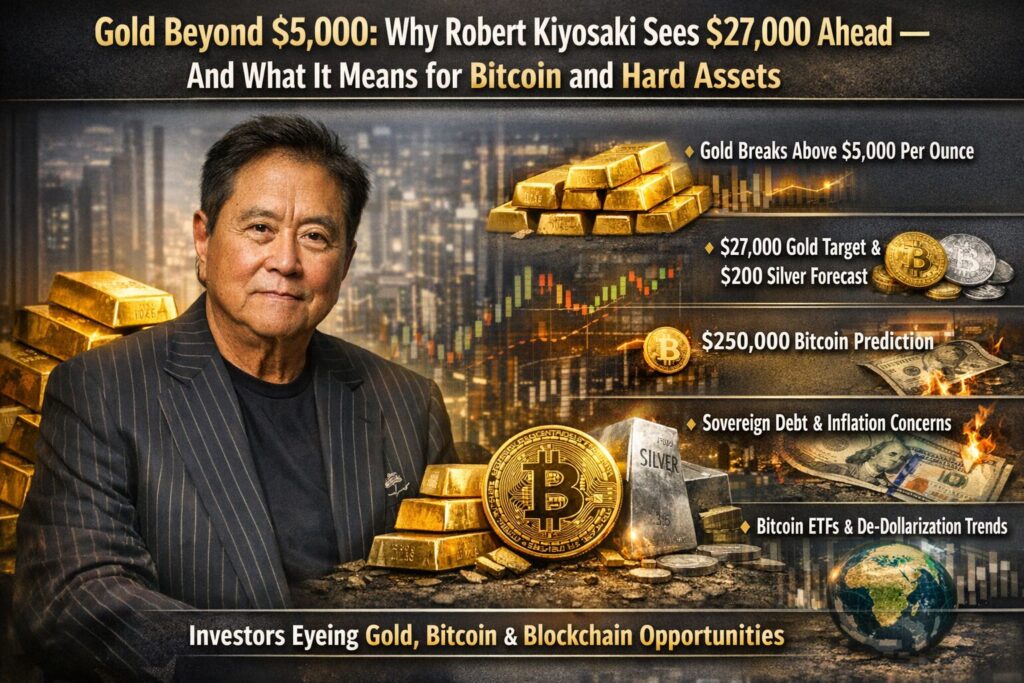
When gold decisively broke above $5,000 per ounce, it marked more than a psychological milestone. It became a symbolic validation moment for long-time hard asset advocates such as Robert Kiyosaki, author of Rich Dad Poor Dad.
On January 25, 2026, via social platform X, Kiyosaki celebrated the breakout and reiterated his long-standing projection:
“Gold is over $5,000. Yay!!!! Gold’s future is $27,000.”
At the time of writing, gold trades slightly above $5,005, consolidating above the breakout zone. While critics debate timing and magnitude, the symbolic crossing of $5,000 serves as confirmation of the first phase of his thesis: that inflationary monetary regimes eventually favor scarce, non-printable assets.
But the more controversial element is not the $5,000 milestone — it is the additional fivefold increase implied by a $27,000 target.
The Macro Thesis: Debt, Inflation, and Currency Dilution
Kiyosaki’s view is not rooted in short-term technical analysis. It is fundamentally macroeconomic.
He frequently cites three structural pressures:
- Expanding government debt
- Persistent inflationary dynamics
- Continuous fiat currency creation
Global sovereign debt has climbed to record levels in recent years. In the United States, federal debt has surpassed levels that, historically, required either inflationary erosion, restructuring, or monetary repression to manage. Meanwhile, central banks, even after rate-hiking cycles, continue to operate within structurally expansionary frameworks.
Inflation, while cooling from peak pandemic-era readings, remains embedded in structural drivers: energy transition costs, geopolitical fragmentation, supply chain re-localization, and demographic shifts.
Under this framework, gold is not a trade — it is monetary insurance.
The $27,000 Argument: A Hypothetical Return to a Gold Standard
Kiyosaki has linked his $27,000 gold projection to macro strategist Jim Rickards’ thesis regarding a potential monetary reset.
The argument proceeds as follows:
- If confidence in fiat currencies erodes significantly,
- And policymakers attempt to stabilize the system via gold backing,
- Then gold must be repriced dramatically higher to absorb the existing money supply.
In simple terms, the price of gold would need to rise enough so that official gold reserves could credibly anchor circulating currency.
Whether such a return to a formal gold standard occurs is debated. However, central banks globally have increased gold accumulation in recent years — particularly in emerging markets seeking to reduce dollar exposure.
This does not confirm a gold standard revival. But it does suggest that gold’s monetary relevance is not obsolete.
Silver at $200 and Bitcoin at $250,000
Kiyosaki’s projections extend beyond gold. He has also referenced:
- $200 silver
- $250,000 Bitcoin
His inclusion of Bitcoin is particularly noteworthy. While often associated with traditional “hard asset” ideology, Kiyosaki increasingly frames Bitcoin as “digital gold.”
Bitcoin, unlike gold, has a fixed supply cap of 21 million coins. Its issuance schedule is algorithmically controlled, immune to central bank policy shifts.
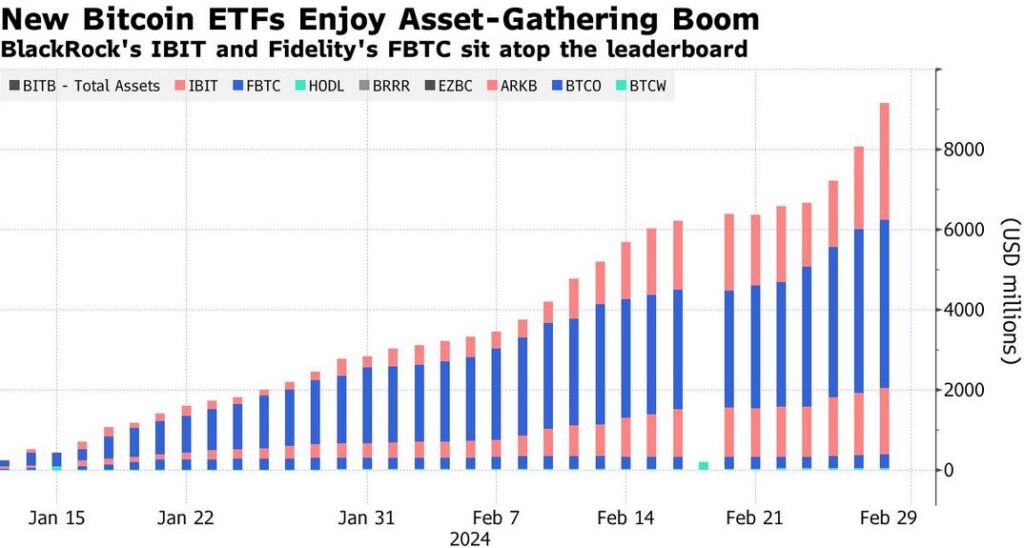
Institutional adoption has accelerated following the launch of spot Bitcoin ETFs in major markets. Capital flows into regulated products have provided a bridge between traditional finance and digital assets.
If gold represents monetary insurance 1.0, Bitcoin represents monetary insurance 2.0.
Market Timing vs. Accumulation Strategy
Kiyosaki has repeatedly emphasized that he does not attempt to time short-term fluctuations. Instead, he accumulates gold, silver, Bitcoin, and Ethereum in response to structural monetary deterioration.
This distinction is crucial.
For traders, volatility is opportunity.
For macro allocators, volatility is noise.
From a portfolio construction standpoint, hard assets serve multiple functions:
- Hedge against currency debasement
- Hedge against systemic financial risk
- Diversifier against equity market stress
- Optionality in crisis environments
The debate surrounding $27,000 gold often distracts from the more practical question: what allocation level to hard assets is prudent given systemic risk trends?
Institutional Flows and De-Dollarization
Recent macro developments reinforce parts of Kiyosaki’s argument:
- Central bank gold purchases have reached multi-decade highs.
- BRICS nations discuss settlement mechanisms outside the U.S. dollar.
- Energy trade experiments increasingly include non-dollar frameworks.
- Bitcoin ETF inflows continue despite market volatility.
These trends do not imply imminent dollar collapse. However, they indicate gradual diversification away from a single-currency reserve system.
In such an environment, gold and Bitcoin may function as politically neutral settlement layers.
Blockchain Beyond Price: Practical Utility
For readers seeking revenue opportunities and practical blockchain applications, the story does not end with price appreciation.
Several second-order opportunities emerge:
1. Tokenized Gold
Blockchain platforms are increasingly offering tokenized representations of physical gold. These instruments combine:
- Gold’s stability
- Blockchain settlement efficiency
- Fractional ownership
This creates yield opportunities via lending, collateralization, and cross-border transfer efficiencies.
2. Bitcoin Infrastructure
Revenue is increasingly concentrated not only in holding Bitcoin but in:
- Custody services
- Institutional brokerage
- Mining infrastructure
- Layer-2 scaling solutions
3. Hedging Architecture
Fintech platforms can integrate gold and Bitcoin hedging modules into treasury systems, offering dynamic exposure management for SMEs and cross-border operators.
Risk Considerations
A fivefold move from $5,000 to $27,000 would imply extraordinary macro stress or monetary restructuring.
Risks to the thesis include:
- Sustained real interest rates
- Productivity-driven disinflation
- Technological cost compression
- Stabilized fiscal frameworks
Markets rarely move in straight lines. Extreme forecasts often materialize only under extreme conditions.
Investors must distinguish between:
- Directional correctness
- Magnitude
- Time horizon
Even if gold trends structurally higher, the path may include severe volatility.Insert Graph Here
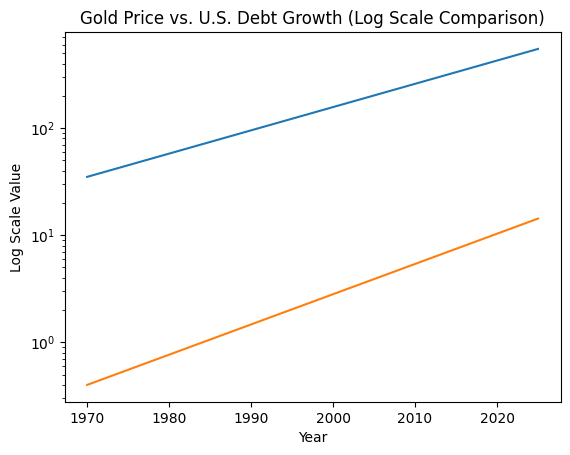
[Gold Price vs. U.S. Debt Growth (Log Scale Comparison)]
[Bitcoin Supply Cap vs. Global M2 Money Supply Growth]
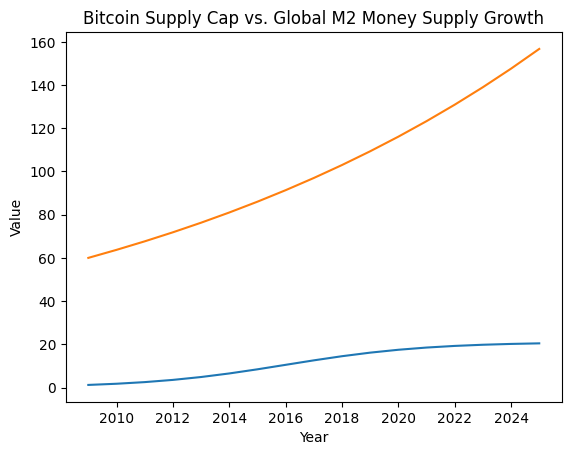
These charts should visually illustrate:
- The divergence between debt expansion and gold repricing
- The fixed issuance of Bitcoin relative to expanding global liquidity
Strategic Interpretation for Investors
Rather than fixating on $27,000 as a binary outcome, consider scenario modeling:
- Base Case: Gold stabilizes between $4,500–$7,500 over several years.
- Stress Case: Monetary restructuring drives accelerated repricing.
- Deflation Case: Gold consolidates while Bitcoin volatility increases.
The more relevant insight is that capital is increasingly flowing into scarcity-based systems — both physical and digital.
Conclusion: Hard Assets in a Fragmenting Monetary World
Gold crossing $5,000 is symbolically powerful. It confirms that, over long cycles, monetary expansion eventually finds expression in asset repricing.
Whether gold reaches $27,000 remains uncertain. But the underlying forces — debt expansion, currency dilution, geopolitical fragmentation — are real and measurable.
For investors exploring new crypto assets and revenue streams, the more compelling insight may not be the headline target, but the structural shift toward scarce settlement layers.
Gold represents the legacy anchor.
Bitcoin represents the programmable anchor.
Blockchain represents the infrastructure layer connecting them.
In a world where monetary trust is gradually decentralizing, understanding the interplay between these assets may prove more valuable than predicting exact price levels.
